







Executive Overview
The transatlantic aviation market is experiencing a notable shift in pricing strategies as legacy and alliance-aligned carriers fine-tune their fare architectures to capture post-pandemic leisure and business travel demand. In a recent fare development tracked across global distribution systems, Scandinavian Airlines (SAS)—now operating as a core member of the SkyTeam Alliance and a key transatlantic partner to Delta Air Lines—has rolled out an attractive pricing structure connecting the San Francisco Bay Area (SFO) to Norway’s capital, Oslo (OSL).
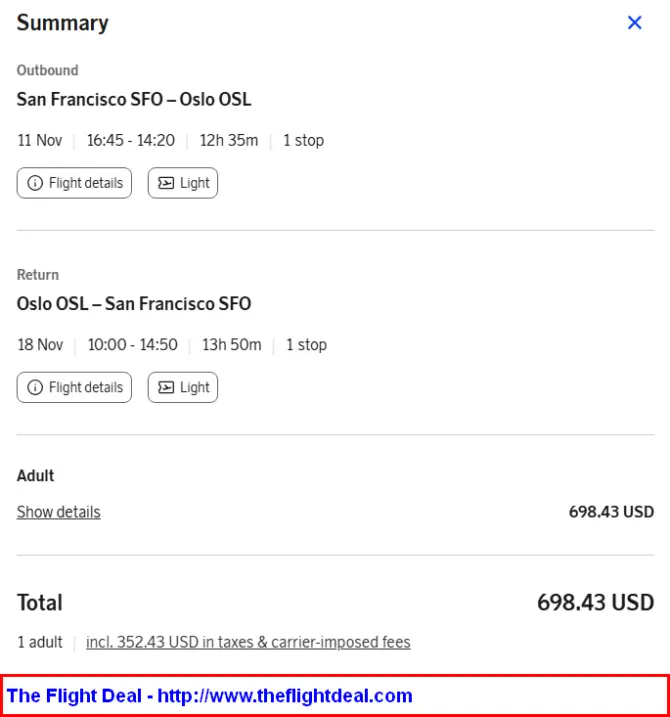
This pricing strategy highlights a divergence between automated itinerary platforms and direct airline distribution channels. Initial pricing discovered via ITA Software’s Matrix Airfare Search engine pegs the baseline Basic Economy itinerary at approximately $712. However, travelers who take those exact calendar parameters and book directly through the official Scandinavian Airlines portal can secure the itinerary for a reduced baseline of $698 in Basic Economy, or step up to a Regular Economy tier priced at $768.
For modern travelers balancing cost against itinerary flexibility and baggage allowances, these marginal price differences introduce critical decision points. While the $698 Economy Light/Basic tier appeals to budget-conscious passengers traveling light, the $768 Regular Economy tier includes a checked bag each way, altering the true comparative value of the ticket. Furthermore, because SAS recently transitioned its alliance alignment to SkyTeam, passengers eyeing these routes can leverage valuable frequent flyer mileage-earning opportunities across partner networks, most notably through Delta Air Lines’ SkyMiles program.
This comprehensive report examines the structural breakdown of this fare sale, analyzes the mechanics of booking through ITA Software versus direct channels, details the loyalty program implications of SAS’s alliance migration, and offers strategic guidance for Bay Area travelers looking to maximize value on European getaways.

Detailed Chronology: How the Fare Materialized and Booking Mechanics
The discovery of competitive transatlantic pricing typically follows a structured trajectory within the travel hacking and airfare monitoring community. The process of uncovering, verifying, and securing the Oslo fare from San Francisco involves specific digital touchpoints and technical nuances that frequent flyers must navigate.
Phase 1: Algorithmic Discovery via Matrix Software
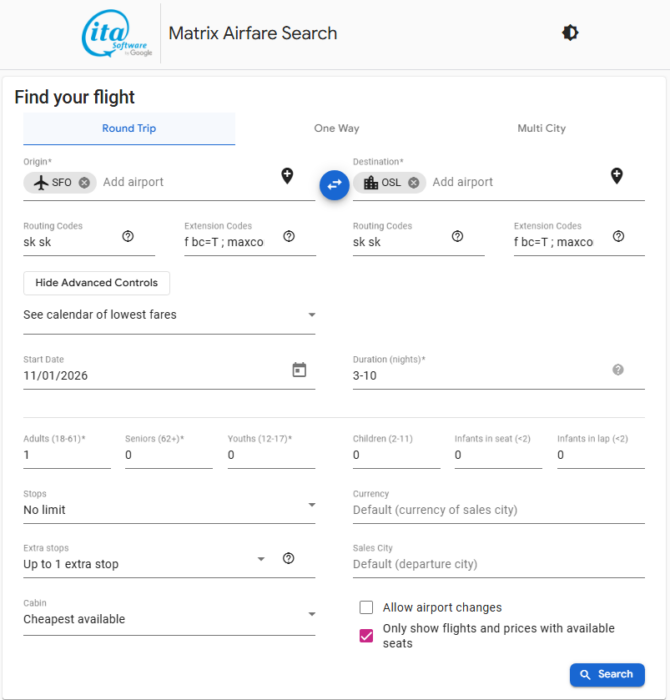
The initial footprint of the fare appeared on ITA Software’s Matrix Airfare Search, a powerful flight-shopping engine favored by travel professionals and advanced consumers for its raw data accessibility. Matrix priced the introductory Basic Economy routing at $712 round-trip. While competitive for a West Coast-to-Scandinavia routing, the Matrix platform serves primarily as a search aggregator rather than a ticketing merchant. Consequently, travelers must translate these raw routing codes and date availability matrices into live inventory on carrier-direct channels.
Phase 2: Direct Channel Repricing
Upon migrating the exact routing and date parameters from Matrix to the official Scandinavian Airlines booking portal (flysas.com), the pricing architecture adjusted dynamically. The carrier’s direct booking engine repriced the itinerary downward to $698 for the Basic Economy (marketed internally as Economy Light) product. For travelers requiring standard amenities, the Regular Economy fare tier surfaced at $768.
This $70 delta between the $698 Economy Light tier and the $768 Regular Economy tier represents a pivotal economic choice for consumers:
- The $698 Economy Light (Basic Economy) Fare: This entry-level price point comes with standard restrictions typical of modern European and transatlantic basic economy products. It generally excludes advance seat selection, changes or cancellations without heavy penalty, and complimentary checked baggage.
- The $768 Regular Economy Fare: By paying an additional $70, passengers receive a bundle that explicitly includes one checked bag in each direction. For anyone planning to travel with more than a personal item and a standard overhead carry-on, this tier often undercuts the cumulative ancillary fees of purchasing baggage a la carte on the lower fare.
Phase 3: Verification and Validation
Following direct validation on the carrier’s platform, routing data confirmed standard transatlantic connections. While specific schedule availability shifts dynamically based on seasonal demand, the structural availability of these sub-$750 round-trip fares underscores a concerted effort by SAS to stimulate demand out of the competitive San Francisco Bay Area gateway.
Supporting Context & Metrics: Alliances, Mileage Earning, and the Passenger Experience
Understanding the true value of an international airfare requires looking beyond the base ticket price to evaluate baggage policies, frequent flyer utility, and alliance integration. With Scandinavian Airlines executing its high-profile transition into the SkyTeam Alliance, the calculus for US-based travelers—particularly loyalists of Delta Air Lines—has evolved significantly.
The SkyTeam Transition and Delta Air Lines Partnership
For decades, Scandinavian Airlines was a foundational pillar of Star Alliance. However, following strategic ownership shifts and corporate restructuring, SAS completed its departure from Star Alliance and officially integrated into SkyTeam in late August 2024.
This structural migration completely alters how frequent flyers earn and redeem miles on SAS-operated metal:

- Mileage Accumulation: Because SAS is now a formal partner of Delta Air Lines, passengers flying on SAS-marketed and operated flights can credit their journeys to Delta SkyMiles.
- Medallion Qualification Dollars (MQDs): Under Delta’s modern SkyMiles program architecture, earnings on partner-marketed and partner-operated flights accrue based on distance flown and the fare class purchased. Travelers utilizing the Economy Light ($698) or Regular Economy ($768) fare classes must consult Delta’s partner accrual charts to determine exact Medallion Qualification Dollar (MQD) and redeemable mile generation. Generally, basic economy tickets on partner airlines may yield reduced accrual rates compared to fully flexible or standard main cabin fares.
- Elite Benefits: SkyTeam Elite and Elite Plus members traveling on SAS can expect reciprocal tier benefits, such as priority check-in, priority boarding, and additional baggage allowances, depending on their specific membership tier and the fare class booked.
Baggage Economics and Ancillary Costs
When analyzing the fare disparity between the $698 Economy Light option and the $768 Regular Economy option, passengers must calculate their total trip cost:
- Checked Bag Fees: Transatlantic checked bag fees on legacy carriers typically range from $75 to $100 each way ($150 to $200 round-trip) if purchased separately on a basic economy ticket.
- The Value Proposition: Because the Regular Economy fare includes a checked bag each way for a modest $70 premium over the base fare, passengers who check luggage save substantial capital by opting for the higher tier upfront. Conversely, solo minimalist travelers carrying only an approved carry-on bag and a personal item can maximize savings by sticking with the $698 Economy Light fare.
Strategic Guidance: Navigating Booking Channels, Credit Card Perks, and International Travel Tips
Securing a competitive airfare is only the first step in orchestrating a seamless international journey. Travelers originating from the San Francisco Bay Area heading to Oslo should consider several financial and logistical best practices to safeguard their investment and optimize their travel experience.
Leveraging Travel Rewards and Credit Card Protections
When purchasing international airfare, the choice of payment instrument can provide critical consumer protections. Travelers should utilize travel rewards credit cards that offer robust trip interruption, trip cancellation, and baggage delay insurance.
- Affiliate Disclosure Notice: Independent airfare tracking services frequently partner with financial institutions and booking platforms to sustain operations. For example, readers applying for travel credit cards or utilizing booking engines via designated referral links may trigger commission structures that support ongoing fare-monitoring services. Consumers should always review terms, conditions, and annual fees associated with recommended credit card products before applying.
- Foreign Transaction Fees: Ensure that the credit card used for booking international travel carries zero foreign transaction fees, protecting the consumer from unexpected surcharges when interacting with foreign merchant processors or making purchases abroad in Norwegian Krone (NOK).
Staying Ahead of Flash Sales and Fare Dials
Transatlantic fare sales of this caliber are inherently volatile. Pricing anomalies between automated aggregators (like ITA Matrix) and airline direct booking engines can fluctuate within hours based on seat inventory adjustments, fuel cost variations, and yield management algorithms.

To capitalize on these fleeting opportunities before they are absorbed by the broader market, frequent flyers often utilize tiered alert systems:
- Real-Time Newsletters: Dedicated real-time notification channels provide economy class deal alerts to subscribers roughly an hour before public dissemination across standard web and social media feeds.
- Premium Subscriptions: For travelers tracking Business Class, First Class, or Premium Economy cabins, specialized premium alert channels deliver higher-end long-haul opportunities directly to inboxes.
Future Outlook: Transatlantic Pricing Trends and the Road Ahead
The appearance of sub-$750 round-trip itineraries between San Francisco and Oslo points toward a fiercely competitive environment for European travel corridors originating on the US West Coast. As airlines manage capacity and deploy fuel-efficient widebody aircraft onto secondary and primary European routes, consumers can expect continued price experimentation.
Several macroeconomic and industry factors will dictate fare stability in the coming quarters:
- Capacity Adjustments: Transatlantic seat capacity continues to normalize following post-pandemic surges. Airlines are closely monitoring yield curves to prevent over-saturation, meaning flash sales may be more targeted and short-lived.
- Alliance Maturation: As SAS deepens its operational integration within SkyTeam, code-sharing agreements and joint-venture structures with Delta Air Lines will likely streamline connecting itineraries, potentially opening up more multi-city and domestic US feeder options for travelers based outside the immediate Bay Area.
- Consumer Demand Elasticity: Despite inflationary pressures, consumer demand for European leisure destinations remains resilient. However, price sensitivity in the economy cabin means that slight cost variations—such as the $14 variance between ITA’s initial quote and SAS’s direct pricing—will continue to drive savvy travelers toward direct-booking optimization.
For travelers yearning to explore Norway’s dramatic fjords, historic architecture, and vibrant cultural capital, the current window offers an opportune moment to secure value, provided they carefully weigh baggage requirements, alliance loyalty benefits, and booking channel mechanics before finalizing their travel plans.