








The first full quarter following the outbreak of the conflict in Iran has delivered a stark reality check to India’s aviation sector. For years, Indian aviation has enjoyed breakneck growth, fueled by rising middle-class incomes, a massive global diaspora, and aggressive fleet expansions by domestic carriers. However, newly released data from the Directorate General of Civil Aviation (DGCA) reveals that this rapid expansion remains highly vulnerable to external geopolitical shocks, particularly those radiating from the Middle East.
During the April-June 2026 quarter—the first three-month window fully captured after the onset of the Iran conflict—India’s international aviation network contracted sharply. The disruption has laid bare the structural vulnerabilities of a market that remains deeply dependent on Gulf transit hubs to connect its passengers to the rest of the world.
A Vulnerable Connection: The Hard Math of the Q2 Decline
According to the official data compiled by the DGCA, total international passenger traffic to and from India fell by approximately 9% year-on-year, dropping to 17.2 million passengers during the April-June 2026 quarter. While a single-digit decline for the entire market is significant, it masks a much more severe crisis for home-grown Indian airlines.
Q2 2026 Indian International Aviation Performance
┌────────────────────────────────────────────────────────┐
│ Total International Passengers: 17.2 Million (▼ 9%)    │
├────────────────────────────────────────────────────────┤
│ Indian Carriers' Share: 6.4 Million (▼ 27%)            │
└────────────────────────────────────────────────────────┘
Indian carriers bore the brunt of the geopolitical fallout. Their combined international passenger volume plummeted by an alarming 27%, falling to just 6.4 million. This disproportionate decline suggests that while foreign airlines managed to navigate the airspace crises and maintain a semblance of network integrity, Indian operators were forced to aggressively scale back operations, cancel routes, or cede market share due to escalating operational complexities.
The divergence in performance highlights a long-standing competitive gap. While major foreign network carriers possess the fleet flexibility, global route diversifications, and financial cushions to absorb sudden airspace closures, Indian airlines—many of which are still in the process of scaling up their widebody operations—proved far more susceptible to the sudden closure of critical flight corridors.
The Gulf Hub System: India’s Indispensable Aviation Windpipe
To understand why a conflict in Iran has had such a devastating effect on Indian aviation, one must look at the geography of global air travel. The Middle East is not merely a regional destination for Indian travelers; it serves as the central nervous system for India’s international connectivity.
For decades, hubs such as Dubai, Doha, Abu Dhabi, and Muscat have acted as critical gateways. They serve two primary, highly lucrative demographics:
- The Expatriate Corridor: Millions of Indian citizens live and work in the Gulf Cooperation Council (GCC) countries. This blue-collar and white-collar workforce generates a continuous, high-volume flow of point-to-point traffic back to India’s metro cities and secondary airports.
- The Transit Bridge: These airports function as massive transit stations utilizing "sixth-freedom" traffic rights. They funnel Indian travelers from dozens of tier-1, tier-2, and tier-3 Indian cities through the Middle East and onward to destinations across Europe, Africa, and North America.
When the conflict in Iran triggered sweeping airspace restrictions across the region, these transit corridors were immediately compromised. The sudden blanket of flight bans and restricted flight paths meant that the seamless, high-frequency schedules operated by both Indian and Gulf carriers could no longer be sustained.
Airspace Redirection and the Logistics of Detours
The primary operational challenge stemming from the conflict was the immediate loss of Iranian airspace. Historically, flights departing from India heading toward Europe, the Mediterranean, and the East Coast of North America have relied heavily on transit corridors running directly over Pakistan, Iran, and Turkey.
Standard Corridor vs. Conflict Detour
[India] ──(Standard: Over Iran)──> [Europe / North America]
                  VS.
[India] ──(Detour: South over Arabian Sea & Africa)──> [Europe / North America]
With Iranian skies closed or deemed high-risk by international aviation safety regulators, airlines were forced to implement dramatic, costly reroutings.
- Extended Flight Paths: Flights had to be routed further south over the Arabian Sea, skirting around the southern tip of the Arabian Peninsula, or pushed far to the north through Central Asia.
- Increased Fuel Burn: These detours added hours to flight times. For long-haul operations, every additional minute in the air translates to tons of extra aviation turbine fuel (ATF) consumed, severely hurting airline profit margins.
- Payload Restrictions: On certain ultra-long-haul routes, the necessity of carrying extra fuel to cover the longer detours forced airlines to limit passenger numbers or cargo weight to remain within safe takeoff limits.
- Crew Flight Time Limitations: Longer flight times frequently pushed flight crews past their legal duty-time limits, causing cascading scheduling delays and requiring airlines to station additional flight crews at overseas stations at high expense.
These operational hurdles quickly translated into reduced capacity. Airlines chose to cancel flights altogether rather than operate at a financial loss or risk scheduling chaos across their broader networks.
The Disproportionate Toll on Indian Airlines
The 27% drop in international traffic for Indian carriers points to a structural limitation in their business models and fleet compositions.
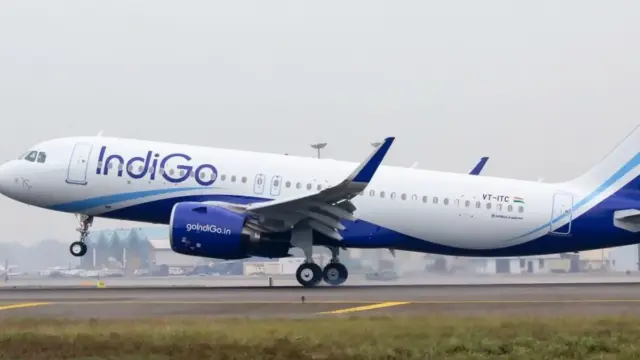
A significant portion of India’s international capacity is operated by low-cost carriers (LCCs) utilizing narrowbody aircraft, such as the Airbus A320neo and Boeing 737 MAX families. While these aircraft are highly efficient for short-to-medium-haul flights, they have limited range. Under normal circumstances, they can comfortably fly from Indian cities to the Gulf. However, when forced to take long, circuitous routes to avoid restricted airspace, these narrowbody planes simply do not have the fuel capacity to make the journeys nonstop.
Consequently, Indian LCCs were forced to suspend numerous routes to the Middle East, as technical refueling stops would have rendered the flights economically unviable and logistically impractical.
In contrast, foreign legacy carriers operating into India rely almost exclusively on large, long-range widebody aircraft (such as the Boeing 777, 787, and Airbus A350). These aircraft possess the range to absorb multi-hour detours without needing to stop for fuel, allowing them to maintain their schedules, albeit at a higher operating cost. This structural advantage allowed foreign airlines to capture a larger share of the remaining, contracted market, explaining why their overall traffic decline was far less severe than that of their Indian counterparts.
The Impact on the India-UAE Corridor
The disruption was felt unevenly across different regional markets, with the highly critical India-United Arab Emirates (UAE) corridor serving as a prime example of the localized impact.
As the region’s largest aviation market and a primary economic partner for India, the UAE saw its flight schedules heavily disrupted. While demand for travel between India and cities like Dubai and Abu Dhabi remained fundamentally strong, the logistical bottleneck of operating flights through congested, narrowed air corridors meant that airlines simply could not supply the necessary seats.
The reduction in capacity on this route triggered a sharp increase in airfares, leaving many budget-conscious expatriate workers unable to travel home during the quarter. The drop in traffic along this specific corridor alone acted as a major drag on India’s overall international passenger statistics.
Redefining Strategic Autonomy in Indian Skies
The crisis of Q2 2026 serves as a powerful warning for the Indian government and its aviation planners. For years, there has been a growing policy debate within India regarding the country’s reliance on foreign hubs. The DGCA’s latest quarterly figures have added intense urgency to this discussion.
To build a resilient aviation sector that is insulated from regional geopolitical conflicts, industry analysts point to several necessary long-term structural shifts:
1. Accelerating Widebody Fleet Acquisition
Indian carriers must reduce their reliance on narrowbody aircraft for international routes. The ongoing fleet renewal strategies of major Indian airlines, which include large orders for widebody jets, must be accelerated. Having a robust fleet of long-range aircraft will allow Indian airlines to bypass regional hubs entirely and operate direct, nonstop flights to Europe, the Americas, and East Asia via flexible routings.
2. Developing Domestic Mega-Hubs
India has the geographical advantage and the sheer volume of passenger traffic to develop its own global transit hubs. Transforming airports like Delhi’s Indira Gandhi International (DEL), Mumbai’s Chhatrapati Shivaji Maharaj International (BOM), and the upcoming Jewar and Navi Mumbai airports into true international transfer points would allow Indian aviation to retain its passengers rather than outsourcing them to third-country hubs.
3. Diversifying International Partnerships
While the Middle East will always remain an important partner due to geographic proximity and diaspora ties, Indian aviation must diversify its international routing strategies. Strengthening direct air corridors to East Asian hubs (like Singapore, Bangkok, and Kuala Lumpur) and expanding direct flights over northern polar routes could provide vital alternative pathways during times of Middle Eastern instability.
A Challenging Horizon
The April-June 2026 quarter has proven that geopolitical stability is a prerequisite for the smooth operation of global aviation, and that India’s international flight network remains highly sensitive to disruptions in the Middle East.
As Indian carriers work to recover from a devastating 27% drop in international passenger volumes, the industry must look beyond temporary tactical adjustments. The lessons of this downturn are clear: to secure its aviation future, India must transition from a nation dependent on foreign transit hubs to one that can reliably, directly, and independently connect its citizens to the world. Until that structural transition is complete, the fortunes of Indian aviation will remain tethered to the volatile geopolitics of the skies above the Middle East.