







For over half a century, the Carrier Onboard Delivery (COD) mission served as the invisible lifeblood of United States Navy carrier strike groups. For decades, this vital logistical pipeline—moving mail, critical spare parts, high-priority cargo, and personnel between the shore and flight decks at sea—was anchored by the twin-turboprop Grumman C-2A Greyhound. A rugged and reliable transport, the Greyhound earned its keep through countless deployments across the globe. However, the relentless march of technological innovation, combined with a fundamental paradigm shift in naval warfare strategy, ultimately rendered the venerable fixed-wing transport obsolete.
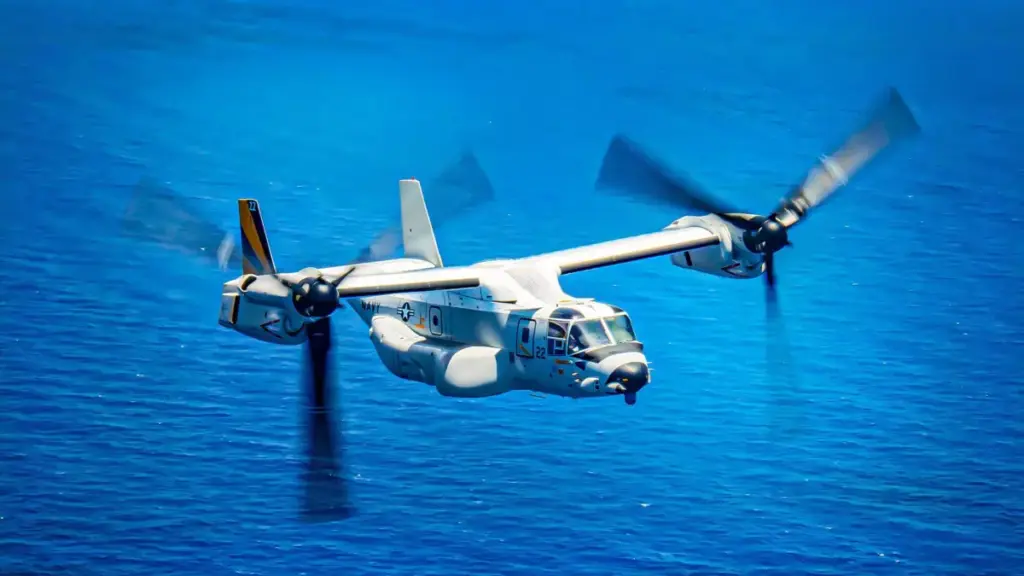
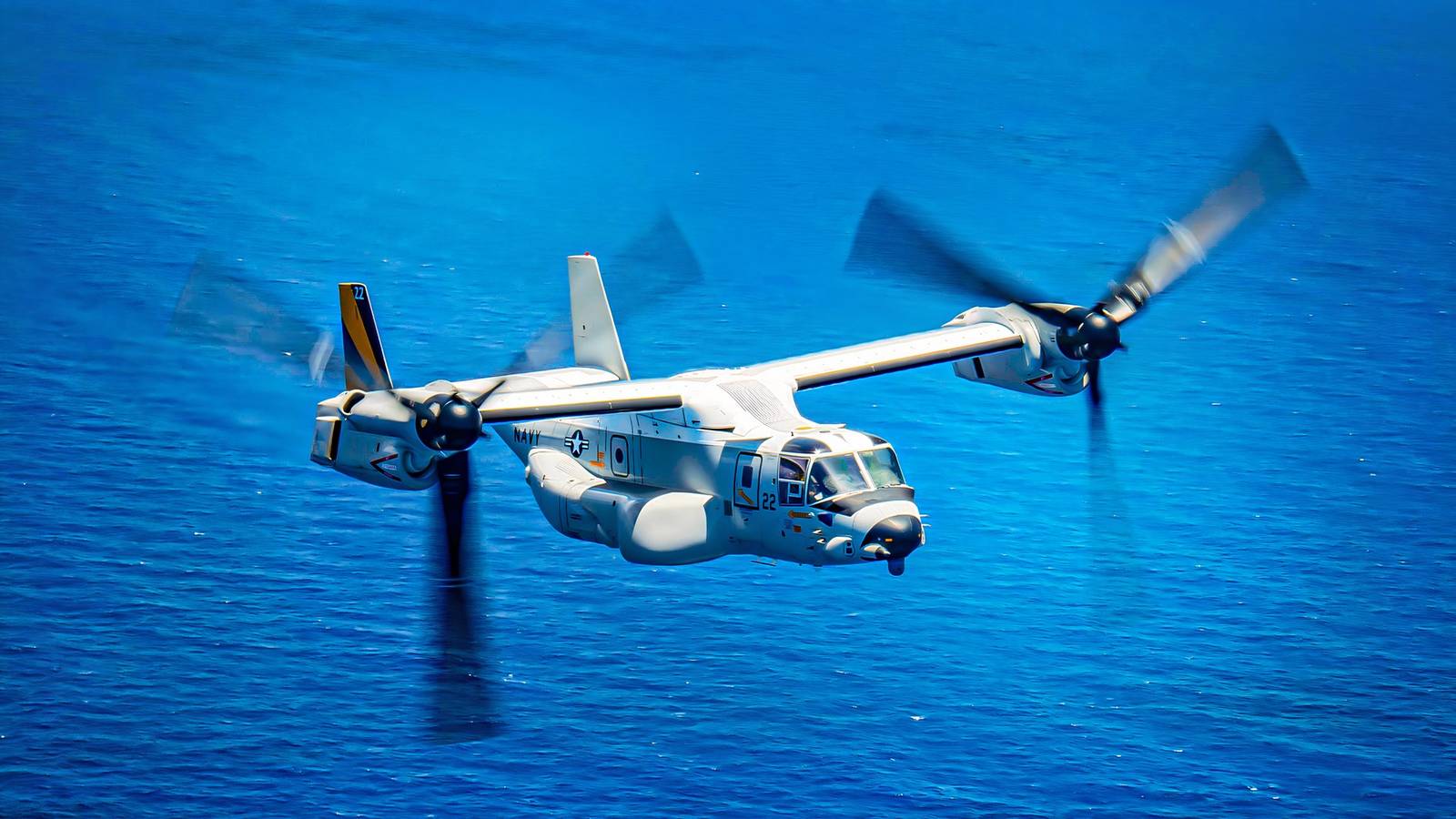
Enter the Bell Boeing CMV-22B Osprey. Jointly developed by Bell Textron and Boeing as a navalized variant of the U.S. Marine Corps’ MV-22 platform, the tiltrotor aircraft achieved initial operating capability (IOC) in late 2021, fundamentally rewriting the rules of naval logistics. While aviation purists initially questioned the transition—pointing to the Osprey’s lower maximum cargo weight rating compared to its predecessor—the platform introduced a quantum leap in operational flexibility, range, and tactical utility.
Most importantly, the CMV-22B solved a logistical bottleneck that threatened to hobble the Navy’s most advanced strike fighter: the ability to transport the fully assembled Pratt & Whitney F135 power module required by the Lockheed Martin F-35C Lightning II. As the United States military pivots decisively toward Distributed Maritime Operations (DMO) and prepares for the realities of great power competition in the Indo-Pacific, the Osprey has emerged not merely as a cargo hauler, but as an indispensable force multiplier. Yet, as the final aircraft roll off the assembly line and production winds down, the U.S. Navy faces a looming strategic question: has it procured a sufficient number of tiltrotors to sustain high-intensity, distributed conflict?
Detailed Chronology: A Four-Decade Quest for a Greyhound Successor
The U.S. Navy’s journey to replace the C-2A Greyhound was neither swift nor straightforward. Discussions regarding the long-term viability of the fleet began as early as the opening years of the 1980s. Having entered service in the mid-1960s, the Greyhound airframe was projected to face structural fatigue and technological obsolescence well before the turn of the century, prompting naval leadership to explore alternatives.
The 1981 MMVX Competition and the Fokker Proposal
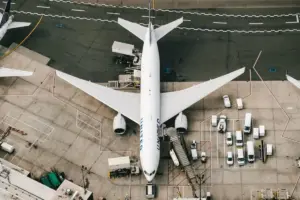
In 1981, the Navy instituted the Multi-Mission Tactical Support/Carrier-based Experimental Aircraft (MMVX) competition, signaling its desire to cast a wide net for a modern COD and utility platform. Among the most intriguing proposals came from Dutch aerospace manufacturer Fokker, which pitched a carrier-adapted variant of its successful F28 regional passenger jet.
To make the commercial design viable for naval aviation, Fokker proposed retrofitting the F28 with a strengthened lower keel to absorb the brutal impact of carrier landings, integrating an arresting hook, designing foldable wings for hangar deck storage, and outfitting the aircraft with auxiliary refueling pods. Had it been selected, the F28 carrier variant would have doubled as a sea-going tanker for the carrier air wing. However, the sheer financial and engineering hurdle of converting a regional jet into a carrier-borne workhorse ultimately scuttled the concept.
The C-2A Service Life Extension Program (SLEP)
Rather than commit vast financial resources to an unproven, high-risk developmental program in the early 1980s, the Navy pivoted to a pragmatic stopgap measure. The service elected to order an additional 39 newly built Greyhounds under a modernized contract, featuring upgraded engines, advanced avionics, heightened payload tolerances, and enhanced overall reliability.
Deliveries of these refreshed aircraft commenced in the mid-1980s, allowing the Navy to phase out its oldest first-generation C-2 airframes by 1987. The final new-build Greyhound was delivered to the fleet in 1990. While this move extended the life of the COD mission by decades, it merely delayed the inevitable. More than thirty years would pass before the Navy finally found a true successor capable of meeting the demands of 21st-century warfare.
IOC and Operational Debut
The modern era of naval tiltrotor logistics officially began on December 14, 2021, when the Navy’s V-22 variant achieved initial operating capability. Months prior to this formal milestone, the aircraft made its operational debut during the summer of 2021, deploying aboard the nuclear-powered aircraft carrier USS Carl Vinson (CVN 70) with Carrier Air Wing 2. This deployment was historic: it marked not only the operational baptism of the CMV-22B, but also the maiden deployment of the carrier-borne F-35C Lightning II, tightly coupling the fate of the two aircraft.
Supporting Context & Metrics: Comparing the Greyhound and the Osprey
To understand the tactical revolution represented by the CMV-22B, one must examine the raw engineering metrics and performance parameters that separate the legacy turboprop from the modern tiltrotor.

| Characteristic | Northrop Grumman C-2A Greyhound | Bell Boeing CMV-22B Osprey |
|---|---|---|
| Primary Function | Carrier On-board Delivery (COD) | Carrier On-board Delivery & Special Logistics |
| Prime Contractor | Northrop Grumman | Bell Textron / Boeing |
| Unit Cost | ~$38.96 million (historical baseline) | ~Dependent on block buys and modifications |
| Powerplant | Two Allison T56-A-425 turboprops | Two Rolls-Royce AE1107C turboshafts |
| Power Output | 4,600 shaft horsepower each | 6,150 shaft horsepower (4,586 kW) each |
| Length | 56 feet, 10 inches (17.3 m) | 57.3 feet fuselage / 63 feet stowed |
| Wingspan / Rotor Diameter | 80 feet, 7 inches (24.56 m) wingspan | 38.1 feet rotor diameter (84.6 ft turning width) |
| Maximum Takeoff Weight | 57,500 lbs (26,082 kg) gross | 52,600 lbs (VTOL max gross weight) |
| Unrefueled Range | ~1,000 nautical miles (1,852 km) | ~1,150 nautical miles (2,130 km) |
| Aerial Refueling Capability | No | Yes |
| Vertical Landing Capability | No (requires arrested landing) | Yes (VTOL / STOVL flexibility) |
The Trade-Off: Cargo Capacity vs. Operational Versatility
At first glance, critics of the transition pointed to a seemingly counterintuitive metric: cargo capacity. The C-2A Greyhound possessed a maximum cargo rating of approximately 10,000 pounds, whereas the CMV-22B Osprey is officially rated for around 6,000 pounds.
However, what the Navy surrendered in sheer weight capacity, it multiplied exponentially in tactical versatility, reach, and spatial independence. The Greyhound was shackled to traditional aviation infrastructure; it required a catapult to launch and arresting gear to recover, occupying the angled flight deck and temporarily halting high-tempo cyclic flight operations during recovery and launch cycles.
The Osprey, by contrast, possesses vertical takeoff and landing (VTOL) capabilities. It can drop vertically onto a carrier’s deck or an auxiliary support ship without interfering with ongoing flight deck operations. Furthermore, the V-22 is not restricted to aircraft carriers and land-based airfields. It can land on unimproved clearings, auxiliary vessels, and remote islets, bringing unprecedented logistical agility to the fleet.
Official Statements and Strategic Endorsements
The operational validation of the CMV-22B has drawn high praise from senior naval leadership, who view the aircraft as a foundational pillar of modern naval doctrine.
The U.S. Navy’s overarching warfighting concept, Distributed Maritime Operations (DMO), is designed to counter peer adversaries by deliberately dispersing strike groups and surface action groups across hundreds—and potentially thousands—of square miles of open ocean. This spatial separation complicates an enemy’s targeting calculus and enhances fleet survivability. However, it places an immense strain on logistics.

Speaking directly to how the CMV-22B bridges this strategic gap, Vice Admiral Kenneth Whitesell, former commander of Naval Air Forces, emphasized the aircraft’s transformative impact:
"With distributed maritime ops, longer ranges, distances between multi-carrier operations, distances from land-based areas, and the ability for the V-22 to plop down on unimproved spaces, it proved to be a game-changer for us on deployment…"
Beyond raw operational range, the Osprey’s capacity for aerial refueling gives it a theoretical unlimited range when supported by tanker assets. This capability is vital in vast, contested theaters like the Indo-Pacific, where distances between land-based staging areas and maritime strike groups dwarf those encountered during decades of counterinsurgency operations in the Middle East.
The F-35C Factor: Unlocking Strike Group Sustainability
Perhaps the most decisive factor tipping the scales in favor of the Osprey was not range or vertical landing capability, but a mechanical imperative born from the F-35C Lightning II.
The fifth-generation stealth fighter relies on the Pratt & Whitney F135 turbofan engine, a powerplant of immense power and complexity. During carrier deployments, maintaining operational readiness requires the rapid turnaround of damaged or worn propulsion modules. The legacy C-2A Greyhound simply lacked the internal cargo volume and hatch dimensions required to transport a fully assembled F135 power module in its required shipping configuration.

The CMV-22B, however, was specifically engineered with a cabin layout and cargo bay capable of swallowing the F135 power module whole. This allows the Navy to transport replacement engine modules directly from shore facilities to an aircraft carrier—or laterally between ships at sea—without resorting to complex, time-consuming disassembly processes.
In a high-intensity conflict scenario, such as a hypothetical Taiwan strait contingency, time is the ultimate currency. Analysts routinely project that a major naval engagement in the Western Pacific would involve multiple carrier strike groups operating across expansive oceanic sectors. A three-carrier force would command roughly 18 to 24 major surface combatants and auxiliary ships, deploying between 180 and 210 tactical aircraft while supporting upwards of 25,000 sailors and aviators.
In such a sprawling, high-attrition environment, the ability of the CMV-22B to rapidly shuttle critical F-35 components, spare parts, mail, and key personnel across vast distances—and land them directly aboard auxiliary vessels or carriers operating under strict emission and radar-silent controls—is what keeps the air wing flying.
Future Outlook: The End of the Line and Unresolved Questions
Despite its proven utility and glowing reviews from fleet commanders, the V-22 program currently faces a complex and uncertain future regarding its industrial base.
Across all branches of the U.S. armed forces, a total of 469 V-22 variants have been procured. This total includes roughly 360 airframes serving with the U.S. Marine Corps, 56 assigned to Air Force Special Operations Command, and 53 operated by the U.S. Navy.

While the Department of Defense has allocated billions of dollars through the end of the decade to modernize the existing V-22 fleet—focusing heavily on critical upgrades such as new proprotor gearboxes, subcomponent overhauls, and advanced health-and-usage monitoring systems—production of the aircraft is rapidly drawing to a close. With the final five Ospreys currently making their way down the assembly line, prime contractors Bell Textron and Boeing are actively grappling with the future disposition of the specialized manufacturing tooling and infrastructure.
This manufacturing shutdown leaves the U.S. Navy in a delicate strategic position. The service has integrated the CMV-22B as the central nervous system of its carrier logistics network, and its importance will only magnify as great power competition in the Indo-Pacific intensifies. However, with the production lines going dark, the Navy will soon find itself operating a fixed fleet size with no viable pathway for rapid expansion or numerical replenishment in the event of wartime attrition.
Whether the current inventory of CMV-22B Ospreys will be sufficient to shoulder the logistical burdens of a prolonged, high-intensity trans-oceanic conflict remains an open and pressing question for defense planners. What is indisputable, however, is that the tiltrotor has successfully redefined naval aviation logistics, transforming what was once a routine point-to-point delivery task into a dynamic, survivable, and indispensable element of modern sea power.