The transatlantic aviation market has entered a period of aggressive pricing competition and product unbundling, highlighted by a newly introduced fare structure connecting the United States Pacific Northwest to the Finnish capital of Helsinki. Travelers eyeing a Nordic escape can now secure round-trip economy tickets starting at an eye-catching $443, though this baseline figure comes with strings attached that reflect a broader structural shift in legacy and network carrier pricing models.
This deep-dive analysis examines the financial mechanics, baggage policies, frequent flyer implications, and broader economic forces governing the current $443 to $563 fare bracket to Helsinki (HEL). As major carriers and strategic partners refine their ancillary revenue streams, understanding the fine print of basic economy versus standard economy has never been more critical for the modern globetrotter.
In an environment where airlines increasingly rely on a la carte pricing to protect profit margins against volatile jet fuel costs and inflation, consumers must weigh nominal savings against the hidden expenses of checked luggage, seat selection, and change fees. This report deconstructs the recent Helsinki fare sale, evaluating what these price points mean for consumer behavior, loyalty program strategists, and the future of trans-oceanic travel economics.
Detailed Chronology: The Evolution of Transatlantic Unbundling
To understand the mechanics of the current Helsinki fare sale, one must first trace the historical trajectory of transatlantic ticket pricing. For decades, long-haul international flights operated under a bundled pricing model. A ticket purchased from any major hub to a European destination inherently included at least one checked bag, seat selection, a standardized meal service, and a flexible—or at least moderately changeable—ticket class.
The Shift to Basic Economy
The introduction of "Basic Economy" or "Economy Light" tiers on transatlantic routes marked a watershed moment in commercial aviation. Originating largely as a defensive maneuver against ultra-low-cost carriers (ULCCs) attempting to penetrate long-haul markets, legacy carriers and international alliance partners adopted unbundled structures to protect their lowest-tier price points.
Phase One: Introduction of domestic basic economy, restricting carry-ons and eliminating advance seat assignments.
Phase Two: Expansion of basic economy to transatlantic routes, initially preserving carry-on allowances due to overhead bin capacities, but stripping away checked bags and flexibility.
Phase Three (Current): Refinement of multi-tier fare matrices where passengers are presented with hyper-specific choices—such as the $443 baseline versus the $563 bundled option identified in recent market analyses.
The Mechanics of the $443 vs. $563 Helsinki Offering
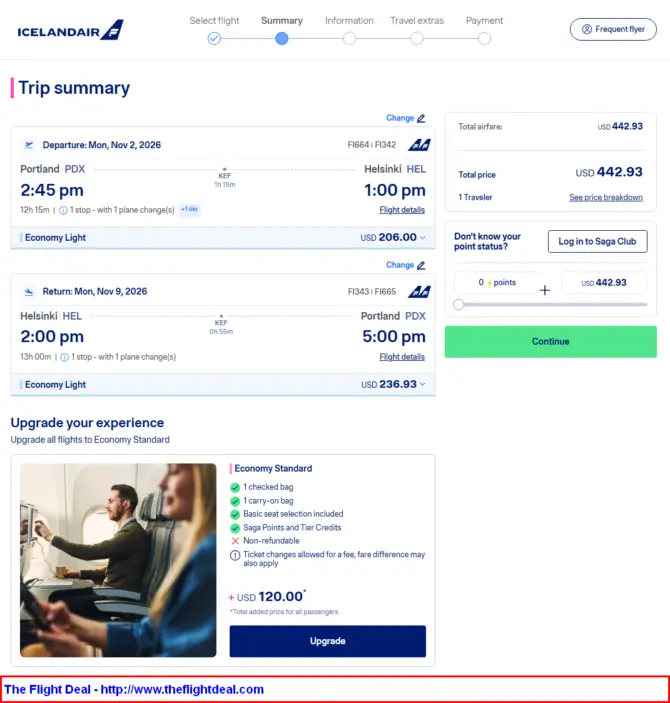
The current promotional pricing structure offers a clear case study in modern airline revenue management. Passengers looking to fly to Helsinki face a bifurcated choice at checkout:
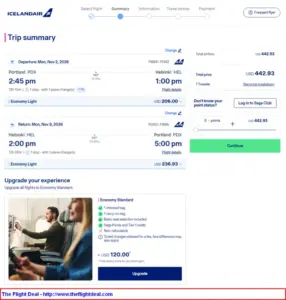
The $443 Basic Economy / Economy Light Fare:
Inclusions: Advance seat assignment, one carry-on bag weighing up to 22 lbs (10 kg), and one personal item.
Exclusions: Zero checked baggage included.
Penalties/Add-ons: Opting to check a bag at the airport check-in counter incurs a steep fee of $69 each way ($138 round-trip).
The $563 Standard Economy Fare:
Inclusions: Advance seat assignment, carry-on allowance, personal item, and ONE checked bag included natively in the fare.
Cost-Benefit Analysis: The price delta between the two tiers is exactly $120. Because checking a single bag on the basic economy fare costs $69 each way ($138 total), travelers who know in advance that they will require checked luggage actually save $18 by opting upfront for the $563 standard fare. Conversely, minimalist packers traveling light capture the full $120 savings by sticking with the $443 tier.
Supporting Context & Metrics: Decoding the Numbers and Partnerships
Analyzing a flight deal requires looking beyond the sticker price to evaluate routing efficiency, baggage fee architecture, and airline alliance loyalty payoffs.
Baggage Fee Economics and Consumer Psychology
Airline ancillary revenue has transitioned from a supplementary income stream to the primary engine of profitability for many commercial carriers. By keeping the headline price low ($443), airlines capture consumer search traffic on aggregators and online travel agencies (OTAs), where sorting by "Lowest Price" dictates initial visibility.
However, behavioral economics demonstrates that consumers frequently underestimate their ancillary needs at the point of initial purchase. A traveler enticed by the $443 price point may fail to factor in return baggage logistics. If they realize at check-in that they need to check a bag, the $69-per-way penalty converts the effective ticket price to $581—higher than the upfront $563 standard economy tier.
Alliance Mechanics and Mileage Earning
The structural routing for these Pacific Northwest-to-Helsinki itineraries typically involves major transatlantic network carriers operating in conjunction with regional or alliance partners. For instance, itineraries routing through North Atlantic hubs often leverage partnerships with carriers like Icelandair, which maintains a strategic commercial partnership with Alaska Airlines.
For frequent flyers, evaluating these deals involves calculating elite qualifying miles (EQMs) and redeemable miles (RMs). Because Icelandair operates as an Alaska Air partner, passengers must carefully cross-reference the specific fare class bucket of their promotional ticket against the partner earning charts provided by Alaska Mileage Plan.
Discounted Economy Buckets: Frequently earn a reduced percentage of flown miles (often ranging from 25% to 50%).
Standard Economy Buckets: Generally command higher earning rates, occasionally matching 100% of the actual distance flown, alongside elite qualifying segment credits.
Strategists recommend that loyalty program members input their frequent flyer credentials during the booking process rather than retroactively, ensuring that every mile accrued from these discounted transatlantic hops is properly credited to their accounts.
Official Statements & Industry Expert Perspectives
Industry analysts and aviation economists have long debated the merits and consumer impacts of unbundled long-haul pricing. While consumer advocacy groups frequently decry basic economy restrictions as "hidden fee traps," airline executives defend the practice as a necessary democratization of air travel.
The Airline Perspective: Choice and Accessibility
Speaking at recent global aviation summits, commercial strategy officers from major transatlantic carriers have emphasized that unbundling allows price-sensitive consumers to purchase seats at historical lows.
"Our objective is to match the diverse economic realities of our customer base," noted a senior commercial director for a major North Atlantic carrier during a recent route profitability briefing. "A student traveling with only a backpack should not subsidize the baggage handling costs of a family of four carrying multiple heavy suitcases. Unbundling ensures that you pay strictly for the services you utilize."
The Consumer Advocacy Perspective: Transparency and Friction
Conversely, consumer protection watchdogs argue that the psychological bias toward lowest-displayed pricing leads to marketplace confusion.
"When the gap between an unbundled fare and a bundled fare is obscured by complex fee schedules at the airport, the consumer loses," explains Sarah Jenkins, senior aviation consumer rights researcher at the Global Travel Integrity Project. "Airlines must ensure that ancillary costs—particularly standard baggage fees incurred at check-in—are prominently displayed before the final payment gateway, rather than acting as an unpleasant surprise at the departure terminal."
Furthermore, industry experts point out that the rigid restrictions on basic economy tickets—such as the prohibition against changes or cancellations without steep financial penalties—introduce operational friction when travel plans face unexpected disruptions.
Future Outlook: The Trajectory of Transatlantic Travel Economics
As the aviation sector looks toward the remainder of the decade, several macro-trends will dictate how promotional fares like the Helsinki $443–$563 offerings behave.
1. Dynamic Pricing and Predictive Analytics
Airlines are increasingly deploying machine-learning algorithms to predict individual consumer willingness to pay. In the near future, the price delta between basic economy and standard economy may no longer be a static $120; instead, it will dynamically fluctuate based on user search history, day of the week, and projected demand for cargo versus passenger luggage space.
2. Sustainability Mandates and Fuel Volatility
European destinations, particularly in the Nordic region, are leading the charge toward green aviation initiatives, including mandates for Sustainable Aviation Fuels (SAF). As the European Union tightens environmental regulations and carbon-tax structures on commercial flights, airlines will face mounting pressure to absorb or pass along these compliance costs.
This dynamic could place upward pressure on baseline economy fares, making sub-$500 transatlantic tickets an increasingly rare commodity over the next five to ten years. Travelers capitalizing on current sales to Helsinki are experiencing a pricing window that may contract as environmental surcharges become fully integrated into ticket pricing.
3. The Ongoing Battle for Ancillary Dominance
As non-ticket revenue continues to account for upwards of 15% to 20% of total airline revenues globally, carriers will likely experiment with further unbundling. We may see the emergence of "ultra-basic" tiers that restrict carry-on baggage entirely to personal items fitting under the seat, mirroring the domestic ultra-low-cost carrier model popularized over the last decade.
Strategic Recommendations for Travelers
For travelers seeking to capitalize on current and future European flight sales, adherence to a disciplined booking methodology is essential:
Audit Your Packing Requirements Upfront: Never default to the cheapest ticket without first calculating whether you will need a checked bag. If you are traveling for more than four days, the standard economy tier ($563 in this instance) frequently provides better overall value than paying airport check-in fees ($69 each way).
Leverage Real-Time Intelligence: Because flash sales on premium routes to destinations like Helsinki are notoriously volatile—often disappearing within hours of publication—relying on dedicated real-time deal alerts and newsletters ensures timely notification before inventory is exhausted.
Maximize Partnership Value: Always check alliance alignments. Ensure that your bookings with carriers like Icelandair are properly mapped to partner programs (such as Alaska Airlines) to capture valuable frequent flyer miles, even on discounted promotional fares.
Understand Credit Card Protections: When booking international travel, utilize credit cards that offer robust trip interruption, delayed baggage, and travel accident insurance, mitigating the risks associated with non-refundable, unbundled basic economy tickets.
By maintaining a rigorous, analytical approach to fare structures, modern travelers can navigate the complex labyrinth of airline unbundling and secure extraordinary value across the transatlantic corridor.