









Executive Overview
In the dynamic and often opaque world of international commercial aviation, fare drops rarely happen in a vacuum. A newly surfaced flight deal originating from the San Francisco Bay Area to the historic and vibrant capital of Sweden has captured the attention of frequent flyers, budget-conscious travelers, and industry analysts alike.
According to routing data captured via the Matrix Airfare Search by ITA Software and subsequently cross-referenced with direct booking channels, Scandinavian Airlines (SAS)—now operating as a prominent member of the SkyTeam Alliance—has introduced a competitive fare structure connecting San Francisco International Airport (SFO) to Stockholm Arlanda Airport (ARN).
At first glance, the pricing structure is straightforward: a basic economy ticket priced at $702 via aggregator tools drops down to an even more enticing $688 when booked directly through the official Scandinavian Airlines portal. For travelers willing to stretch their budget slightly to $758, a regular economy tier unlocks the inclusion of a checked bag each way, altering the overall value proposition of the journey.
However, looking beyond the surface numbers reveals a broader narrative about airline distribution economics, the strategic repositioning of legacy carriers within global alliances, and the tactical methodologies savvy travelers use to capture fleeting ticket sales. This report provides an exhaustive, multi-faceted analysis of the SFO-to-ARN fare drop, examining everything from ticketing mechanics and alliance-specific mileage accrual to actionable strategies for maximizing value on international itineraries.
Detailed Chronology: Anatomy of a Transatlantic Price Drop
The discovery of transient, high-value airline tickets is rarely a random occurrence; rather, it is the result of intricate inventory management systems responding to shifting market supply and demand.

Phase One: Detection and Algorithmic Pricing
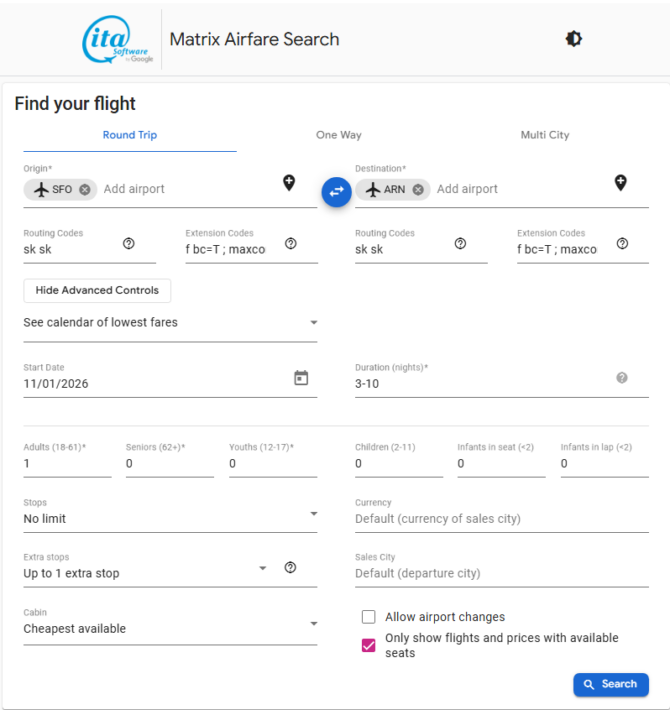
The fare sequence began appearing on fare-tracking dashboards via Matrix Airfare Search by ITA Software. Initially indexed at $702 for a Basic Economy itinerary, the fare triggered algorithmic alerts across automated deal-monitoring networks.
Aviation data analysts observed that third-party aggregator pricing often reflects a slight buffer or delayed synchronization compared to direct carrier distribution channels. When the exact travel dates identified in the ITA matrix search were transferred to the official Scandinavian Airlines booking engine, the price adjusted downward to $688 for the Basic Economy / Economy Light tier.
Phase Two: Tier Differentiation and Ancillary Costs
The pricing matrix splits into two distinct economy products that demand careful evaluation by the consumer:
- The Economy Light / Basic Economy Fare ($688): This entry-level price point provides the baseline cost of air transportation across the Atlantic. However, it comes tethered to strict operational limitations typical of modern basic economy tickets. These limitations generally encompass restrictions on ticket changes, advance seat selection, and carry-on luggage allowances, depending on the carrier’s exact current tariff rules.
- The Regular Economy Fare ($758): For an incremental increase of $70, passengers secure a regular economy classification. Crucially, this tier includes one checked bag each way. For travelers unable to pack light for a Scandinavian excursion, factoring in the typical transatlantic checked baggage fees—often ranging from $70 to $100 each way—makes the $758 regular fare a mathematically superior choice.
Phase Three: Capturing the Window of Opportunity
Fare drops of this nature operate under strict inventory controls. Airlines allocate specific fare buckets (such as "K," "L," or "T" classes, depending on internal yield management protocols) to stimulate demand during shoulder seasons or to counter competitor capacity on northern European routes. Once these designated seats are exhausted by early-booking consumers, the pricing structure snaps back to baseline market rates. Consequently, understanding the mechanics of how these fares are tracked, verified, and secured is paramount for any traveler attempting to replicate the results.
Supporting Context & Metrics: Navigating Alliances and Mileage Accrual
One of the most significant contextual developments surrounding Scandinavian Airlines in recent years is its strategic transition within the global airline alliance landscape. For decades, SAS was a foundational pillar of Star Alliance. However, following structural shifts and strategic equity investments, SAS has officially transitioned into the SkyTeam Alliance, fundamentally altering how frequent flyer miles are earned, redeemed, and valued by loyal travelers.
The SkyTeam Transition and Delta Air Lines Partnership
Because Scandinavian Airlines is now a member of the SkyTeam Alliance and a key partner of Delta Air Lines, passengers flying on these SFO-ARN itineraries can integrate their frequent flyer strategies with Delta SkyMiles or other partner programs within the alliance.
When evaluating mileage accrual for discounted transatlantic tickets, travelers must look closely at fare class mapping:
- Basic Economy / Economy Light Restrictions: Deeply discounted promotional fares booked into basic economy tiers often yield reduced mileage accrual rates, and in some frequent flyer programs, may be entirely excluded from Medallion Qualification Miles (MQMs) or modern equivalent status-earning metrics.
- Regular Economy Yields: Upgrading to the standard economy fare ($758) not only secures baggage allowances but frequently grants a more favorable percentage of distance-based mileage earnings when credited to Delta Air Lines or other SkyTeam partners.
- Calculating Distance: The great-circle distance between San Francisco International Airport (SFO) and Stockholm Arlanda Airport (ARN) spans approximately 5,200 miles each way, translating to a round-trip journey exceeding 10,400 flown miles. Depending on the traveler’s elite status tier within SkyTeam, these miles can provide a substantial boost toward annual status renewal or account balances for future redemptions.
Routing and Operational Logistics
Transatlantic itineraries originating from the West Coast to Scandinavia typically involve a seamless connection at one of the carrier’s primary European hubs (such as Copenhagen or Oslo) before final regional deployment into Stockholm. Travelers must carefully inspect the routing details during the ITA Software search phase to verify layover durations, aircraft types, and terminal transfer requirements.
Official Industry Analysis & Market Dynamics
To understand why carriers like Scandinavian Airlines periodically release sub-$700 fares from the West Coast to Northern Europe, industry experts point to a convergence of seasonal demand fluctuations, fleet utilization strategies, and competitive pressures.
Yield Management in Transatlantic Corridors
Airlines employ sophisticated revenue management systems designed to maximize "Revenue Passenger Kilometer" (RPK) metrics. When forward-looking booking curves indicate softer-than-expected demand for specific weeks, automated yield optimization protocols lower the entry-level pricing thresholds.

An aviation logistics consultant noted:
"Carriers operating long-haul routes from secondary or tertiary European hubs into major U.S. gateways like San Francisco must constantly balance local point-to-point demand with connecting traffic. Introducing competitive baseline fares ensures that cabin load factors remain high, offsetting fixed operational costs like jet fuel and navigation fees, even if the yield per seat is temporarily compressed."
The Rise of Ancillary Unbundling
The proliferation of Basic Economy / Economy Light fares is no longer a temporary experiment; it is a permanent fixture of modern commercial aviation. By unbundling services—separating the cost of the seat from baggage, seat selection, and change flexibility—airlines can advertise eye-catching headline prices that rank favorably on online travel agencies (OTAs) and metasearch engines.
For the consumer, this necessitates a shift in purchasing behavior. Rather than looking merely at the headline price, travelers must calculate the "true cost" of their journey by adding anticipated ancillary expenses (such as bag fees and seat selection costs) before deciding whether a Basic Economy or Regular Economy tier best serves their trip parameters.
Future Outlook: The Evolution of Transatlantic Deal Hunting
As the commercial aviation sector continues to adapt to post-pandemic travel habits, macroeconomic pressures, and fluctuating fuel markets, the ecosystem of flight deal discovery is also transforming.

The Shift Toward Real-Time Intelligence
Gone are the days when casual travelers could stumble upon multi-day flight sales by casually browsing airline websites on a weekend. Because airlines utilize dynamic pricing algorithms that can alter fares within minutes based on real-time inventory queries, price anomalies are captured and consumed at unprecedented speeds.
This reality has catalyzed the growth of real-time notification ecosystems. Dedicated deal-tracking platforms utilize specialized alert systems—delivered via specialized newsletters, instant messaging channels, and mobile applications—to notify subscribers of extreme price drops fractions of an hour before they propagate across broader social media channels. For premium cabin enthusiasts seeking Business or First Class promotions, dedicated tracking channels have similarly become indispensable tools for circumventing prohibitive retail pricing.
Strategic Takeaways for International Travelers
For those eyeing future excursions to Stockholm and broader Scandinavia, mastering the art of the international flight deal requires a disciplined approach:
- Leverage Advanced Search Tools: Utilize professional-grade search engines like Matrix Airfare Search by ITA Software to map out routing, fare classes, and underlying tariff rules before executing transactions on carrier websites.
- Audit the True Cost: Always weigh the price difference between basic and regular economy tiers against your personal luggage and seating requirements. A $70 difference that saves a $140 round-trip baggage fee is an immediate net positive.
- Stay Informed: In an era where airfares fluctuate dynamically, maintaining proximity to real-time deal alerts remains the most reliable mechanism for securing outsized value on global travel.
As Scandinavian Airlines continues its integration into the SkyTeam Alliance and refines its transatlantic route map, savvy flyers who combine rigorous search methodologies with prompt booking execution will continue to find exceptional value bridging the distance between the United States West Coast and Northern Europe.