


Executive Overview
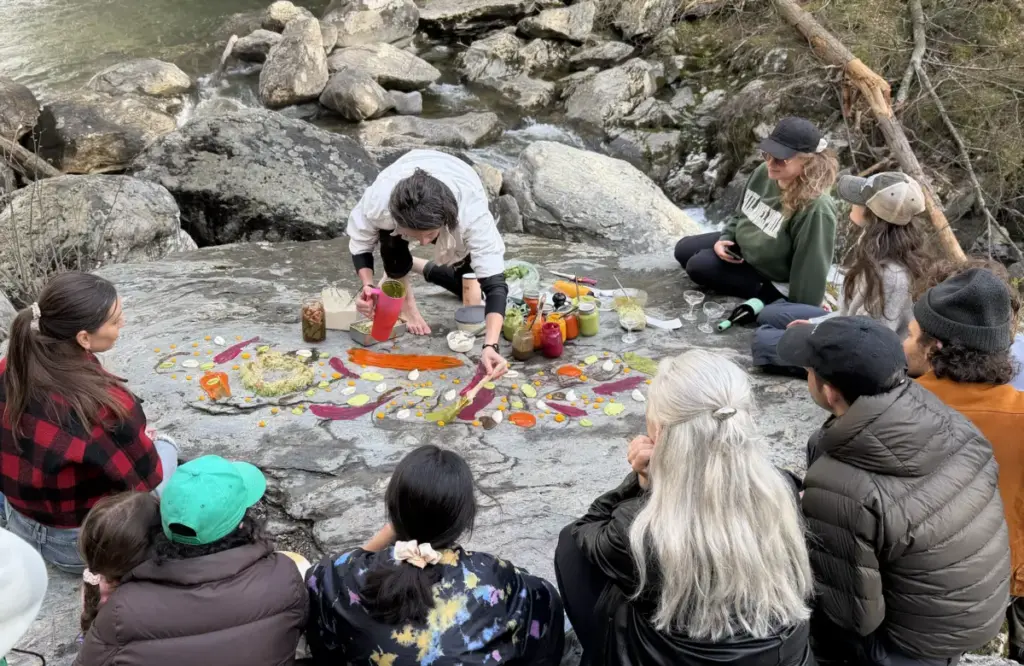
In the misty expanse of an upstate New York retreat, a small collective of diners huddles not around a polished mahogany dining set, but directly upon a flat, damp river rock by a rushing waterfall. Charles Michel, a culinary artist, researcher, and self-described "food futurist," approaches the natural stone canvas. Armed with a brush and vinegars, he primes the slate before laying down sweeping brushstrokes of vibrant vegetable purees, garnishing the abstract composition with foraged flora and organic remnants. There are no individual plates, no silverware, and no structured courses. Instead, diners use hunks of artisanal sourdough to scoop up colorful, umami-rich strokes of food that have been repurposed from the retreat’s kitchen trimmings.
This sensory-driven, deeply immersive meal is not an isolated piece of performance art. It is a striking manifestation of earthwork dining—an avant-garde, rapidly expanding global movement that dissolves the boundaries between land art, performance, ecology, and gastronomy. Across the globe, artists, farmers, and chefs are abandoning traditional dining rooms, tables, and porcelain. In their place, they are carving dining spaces directly into the earth, floating banquets on the open sea, and transforming local landscapes into active participants in the culinary ritual.
Yet, as earthwork dining captivates the imagination of counter-cultural artists and sustainability advocates alike, it stands at a fascinating crossroads. While pioneers use the medium to critique consumerism, foster community, and reconnect humans with the provenance of their food, corporate marketing machines and luxury brands have increasingly co-opted the aesthetic. Turning organic, dirt-carved banquets into viral influencer backdrops, this commercialization threatens to dilute the radical, low-waste ethos at the heart of the movement. Ultimately, however, practitioners argue that the core mission remains unchanged: using food as a Trojan horse to ground humanity in a disconnected, digital age.
Detailed Chronology: From Radical Avant-Garde Roots to Modern Earthwork
The philosophical blueprints of earthwork dining did not emerge overnight; rather, they are rooted in decades of performance art, political activism, and agricultural experimentation.

The 1960s–1970s: Radical Art and the Farm-to-Table Awakening
Decades before the term "earthwork dining" entered the cultural lexicon, groups like the Bread & Puppet Theater laid the early philosophical foundation. Emerging as a revolutionary 1960s puppet-activist troupe in the rolling hills of Vermont, the collective began baking and sharing house-made sourdough rye and pumpernickel loaves with their audiences. Their guiding philosophy was clear: theater and food should be liberated from commerce-driven mentalities and elevated to essential, nourishing human rights.
Shortly thereafter, the 1970s farm-to-table movement catalyzed a global reawakening regarding local, seasonal ingredients. By placing regional produce front and center, the movement validated the idea that the origin of food is just as important as its preparation—a concept that would soon scale upward into large-scale land art dinners.
1999–Present Days: The Expansion of Communal Landscapes
In 1999, land artist Jim Denevan founded Outstanding in the Field, a traveling culinary caravan that transformed remote fields, beaches, and orchards into sprawling communal dining rooms. Setting up a single, impossibly long, tablecloth-draped table for hundreds of guests, Denevan paired breathtaking natural vistas with menus curated by local chefs. While revolutionary in scale, these early iterations still relied on a distinct indoor-outdoor contrast: chairs, silverware, and proper table decorum were maintained to bridge the wild landscape with refined dining.
The 2020s: Stripping Away the Table
As the 2020s progressed, a new wave of culinary artists pushed the envelope further by completely stripping away traditional dining conventions.

- Late 2025 (Peconic, New York): Organizers at Treiber Farms hosted Farm Is Table, a groundbreaking event co-organized by artist Allan Wexler and Michael Yarinsky of the Office of Tangible Space. Diners sat at thirty-foot-long troughs carved directly into the farm’s dirt, dining on locally foraged oysters served off repurposed irrigation pipes, illuminated by candles drilled into the earth.
- Early 2026 (Marseille, France): Culinary artist Alix Lacloche presented Banquet on the Sea, an aquatic dining experience where guests waded into coastal waters. Constructed entirely from upcycled materials—including tables built from old fishmonger cold-room panels and bread baked inside recycled leather flip-flops—the event went viral globally, prompting internet commentators to repeatedly verify that the striking imagery was entirely real, not generated by artificial intelligence.
- August 2026 (Menorca): Outstanding in the Field staged a high-profile eclipse dinner along the rugged coastlines of Menorca, aligning high-end land art with celestial phenomena.
Supporting Context & Metrics: Philosophy, Design, and the Corporate Pivot
Relational Aesthetics and Sensory Disruption
To understand why earthwork dining resonates so deeply today, one must examine its theoretical underpinnings. Many practitioners anchor their work in relational aesthetics, a philosophy championed by French curator Nicolas Bourriaud. This artistic framework calls for creations that actively explore human relationships and social contexts in public, shared spaces.
By removing individual plates, chairs, and distinct courses, earthwork dinners intentionally dismantle modern social isolation. At Charles Michel’s waterfall picnic, the lack of utensils and structure provoked a childlike playfulness and a collective pause of gratitude. Similarly, projects like Farm Is Table drew inspiration from the century-old conceptual Italian text, The Futurist Cookbook. Embracing ideas like "Aerofood"—where diners eat while engaging multiple tactile senses—these events disrupt passive consumption, forcing participants to become physically entangled with their environments.
The Economics of Earthwork Dining
While born from counter-cultural and artistic subversions, earthwork dining operates across a wide economic spectrum:
- Intimate Art Projects: Independent community dinners, such as those at Treiber Farms, operate on micro-budgets with ticket prices hovering around $125, prioritizing low-waste circularity and regional agrarian storytelling.
- Global Luxury Activations: The visual potency of earthwork dining has inevitably caught the attention of corporate marketing teams. In recent years, fast-fashion giants like Mango hosted exclusive dinners inside remote Menorcan stone quarries, while cosmetics conglomerates like L’Oréal carved temporary tables and seating into the snowy peaks of Savoie, France, for high-profile influencer trips. These commercial activations trade the ecological humility of authentic earthwork art for viral reach and luxury brand positioning.
Official Statements and Perspectives
The tension between authentic land stewardship and commercial spectacle is best understood through the voices of those shaping the movement.

"It also became the excuse to provoke interesting social dynamics. Almost none of the rituals resembled the way we normally eat. There were no individual plates, no courses; no clear distinction between audience and participant. And yet everyone arrived hungry and left nourished."
— Charles Michel, Artist, Chef, and Food Futurist
Reflecting on the agricultural and artistic crossroads of Farm Is Table, co-organizer Peter Treiber Jr. emphasizes the grounding nature of the experience:
"That cross section [of agriculture and the arts] is something I’ve been exploring for years both as an artist and a farmer; it really is fertile ground. It was very seafood-forward, and we really just worked with what was available locally… It all created a bigger picture of what North Fork is about through the land and the sea. It’s a pretty simple concept, but it’s pretty effective about getting people grounded. Being at root level."
— Peter Treiber Jr., Co-manager of Treiber Farms
Allan Wexler, looking ahead to his upcoming book release reinterpreting The Futurist Cookbook, notes the transformative power of natural lighting and minimal intervention:

"As the sun went down and the moon came up, it was a gorgeous evening. It just became magical."
— Allan Wexler, Artist and Co-organizer
Future Outlook: Where Earthwork Dining Heads Next
As the culinary world looks toward 2027 and beyond, earthwork dining occupies a delicate dual reality. On one hand, the movement faces the persistent threat of co-optation. As digital platforms continue to reward highly aesthetic, hyper-curated visual content, the risk of "AI slop" and hollow influencer marketing posing as authentic ecological art remains high.
On the other hand, the foundational impulse driving these dinners—a profound societal yearning to escape hyper-connectivity, urban alienation, and environmental detachment—has never been stronger. Whether executed as an academic exercise in relational aesthetics on a waterfall rock or a community-supported farm dinner in the dirt, earthwork dining offers a vital antidote to modern overconsumption.
Ultimately, these gatherings prove that the most radical luxury available today is not found in white-tablecloth restaurants or algorithmic perfection. It is found in getting our hands dirty, breaking bread at root level, and recognizing that food is, as Charles Michel aptly puts it, the ultimate Trojan horse for human connection.