





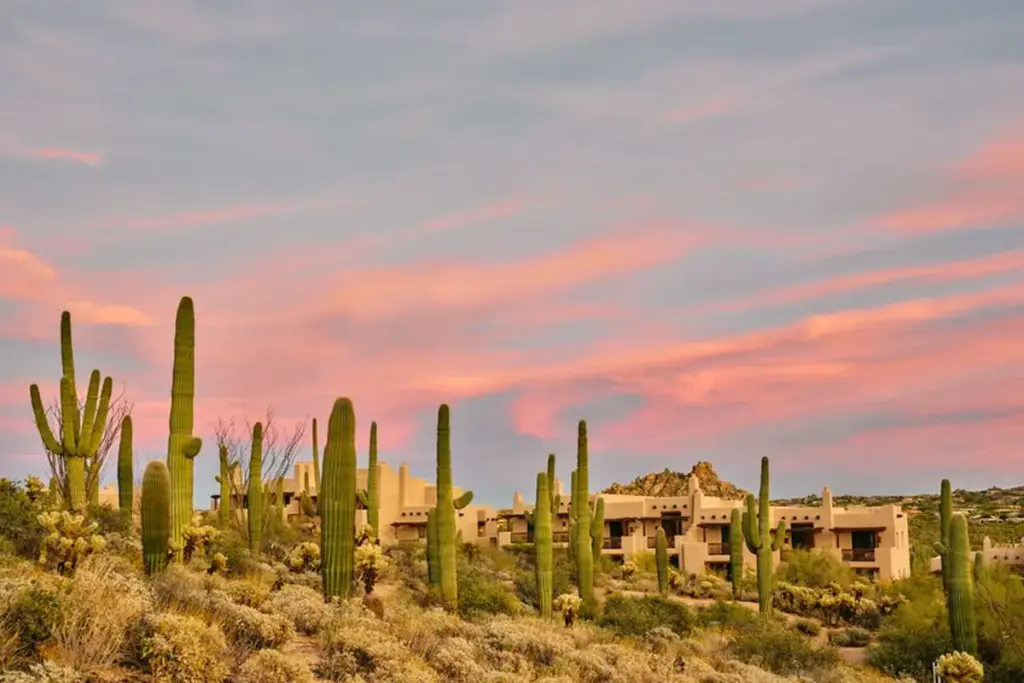
During a recent walk-through of the sun-drenched, desert-framed spaces of the Four Seasons Resort Scottsdale at Troon North, an architect paused in the lobby. Looking around the expansive entryway, they saw an untapped commercial opportunity. They suggested a seemingly logical structural addition: building a bar right in the middle of the lobby area.
To the investors accompanying them, the business case was immediately clear. A lobby bar would inject instant energy into the arrival area. It would serve as a social magnet, drawing in wealthy locals from the surrounding North Scottsdale neighborhoods, and, crucially, it would transform a transitional space into a highly productive, revenue-generating asset.
But Jerome Arribas, the resort’s general manager, saw something else entirely. He saw what would be lost in the pursuit of square-foot optimization. A bar, with its shelving, bottles, glassware, and associated visual noise, would slice directly through the pristine, uninterrupted sightline of the Sonoran Desert—the very view that defines the arrival experience for every guest who steps through the resort’s doors.
"There will never be a bar here," Arribas told them flatly. "You’re going to hide the million-dollar view. That is the core essence of this resort."
This quiet but decisive confrontation perfectly illustrates the constant, high-stakes push and pull required to preserve great luxury experiences today. As global hospitality brands rapidly scale and institutional investors demand higher yields from their real estate portfolios, the role of the hotel general manager (GM) has undergone a profound transformation. No longer just hosts or operational overseers, the modern luxury GM has become the ultimate defender of a property’s soul—often standing as the final barrier between a memorable, place-based guest experience and the creeping tide of commercial homogenization.
The Battle for the Lobby at Troon North
The debate over the lobby at Four Seasons Resort Scottsdale at Troon North is a classic study in the competing philosophies that govern modern hotel development. On one side of the ledger stand the architects and investors, whose mandate is to maximize the utility and financial return of every square foot of a property. In the vocabulary of modern hotel asset management, an empty lobby is often viewed as "dead space"—an underutilized asset that represents lost revenue.
A lobby bar, by contrast, is a proven wealth generator. It capitalizes on the high-margin beverage-and-food sector, encourages dwell time, and fosters a lively atmosphere that can make a hotel feel like the epicenter of a local community. For investors looking at spreadsheets, the upside of such an installation is both obvious and easily quantifiable.
On the other side of the ledger is the intangible, emotional architecture of luxury. At Troon North, this architecture is anchored by the dramatic natural landscape of the high Sonoran Desert, characterized by towering saguaro cacti, ancient granite boulders, and the majestic silhouette of Pinnacle Peak. The resort was deliberately designed to harmonize with this rugged terrain, making the transition from the outside world to the interior spaces feel seamless.
When a guest arrives after a long journey, the immediate, unobstructed view of this landscape through the lobby windows performs a vital psychological function. It grounds them in a specific geography, signals a departure from the mundane, and delivers an instant sense of tranquility. To interrupt this sightline with a bar—no matter how beautifully designed—would be to trade a priceless, unforgettable emotional response for a predictable stream of food-and-beverage revenue.
Arribas’s refusal to compromise on this point highlights a crucial truth in luxury hospitality: the most valuable assets on a property are often the ones that cannot be monetized directly on a receipt.
The High-Stakes Clash of Asset Optimization and Quiet Luxury
The tension observed at Troon North is playing out in luxury properties worldwide. Over the past decade, the hospitality industry has seen a massive influx of private equity and institutional capital. These investors operate on strict investment horizons and demand sophisticated asset management practices. They analyze metrics like Revenue Per Available Square Foot (RevPASF) and look for ways to optimize underperforming areas of a property.
At the same time, the concept of "quiet luxury" has emerged as the dominant preference among affluent travelers. Quiet luxury is defined not by gold leaf, grand chandeliers, or bustling, high-energy spaces, but by space, silence, time, and an authentic connection to the surrounding environment. It is about the luxury of nothingness—having the physical and mental room to breathe.
This creates an inherent paradox for hotel operators:
- The Investor’s Goal: Maximize density, increase transactional touchpoints, and activate every corner of the property to drive auxiliary revenue.
- The Luxury Guest’s Goal: Escape the noise, enjoy privacy, experience unhurried service, and connect with the unique character of the destination.
When these two forces collide, the general manager is caught in the middle. A GM must possess a highly sharpened, uncompromising point of view to successfully navigate these competing demands. They must be able to speak the financial language of investors to explain why not building a bar, not adding more tables to a restaurant, or not converting a quiet garden into an event space is actually the best long-term strategy for preserving the property’s brand equity and premium pricing power.
The Limits of Codified Hospitality
The necessity of a GM’s strong, localized perspective has become even more critical as global hotel brands have grown larger and more systematized. Major hospitality groups have become extraordinarily adept at codifying their operations. They have created exhaustive, highly detailed blueprints for everything from the exact sequence of service at check-in to the specific scent diffused through the ventilation systems, to the precise layout of guest rooms.
This codification yields immense value. It ensures a reliable baseline of quality and operational efficiency across a global portfolio. A loyal guest booking a stay at a luxury brand’s property in Tokyo, London, or Scottsdale expects a certain guaranteed standard of comfort, safety, and recognition.
However, this drive toward consistency carries a significant risk: the erasure of local nuance and the creation of a standardized, "cookie-cutter" luxury experience. When design, service, and commercial practices are dictated entirely by corporate playbooks and brand standards, hotels can begin to lose their sense of place. The guest experience becomes sanitized, predictable, and ultimately forgettable.
This is where the individual agency of the general manager becomes paramount. While corporate standards provide the framework, it is the GM who must edit, adapt, and sometimes defy those standards to suit the specific environment of their property. They must decide when to follow the corporate manual and when to break it in order to protect the unique magic that makes their hotel a destination in its own right.
The GM as the Curator-in-Chief
As luxury hospitality continues to expand and evolve, the profile of the successful general manager is shifting. The role is no longer merely administrative or operational; it is curatorial.
A great modern GM must act as the curator-in-chief of the guest experience. This requires a deep understanding of human psychology, an aesthetic sensibility, and an unwavering commitment to the narrative of the property. They must look at the hotel through the eyes of the guest, identifying the subtle, non-transactional moments that elevate a stay from a simple transaction to a lifelong memory.
At Four Seasons Resort Scottsdale at Troon North, Jerome Arribas’s defense of the lobby view is a prime example of this curatorial mindset. By protecting the sightline, he preserved a key narrative element of the resort’s identity. He understood that the value of that "million-dollar view" far outweighs the short-term financial gains of a lobby bar, because it is that very view that captures the imagination of travelers, inspires them to return year after year, and justifies the premium rates that sustain the property’s long-term financial health.
Ultimately, luxury cannot be entirely codified, automated, or managed by a spreadsheet. It relies on the intuition, passion, and stubborn resolve of individuals who understand that the true essence of hospitality lies in the things you cannot quantify—and who are willing to stand their ground to protect them.