








As modern travelers become increasingly conscious of their personal environmental footprints, a pressing question looms over the global tourism industry: How do our journeys fundamentally impact the destinations we visit? For decades, traditional mass tourism has prioritized convenience and volume, frequently at the expense of fragile ecosystems, indigenous sovereignty, and local community well-being. In response, ecotourism has emerged not merely as a niche travel trend, but as a critical operational framework designed to unite conservation, communities, and sustainable travel.
Defined fundamentally as purposeful travel to natural areas that conserves the environment, sustains the well-being of the local people, and involves interpretation and education, ecotourism offers a blueprint for the future. However, in an era plagued by corporate "greenwashing"—where buzzwords like "eco-friendly" are weaponized for marketing without substance—distinguishing between genuine conservation efforts and superficial branding has never been more vital.
This comprehensive guide breaks down ecotourism into its seven core operational principles. Through real-world case studies spanning the high Arctic of Svalbard, the isolated volcanic peaks of the Galápagos, the misty rainforests of Rwanda, and beyond, we examine what these principles demand on the ground. Whether you are a traveler looking to navigate the complexities of booking a responsible getaway, or a tourism operator striving to build ethical infrastructure, this article provides the authoritative insights necessary to move beyond greenwashing and into actionable, regenerative travel.
Detailed Chronology and Evolution of Modern Ecotourism
To fully grasp where ecotourism stands today, it is essential to understand its historical trajectory—how a counter-cultural movement against mass tourism evolved into a sophisticated, highly regulated global framework.
- The Late 20th Century (The Genesis): As global environmental awareness blossomed in the 1970s and 1980s, conservationists and scientists began recognizing that protected areas in developing nations were failing due to a lack of funding. Concurrently, local communities were often forcibly displaced from their ancestral lands to create national parks, creating deep hostility toward conservation. Ecotourism was born as an economic bridge: a way to make nature pay for its own protection while improving the lives of nearby residents.
- The 1990s (Institutionalization and Standards): The term "ecotourism" entered mainstream lexicon, prompting the formation of specialized bodies like The International Ecotourism Society (TIES) in 1990. Destinations began codifying rules. Notably, in 1998, the Galápagos Islands instituted strict caps on cruise tourism to stave off ecological collapse following decades of unmanaged growth.
- The 2000s–2010s (Community-Led Shifts and Certification): The paradigm shifted from top-down conservation—where governments and international NGOs dictated rules—to community-based tourism. Indigenous groups in regions like the Amazon and Mesoamerica began asserting ownership over tourism enterprises on their territories. Concurrently, the Global Sustainable Tourism Council (GSTC) established universal baseline standards for sustainability in travel.
- The Present Era (The Fight Against Greenwashing and the Pivot to Regeneration): Today, ecotourism faces its greatest modern test: balancing surging post-pandemic travel demand with planetary limits. Destinations like Sedona, Arizona, and Torres del Paine, Chile, are abandoning traditional "destination marketing" in favor of "destination management," utilizing real-time data, community feedback caps, and adaptive policies to ensure tourism serves residents rather than exploits them.
The Seven Core Principles of Ecotourism in Action
Each of the following principles forms a pillar of authentic ecotourism. Below, we explore how these theoretical ideals are applied on the ground in some of the planet’s most dynamic ecosystems.
Principle #1: Minimize Negative Environmental and Wildlife Impacts
Nature-based tourism frequently draws travelers into fragile, sensitive environments. Without meticulous management, visitor activities cause soil erosion, pollution, habitat fragmentation, and acute stress to local wildlife populations. Authentic ecotourism demands travel practices that actively reduce harm and foster ecosystem resilience through low-impact infrastructure, rigorous waste reduction, and strict wildlife viewing guidelines.
- The Galápagos Islands, Ecuador: Isolated for millions of years, the flora and fauna of the Galápagos evolved without natural predators, rendering them exceptionally vulnerable to human disturbance. Today, 97% of the archipelago is a designated national park, protected by a vast marine reserve. Cruise tourism has been capped since 1998, visitors are legally required to travel with licensed naturalist guides on designated trails, and advanced renewable energy projects significantly lower the risk of catastrophic fuel spills—such as a past tanker accident that tragically wiped out over 10,000 marine iguanas.
- Svalbard, Norway: In the high Arctic, even a minor human footprint can trigger outsized ecological disturbances. Operators like Svalbard Wildlife Expeditions combat this by eliminating engine-reliant excursions, designing itineraries centered entirely around non-motorized travel: exploring on foot, via kayak, or on skis. This drastically cuts carbon emissions, eliminates engine noise pollution, and upholds strict "leave-no-trace" protocols.
Principle #2: Minimize Negative Impacts on Communities and Cultures
Nature is rarely just an empty landscape; it is the physical and cultural foundation of the communities that inhabit it. Unchecked tourism can degrade sacred natural sites, overwhelm municipal resources, and restrict local access to vital communal assets like forests and fisheries. Furthermore, energy-intensive "eco-lodges" that consume excessive water for swimming pools or landscaping often spark severe friction with neighboring households and agricultural workers.
- Sedona, Arizona, USA: As this stunning desert town faced a surge of overtourism, residents sounded the alarm over chronic traffic congestion, noise pollution, and strained municipal services. Sedona responded by entirely overhauling its strategy, pivoting away from traditional tourism promotion to a community-informed management model. The town has invested heavily in localized transit solutions, directed visitors away from overtaxed trailheads, instituted strict limits on commercial helicopter flight paths over residential zones, and launched comprehensive water-conservation education initiatives.
Principle #3: Provide Financial Benefits for Conservation
Ecotourism must transcend mere harm reduction; its ultimate purpose is to generate the vital capital required to protect and restore natural environments. Financial inputs generated directly from travel—such as national park entrance fees, trekking permits, and direct donations—must be funneled back into the ecosystems visitors come to experience.

- Torres del Paine National Park, Chile: Welcoming over 350,000 hikers annually to its dramatic granite spires and glacial lakes, this Patagonian sanctuary relies heavily on the Legacy Fund. This initiative channels contributions from tour operators, lodges, and travelers into priority projects, including heavily eroded trail restoration, reforestation of wildfire-ravaged sectors, and the preservation of the endangered huemul deer.
- Volcanoes National Park, Rwanda: Few conservation stories are as triumphant as the recovery of Rwanda’s mountain gorillas, whose numbers have climbed to roughly 600 individuals. This success is directly funded by ecotourism: a single gorilla trekking permit costs $1,500 USD. This revenue funds elite tracking teams, sophisticated anti-poaching and snare-removal operations, and critical veterinary care.
Principle #4: Provide Economic Benefits for Local Communities
True ecotourism guarantees that the individuals who live closest to natural environments—and who have historically acted as their stewards—reap the economic rewards of preservation. By creating local jobs and supporting community-owned enterprises rooted in Indigenous knowledge, tourism creates a powerful economic alternative to exploitative industries like illegal logging or poaching.
- Sian Ka’an Biosphere Reserve, Mexico: A Maya-run cooperative offers low-impact nature tours—including lagoon boat trips, mangrove kayaking, and traditional culinary workshops—that keep capital within the community. Participating families have seen average household incomes rise by approximately 30%, transforming environmental stewardship into a lucrative livelihood.
- Nepal’s Community Homestay Network (CHN): In rural mountain regions, CHN pairs immersive cultural lodging with nature excursions. By training local hosts—predominantly women—in hospitality and business management, the initiative has generated over $139,000 USD in direct economic value across 28 distinct communities.
Principle #5: Empower Indigenous and Local Communities as Equal Partners
Historically, Indigenous populations were relegated to menial service roles or treated merely as living tourist attractions, frequently suffering cultural exploitation and land displacement. Ecotourism rewrites this dynamic through authentic collaboration, positioning communities as primary decision-makers who dictate how tourism operates on their ancestral territories.
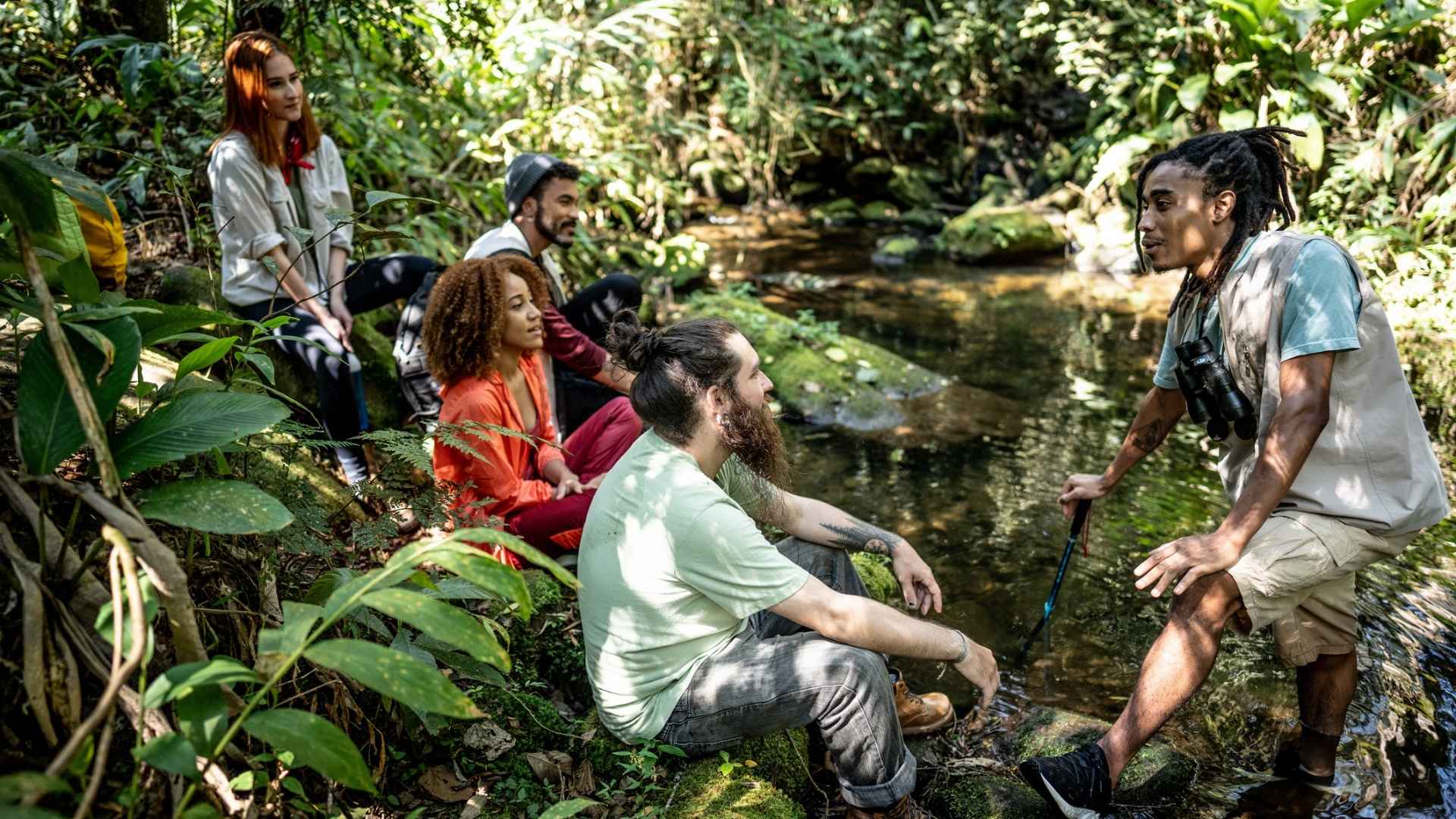
- The Paiter Suruí People, Brazilian Amazon: Breaking away from traditional dependency on outside operators, the Indigenous Paiter Suruí founded their own community-run ecotourism agency. Visitors are hosted directly by community members on immersive forest walks, traditional food workshops, and medicinal plant sessions. By maintaining absolute autonomy over the program, the Suruí ensure that tourism strictly serves their conservation priorities and cultural preservation goals.
Principle #6: Build Awareness and Respect
Education sits at the heart of ecotourism. The goal is to ensure travelers depart with more than photographs; they must leave with a profound, lasting awareness of local socio-ecological realities and the impact of their personal presence.
- Pacuare Reserve, Costa Rica: Transforming the coastal rainforest into an outdoor classroom, the reserve invites visitors to join researchers on guided night patrols to monitor nesting leatherback turtles and collect biological data. By directly participating in science, travelers gain an intimate understanding of species lifecycles and the fragile dependencies of tropical biodiversity.
Principle #7: Create Positive Experiences for Both Visitors and Hosts
The final principle acts as a litmus test for overall systemic health: ecotourism must successfully deliver high-quality, deeply enriching experiences for travelers while simultaneously elevating the quality of life and cultural integrity of the host destination.

- Madidi National Park, Bolivia: The Chalalán Ecolodge stands as a shining global benchmark. Fully owned and managed by the Indigenous community of San José de Uchupiamonas, the lodge was built specifically to protect their ancestral territory through economic self-sufficiency. Revenues from ecotourism are reinvested into vital municipal needs, including clean drinking water access, local health clinics, school construction, and emergency micro-loans, ensuring that every traveler’s journey directly enriches the host society.
Supporting Context & Metrics: The State of Sustainable Travel
To evaluate the broader implications of these seven principles, consider the following critical metrics and contextual realities shaping the industry:
- The Economic Imperative: According to recent analyses, the global ecotourism market is projected to scale exponentially, reflecting a massive consumer shift toward values-aligned travel. However, unmonitored growth threatens this trajectory; destinations worldwide are increasingly adopting carrying-capacity caps to prevent ecological degradation.
- The Threat of Greenwashing: Industry watchdogs note that up to 40% of environmental claims made by travel companies lack verifiable third-party certification. Implementing frameworks like those established by the Global Sustainable Tourism Council (GSTC) remains the single most effective countermeasure against deceptive marketing.
- Community Resilience: Studies show that when local communities retain at least 60% of tourism-generated revenue, incidents of illegal resource extraction (such as poaching or unauthorized logging) drop by over 45% within surrounding protected zones.
Official Statements and Industry Insights
Industry leaders and conservationists have increasingly emphasized that the future of travel depends on structural accountability.
"Ecotourism cannot simply be a marketing label slapped onto a standard resort package," notes a leading expert from Sustainable Travel International. "It is an ironclad commitment to operational transparency, community empowerment, and rigorous ecological stewardship. If the local community is not at the decision-making table, it is not ecotourism—it is extraction."
Furthermore, conservation authorities managing high-impact zones like Rwanda’s Volcanoes National Park underscore that high-cost, low-volume models are essential for species survival: "By pricing permits responsibly and tying those funds directly to anti-poaching and community health, we turn high-end tourism into a shield that protects our most vulnerable wildlife from extinction."

Future Outlook: Navigating the Road Ahead
As we look toward the future of global mobility, the principles of ecotourism will no longer be viewed as an idealistic alternative to traditional travel—they will become a mandatory survival strategy for the tourism industry at large.
For travelers, this evolution requires a shift in mindset: moving away from consumption-driven itineraries toward intentional, respectful, and educational exploration. Before booking your next adventure, utilize verified frameworks to audit your operators. Scrutinize their environmental impact reports, investigate how they reinvest in local communities, and demand absolute transparency.
For businesses and destinations, the path forward requires embracing adaptive management, engaging resident populations as equal stakeholders, and shunning greenwashing in favor of verifiable, impactful sustainability practices.
Ultimately, true ecotourism reminds us that travel is a profound privilege. When executed with integrity, our journeys have the extraordinary power not only to transform our own perspectives, but to actively protect, heal, and sustain the wild places and vibrant communities we are so privileged to visit.