









Executive Overview
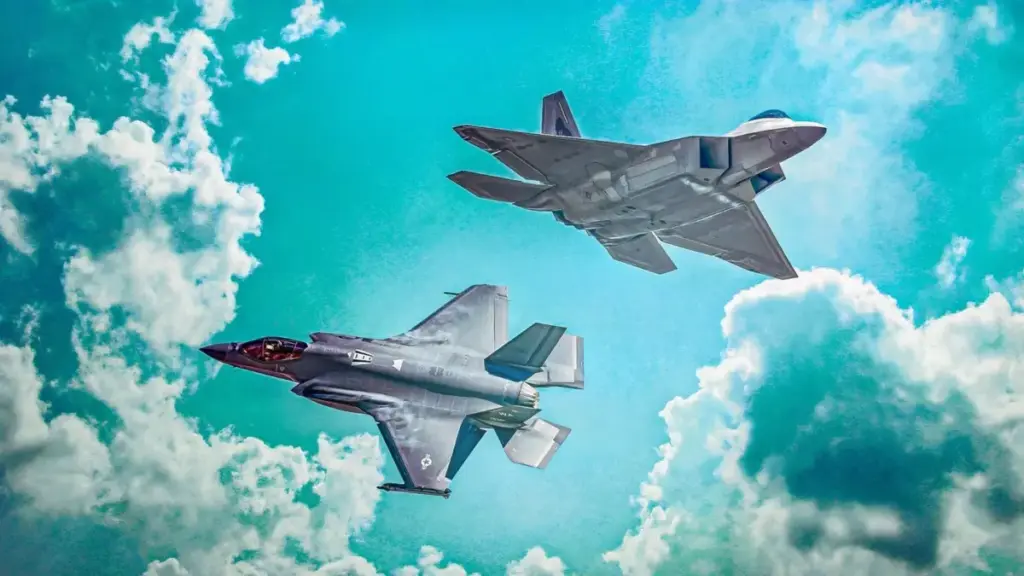
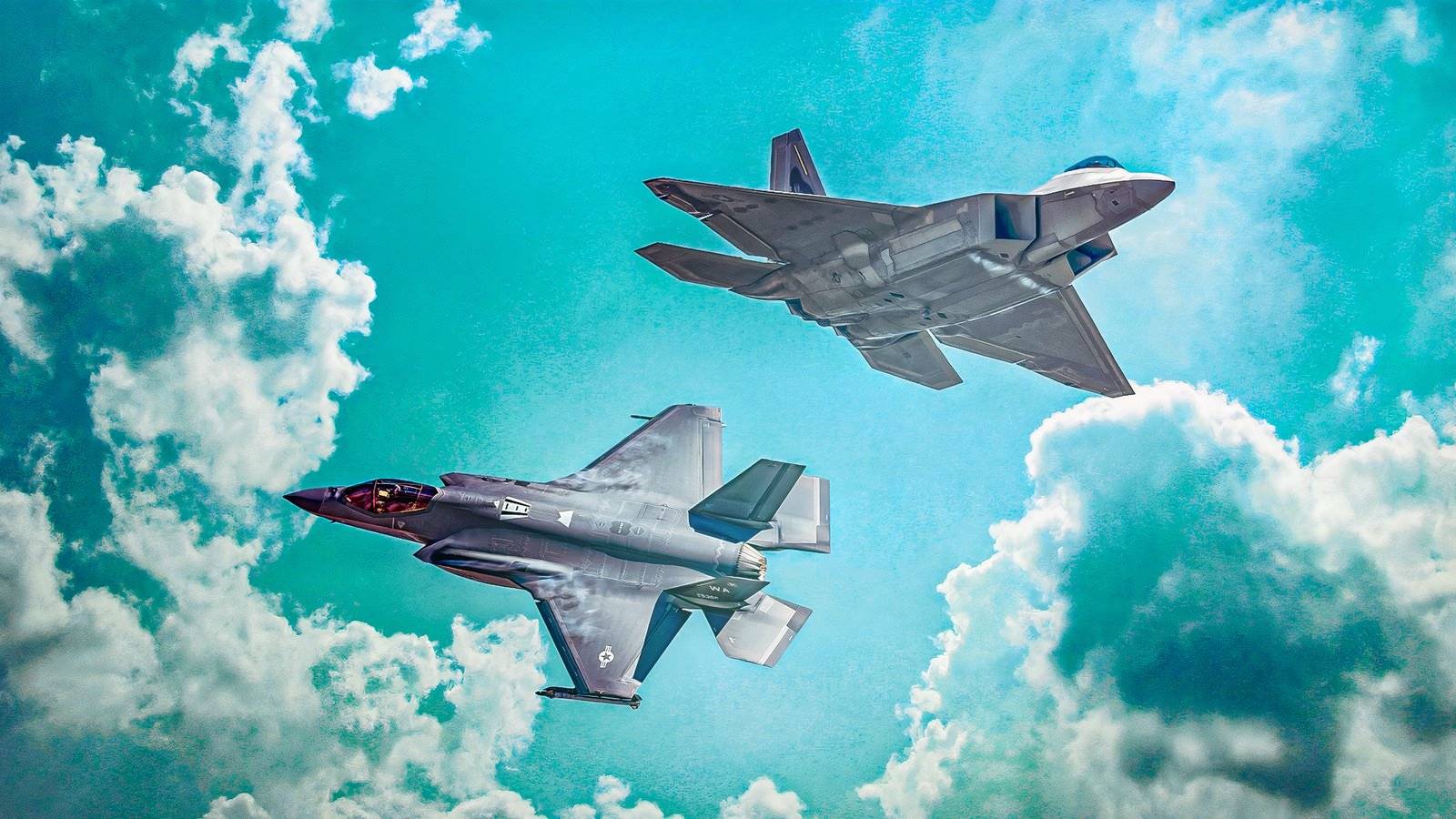
For over two decades, the Lockheed Martin F-22 Raptor and the F-35 Lightning II have stood as the twin pillars of American air dominance. Together, these fifth-generation platforms project unmatched combat power, securing hostile airspace, conducting deep-penetration strike missions, and safeguarding allied forces across European, Middle Eastern, and Indo-Pacific theaters. Yet, despite sharing revolutionary low-observable stealth characteristics and cutting-edge avionics, the two aircraft were engineered with fundamentally divergent combat philosophies.
The F-22 Raptor is a specialized air-superiority titan. Born out of the height of Cold War imperatives to counter and overmatch vast formations of Soviet-bloc interceptors, the Raptor prioritizes raw power, kinematic agility, and absolute aerial supremacy. Conversely, the F-35 Lightning II is a networked multirole strike fighter. Rather than relying purely on kinetic performance, the Lightning II is built around an advanced sensor suite and profound sensor fusion, operating effectively as an airborne battle manager and data hub.
Understanding the differences between these two legendary platforms requires a deep dive into the engineering, aerodynamics, flight-control systems, and mission profiles that set them apart. While the F-22 holds a commanding edge in raw agility, thrust-to-weight ratios, and close-range dogfighting capability, the F-35 counters with pervasive situational awareness, networked connectivity, and unmatched versatility across a broad spectrum of combat scenarios.
Detailed Chronology: From Concept to Combat-Ready Fifth-Generation Icons
The evolution of America’s fifth-generation air fleet traces back to distinct military requirements developed during periods of shifting geopolitical tension.
The Birth of the Air Superiority Fighter (1980s–2005)
- 1981: The United States Air Force initiates the Advanced Tactical Fighter (ATF) program, seeking a replacement for the F-15 Eagle to counter emerging Soviet air defense systems and high-performance interceptors like the Su-27 and MiG-29.
- 1990: Lockheed’s YF-22 prototype competes against Northrop’s YF-23 in a high-stakes fly-off evaluation.
- 1997: The first production-representative F-22 Raptor takes its maiden flight, showcasing revolutionary thrust-vectoring engines and advanced stealth shaping.
- 2005: The F-22 Raptor officially achieves Initial Operational Capability (IOC) with the United States Air Force, establishing a new global benchmark for air dominance. Production is infamously capped at 183 operational airframes due to shifting defense budgets and changing global threats.
The Rise of the Multirole Joint Strike Fighter (1990s–2016)
- 1993: The Joint Advanced Strike Technology (JAST) program—later evolving into the Joint Strike Fighter (JSF) program—begins under the Department of Defense to develop a universal, affordable, and multirole combat aircraft for the Air Force, Navy, and Marine Corps, as well as international allies.
- 2001: Lockheed Martin secures the JSF contract over Boeing, selecting the X-35 design featuring Short Takeoff and Vertical Landing (STOVL) capabilities.
- 2006: The F-35 Lightning II performs its maiden flight, introducing unprecedented levels of software integration and helmet-mounted display technology.
- 2015–2016: The F-35B achieves IOC with the US Marine Corps, followed swiftly by the F-35A achieving IOC with the US Air Force, formally marking the operational expansion of the world’s most ubiquitous fifth-generation fleet.
Supporting Context & Metrics: Aerodynamic and Tactical Comparisons
The divergent operational roles of the F-22 and F-35 are rooted in distinct physical, aerodynamic, and engineering specifications.
1. Thrust-Vectoring and Low-Speed Authority
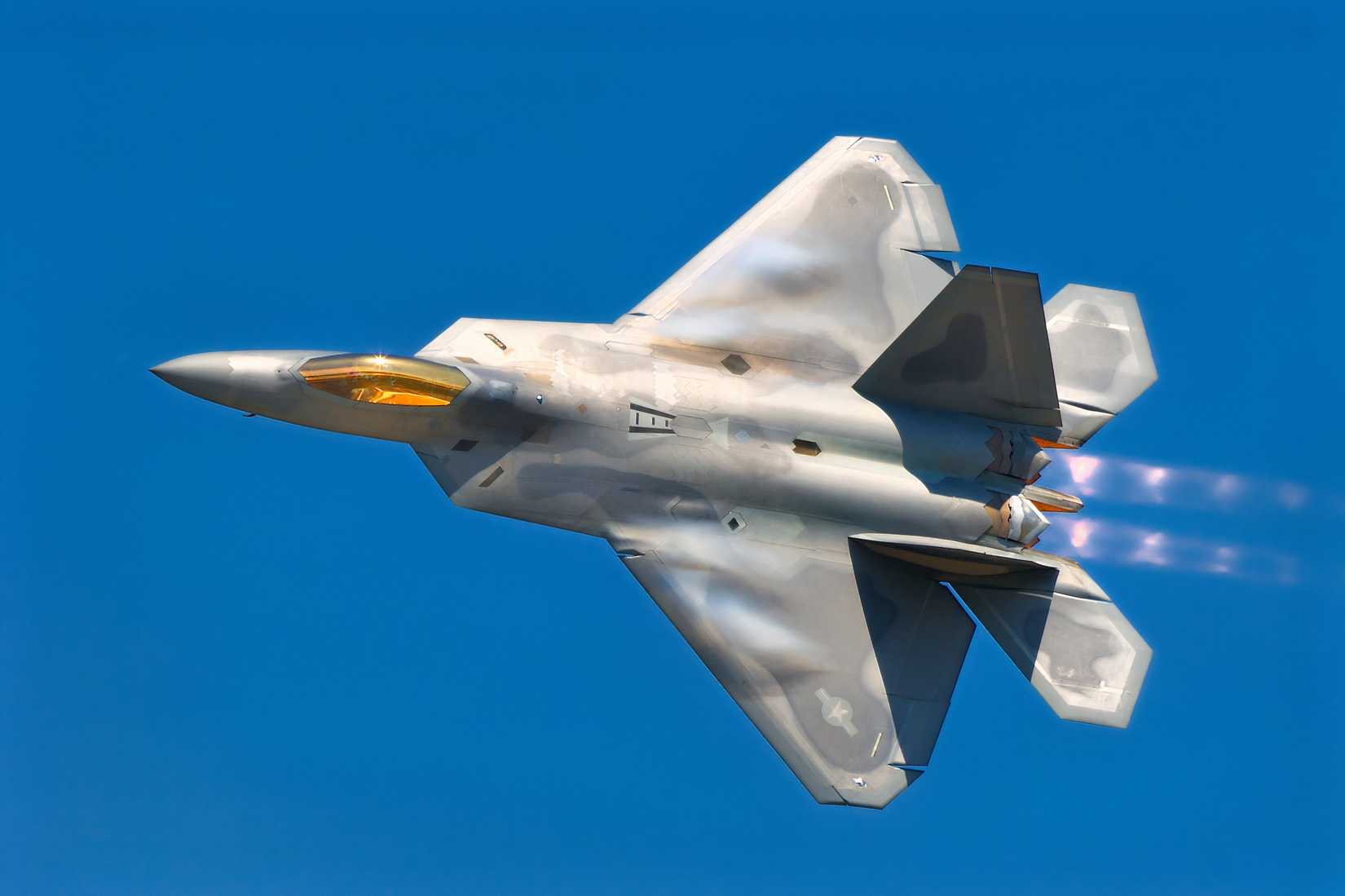
One of the F-22’s most defining attributes is its thrust-vectoring technology. Powered by two Pratt & F119-PW-100 turbofan engines, each generating 35,000 pounds (15,876 kg) of thrust, the Raptor features two-dimensional converging/diverging exhaust nozzles. These nozzles can deflect pitch up or down by up to 20 degrees.

This mechanical vectoring allows the pilot to maintain precise control during extreme high-angle-of-attack (high-alpha) maneuvers and low-speed flight regimes where conventional aerodynamic surfaces lose effectiveness. In close-range engagements, this capability enables the Raptor to point its nose rapidly toward an opponent and employ high off-boresight weapons like the AIM-9X Sidewinder. The F-35, while exceptionally stable and capable of controlled flight at high angles of attack, relies strictly on aerodynamic control surfaces and lacks dedicated thrust-vectoring nozzles.
2. Wing Loading and Kinetic Agility
Wing loading—the total weight of the aircraft divided by its wing area—dictates an aircraft’s turning performance and lift generation.
- F-22 Raptor: Features a wing area of approximately 840 square feet, resulting in relatively low wing loading for its size. This allows the aircraft to sustain tight turns, preserve energy during hard maneuvers, and rapidly recover speed.
- F-35 Lightning II: Features a more compact wing area of approximately 460 square feet while supporting a heavy multirole payload. Its higher wing loading places greater demands on available lift during sustained turning engagements, underscoring its design optimization for stability, strike accuracy, and efficient cruise rather than close-in dogfighting agility.
3. Thrust-to-Weight Ratio
An aircraft’s thrust-to-weight ratio dictates acceleration, vertical climb capability, and energy retention in aerial combat. The twin-engine F-22 maintains a superior thrust-to-weight ratio compared to the single-engine F-35 (powered by the Pratt & Whitney F135 engine producing roughly 43,000 pounds of thrust). This surplus power allows the Raptor to escape hostile engagements, climb vertically with ease, and regenerate kinetic energy far faster than its multirole stablemate.
4. Fuel Fractions and Combat Range
Maintaining stealth requires weapons and fuel to be carried internally to avoid increasing radar cross-sections.
- The F-22 carries approximately 18,000 pounds (8,164 kg) of internal fuel, sustaining long-range air-superiority patrols without external drop tanks.
- The F-35A carries roughly 18,500 pounds of internal fuel, optimized to push deep into contested airspace while supporting complex strike sorties across expansive regional theaters.
Comparative Specifications Summary
| Technical Metric | Lockheed Martin F-22 Raptor | Lockheed Martin F-35A Lightning II |
|---|---|---|
| Primary Mission | Air Superiority & Air Dominance | Multirole Strike, ISR, & Networked Warfare |
| Powerplant | 2x Pratt & Whitney F119-PW-100 turbofans | 1x Pratt & Whitney F135-PW-100 turbofan |
| Total Thrust | ~70,000 lbs combined | ~43,000 lbs |
| Wingspan | 44 ft 6 in (13.6 m) | 35 ft (10.7 m) |
| Wing Area | ~840 sq ft | ~460 sq ft |
| Max Speed | Mach 2.25+ (Supercruise capable) | Mach 1.6 (~1,200 mph / 1,931 km/h) |
| Service Ceiling | Above 50,000 ft (15 km) | Above 50,000 ft (15 km) |
| Inventory / Status | 183 total airframes (Production ended) | Expanding global fleet (Thousands contracted) |
Official Statements & Expert Perspectives
Military strategists and aviation historians emphasize that the F-22 and F-35 are complementary assets rather than competing designs. Their distinct capabilities ensure that the US military maintains full-spectrum dominance across any operational domain.
Highlighting the unique tactical doctrine of the air-superiority flagship, Colonel Michael J. Costigan (USAF) noted in an Air University strategic paper:

"In a complex air battle with dozens of aircraft, the integrated avionics and stealth will allow the pilot to choose where and when to engage to maximize survivability while destroying enemy aircraft that are not even aware of the F-22’s presence."
Senior defense analysts frequently describe the F-35 not merely as a fighter jet, but as a flying data hub. Its advanced Electro-Optical Distributed Aperture System (EO-DAS) and AN/APG-81 Active Electronically Scanned Array (AESA) radar feed unprecedented amounts of situational data directly into the pilot’s helmet-mounted display, instantly sharing tactical intelligence with surface units, AWACS, and allied wingmen across a secure battlefield network.
Future Outlook: The Transition Toward Next-Generation Dominance
As global peer competition intensifies, the operational lifespan and strategic roles of both the F-22 and F-35 continue to evolve.

The F-22 Raptor, despite being a generation ahead of legacy platforms, faces a constrained fleet size of just 183 airframes. While proposals to modernize its sensor suites, electronic warfare capabilities, and stealth coatings remain ongoing, the Air Force is actively looking toward the future. The Next Generation Air Dominance (NGAD) program is slated to succeed the Raptor as the premier air-superiority platform, incorporating manned-unmanned teaming, quantum radar resistance, and advanced propulsion systems.
Concurrently, the F-35 Lightning II remains the backbone of allied tactical airpower for the foreseeable future. With ongoing Block 4 software upgrades, enhanced processing power, and expanding international adoption across NATO and Indo-Pacific partner nations, the F-35 will continue to serve as the critical multirole linchpin of modern coalition warfare.
Ultimately, while the F-22 rules the skies through raw kinetic dominance and unmatched aerodynamic agility, the F-35 commands the battlespace through pervasive connectivity and multi-domain battlefield awareness—proving that American airpower relies on the perfect synthesis of speed, stealth, and smart technology.