





When food lovers seek restaurant recommendations, they rarely want sterile logistical data. Operating hours, dress codes, credit card policies, and reservation links are easily searchable metrics that lack the vital spark of real human experience. What diners truly crave is color, context, and a distinct point of view. A recommendation telling you a venue has a "fun atmosphere" fades from memory instantly; conversely, describing a subterranean, kitsch-laden Thai joint as "the exact kind of place that would impress John Waters" sticks with you, painting a vivid picture long before you ever step through the door.
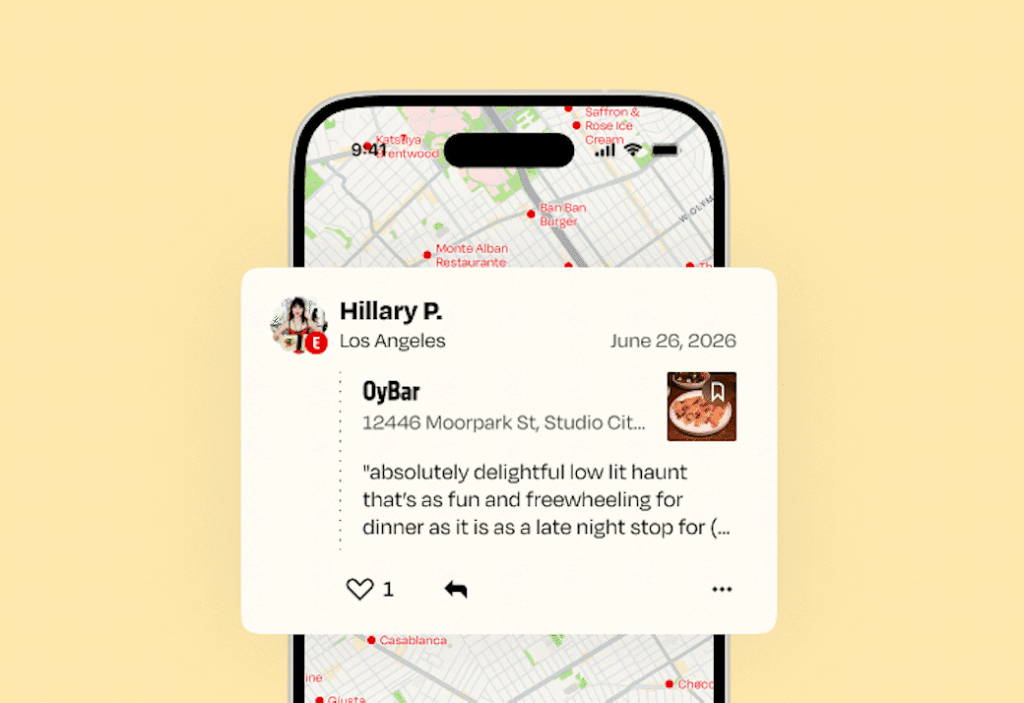
Recognizing this fundamental truth of modern dining culture, the culinary authority Eater has officially integrated this ethos into its newly revamped mobile application. Beyond standard utility features—such as integrated food delivery ordering and ride-sharing coordination—the platform’s crown jewel is its newly minted Notes feature.
This feature moves far beyond conventional star ratings and sanitized reviews. Instead, it captures the idiosyncratic, granular wisdom of professional food critics and editors who treat dining out not just as a meal, but as a cultural exploration. Whether it is confirming that a classic red-sauce institution like Bamonte’s in Williamsburg is indeed the ultimate spot to take visiting parents, or cataloging off-the-grid dive bars and neighborhood taco trucks, the Eater app is transforming crowd-sourced curation and editorial authority into a singular, interactive map.
This report provides a comprehensive examination of the Eater app’s redesign, analyzes the psychology behind hyper-specific food curation, details the expanded national footprint of the platform, and explores how this tool redefines the relationship between digital media and the modern dining public.
Detailed Chronology: From Static Publishing to Interactive Curation
The journey toward the new Eater app represents a major paradigm shift in digital food publishing. For nearly two decades, digital food media operated on a broadcasting model: critics published long-form reviews, neighborhood heat maps, and curated city guides. Readers consumed these pieces statically, cross-referencing them with mapping software or reservation platforms to plan their evenings.
However, the rapid acceleration of urban culinary scenes created a friction point. Diners no longer relied solely on annual top-100 lists; they wanted real-time, highly contextualized advice from trusted palates while standing on a street corner trying to decide between a cocktail haunt and a late-night noodle bar.
The Milestones of the Integration
- Phase 1: The Hyperlocal Blueprint. Editors realized that standard review metrics were failing modern consumers. The editorial team began prioritizing sensory, highly specific details in their reporting—moving away from generic praise toward evocative, narrative-driven descriptions.
- Phase 2: Technological Convergence. Recognizing that diners juggle multiple apps to plan a night out (mapping, reservations, ride-sharing, and delivery), Eater conceptualized an all-in-one ecosystem. The development of the new app incorporated utilitarian infrastructure—such as delivery ordering and ride-booking capabilities—to streamline the logistical friction of dining out.
- Phase 3: The Launch of the "Notes" Feature. The core innovation arrived with the implementation of editorial and user-generated "Notes." Rather than forcing users to sift through generic star ratings, the platform introduced bite-sized, highly opinionated field reports written directly by Eater’s roster of editors, reporters, and senior directors.
- Phase 4: Community Feedback Loop. The platform was designed to scale dynamically. When everyday users leave their own notes within the application, it creates an invaluable data feed for editors, signaling when an off-the-grid dive bar or a localized food truck has achieved the cultural resonance necessary to warrant broader coverage.
Supporting Context & Metrics: Inside the National Food Ecosystem
To understand why the Eater app’s note-taking mechanism is capturing attention, one must examine the specific cultural landscapes highlighted in the platform’s initial rollout. The app’s database has expanded to include a broader array of venues than ever before, stretching from coast to coast and capturing diverse culinary traditions, price points, and dining formats.
A Nationwide Sampling of Eater’s Field Notes
The app’s curated highlights illustrate the geographical and stylistic breadth of the platform’s editorial voice:
1. Thai Diner (New York City)
- The Curator: Bettina Makalintal, Senior Reporter
- The Experience: A staple of the New York dining scene characterized by boundless energy and culinary execution. Makalintal highlights standout items that transcend typical Thai-American fare, noting the chicken liver with roti, creative cabbage rolls, and an ambitious seafood tower featuring standout scallops and quail eggs. Notably, the location is also credited with serving one of the absolute best breakfast sandwiches in Manhattan.
2. Tiki on 18th (Washington, D.C.)
- The Curator: Missy Frederick, Editorial Director
- The Experience: Filling the cultural void left by the closure of the divey neighborhood favorite The Game, this Adams Morgan hotspot successfully preserves Filipino menu highlights—such as lumpiang and Jo-Jo’s pansit—alongside a robust tiki cocktail program. Furthermore, the venue earns praise for thoughtfully highlighting a wide array of gluten-free options on its menu.
3. OyBar (Los Angeles)
- The Curator: Hilary Pollack, Deputy Editor
- The Experience: Described as a low-lit, delightful haunt that transitions seamlessly from a freewheeling dinner destination to a late-night cocktail haven. Pollack points to the "spicy noods" as elite-tier comfort food and characterizes the pickle plate as a brilliant, hybrid Japanese-Jewish bento experience.
4. Chappie’s (Catskills, New York)
- The Curator: Nadia Chaudhury, Deputy Dining Editor
- The Experience: Located within walking distance of the eccentric Roxbury Motel (notably near the coconut cream pie themed room), Chappie’s proves that exceptional fish and chips can be found far beyond coastal metropolitan centers, anchoring regional weekend getaways.
5. Nodoguro (Portland, Oregon)
- The Curator: Kaitlin Bray, Senior Director of Audience Development
- The Experience: Positioned as an elite, special-occasion destination tucked away in a downtown tower. Bray emphasizes the immersive nature of the experience: a multi-course omakase-style format that celebrates the Pacific Northwest’s bounty. The accompanying sake pairings—featuring styles sourced from breweries across Japan—are treated as non-negotiable elements of the meal.
6. J.P. Graziano Grocery (Chicago)
- The Curator: Stephanie Wu, Editor-in-Chief
- The Experience: A multi-generational Chicago institution where the heritage is as palpable as the sandwiches. Wu advises newcomers to order the legendary "Mr. G" sub, greet Jim (whose family has run the establishment for generations), and ensure that extra giardiniera is added to every order.
Official Statements and Industry Insights
The philosophy underpinning the Eater app redesign stems from a unified editorial vision: bridging the gap between authoritative food journalism and everyday consumer utility.
"When I ask a friend for restaurant recommendations, I’m rarely asking for something as cut and dry as the operating hours, dress code intel, or whether it’s cash-only — all of that’s helpful, but also easily searchable," explains the editorial team behind the rollout. "If I’m reaching out to you, I’m looking for some notes with a little more color."
This perspective challenges the prevailing Silicon Valley approach to restaurant discovery, which historically favored algorithmic aggregation over human curation. By leaning heavily into the distinct voices of professional food writers, Eater is doubling down on human expertise as an antidote to review fatigue.
Industry analysts note that modern diners are increasingly skeptical of unverified online review platforms, which are frequently plagued by review-bombing, incentivized positive ratings, and generic feedback. By anchoring app recommendations to recognized journalistic authorities—while simultaneously opening secure channels for community feedback—Eater bridges the gap between trust and accessibility.
Furthermore, the integration of logistical utilities—such as booking rides and arranging delivery directly through the ecosystem—transforms the app from a passive reading tool into an active culinary companion. It acknowledges that the dining journey begins long before the guest sits down at a table, and continues well after the check is paid.
Future Outlook: Where Digital Food Curation is Headed
As the food media landscape continues to evolve at a breakneck pace, the success of the Eater app will likely serve as a litmus test for how legacy media brands can successfully monetize and operationalize their institutional knowledge.
Key Trends to Watch
- The Rise of Hyper-Personalized Editorial Feeds: As machine learning and user-generated data interact with professional notes, future iterations of the app may feature dynamic feeds tailored specifically to a user’s stated culinary obsessions—whether that means tracking natural wine bars, gluten-free noodle houses, or hidden-gem dive bars.
- The Blurring Lines Between Media and Commerce: By embedding transactional features (delivery, ride-hailing, reservations) directly alongside editorial critiques, platforms like Eater are pioneering an integrated commerce model where reading about a dish and consuming it are separated by only a couple of taps on a screen.
- Community-Driven Journalism: The two-way street of the "Notes" feature—where user input signals to editors what off-the-grid spots deserve mainstream investigative spotlight—suggests a democratization of the culinary beat. Local food lovers will increasingly act as regional stringers for major media brands.
Ultimately, the revamped Eater app proves that while technology changes how we navigate our cities, our fundamental desire for a compelling story remains unchanged. Whether you are hunting down a seafood tower in Manhattan, savoring spicy noodles in Los Angeles, or ordering a classic sub in Chicago, the best meals are still found through the eyes—and words—of someone who truly cares about what is on the plate.