









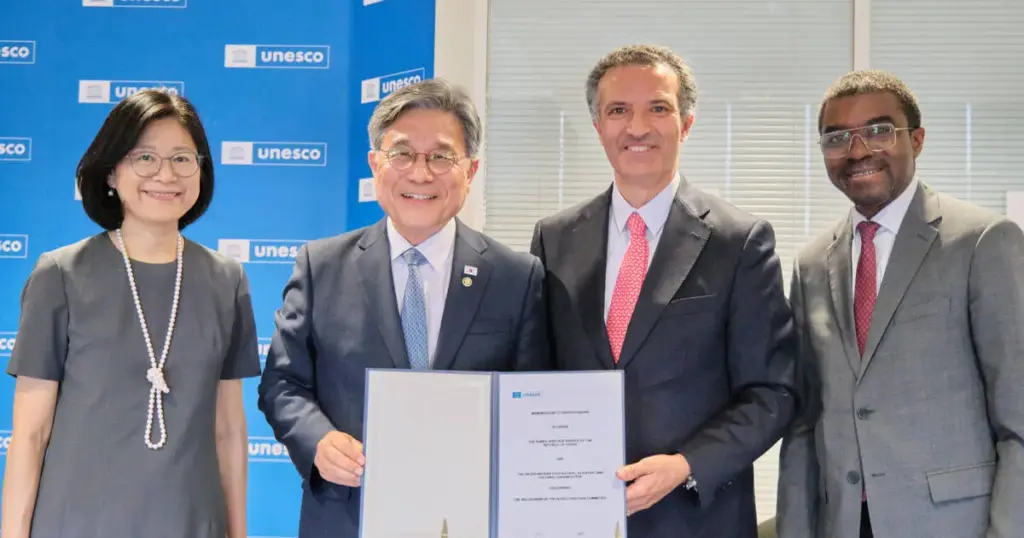
In a landmark diplomatic and cultural agreement solidified at the United Nations Educational, Scientific and Cultural Organization (UNESCO) Headquarters in Paris, the Republic of Korea—acting through the Korea Heritage Service (KHS)—has officially confirmed a substantial multi-year voluntary contribution of KRW 5 billion (approximately USD 3.7 million based on current baseline conversions) spanning the 2026–2030 funding cycle. This renewed financial commitment, disbursed in dependable annual instalments of KRW 1 billion, cements a formidable, quarter-century alliance dedicated to the preservation, safeguarding, and promotion of humanity’s shared cultural and natural heritage.
The high-level formalization ceremony brought together key international figures, including Mr. Huh Min, Administrator of the Korea Heritage Service; Mr. Nayef H. Al-Fayez, Assistant Director-General for Culture at UNESCO; and Her Excellency Jihee Kim, Ambassador and Permanent Delegate of the Republic of Korea to UNESCO. This gathering served not merely as a symbolic renewal of financial patronage, but as a strategic reaffirmation of a shared vision. For over twenty-five years, the Seoul-Paris axis has consistently evolved from a localized donor-recipient dynamic into an innovative, multidimensional partnership addressing some of the most complex heritage management challenges of the twenty-first century.
This latest pledge directly succeeds a robust preceding commitment of KRW 5.8 billion (USD 3,845,858) executed between 2021 and 2025. Far from being a passive cash injection, these funds have historically catalyzed profound structural shifts within global heritage policy, technical capacity building, and crisis-response mechanisms for endangered sites. The newly structured 2026–2030 framework expands upon these past achievements, targeting systemic vulnerabilities in global heritage preservation. The collaborative blueprint prioritizes targeted capacity-building initiatives, the implementation of inclusive heritage interpretation methodologies, specialized technical assistance for vulnerable World Heritage properties across the Korean Peninsula, and ambitious transboundary cooperative frameworks designed to bridge geopolitical divides through cultural diplomacy.
Furthermore, the renewed partnership breaks new ground by directly confronting contemporary planetary crises. A significant allocation of the incoming resources will support the aggressive implementation of UNESCO’s Climate Action Policy for World Heritage, providing vulnerable nations with the diagnostic tools and adaptive engineering frameworks required to mitigate the devastating impacts of climate change on irreplaceable monuments and ecosystems. By emphasizing preparatory assistance for under-represented States Parties—particularly within regions historically excluded from the prestige of the World Heritage List—the Republic of Korea and UNESCO are proactively democratizing access to global heritage protection systems. This comprehensive journalistic investigation examines the chronological evolution of this enduring partnership, breaks down the financial and programmatic metrics, analyzes official statements from key stakeholders, and maps out the strategic future outlook for international cultural diplomacy.
Detailed Chronology: A Quarter-Century of Strategic Collaboration
To fully grasp the weight of the newly announced KRW 5 billion commitment, one must examine the evolutionary trajectory of the partnership between the Republic of Korea and UNESCO. Over the past twenty-five years, this relationship has matured from sporadic bilateral project funding into a institutionalized engine of global heritage governance.
The Foundation Years (Late 1990s–2000s)
Following the Republic of Korea’s rapid economic ascent and subsequent cultural renaissance in the latter half of the twentieth century, Seoul increasingly sought to align its foreign policy with multilateral humanitarian and cultural objectives. In the late 1990s and early 2000s, Korean cultural authorities began deepening their institutional engagement with UNESCO. Recognizing that domestic excellence in heritage conservation—exemplified by the meticulous restoration of landmarks like the Bulguksa Temple and Seokguram Grotto—could serve as a blueprint for international development, South Korea transitioned from a beneficiary of international aid to a proactive donor state.
During this formative era, early cooperation focused primarily on technical information sharing, initial expert exchanges, and foundational contributions to the UNESCO World Heritage Fund. These initial steps laid the groundwork of mutual trust, proving to UNESCO’s leadership in Paris that Korean institutions possessed both the financial discipline and the technical expertise required to manage complex international trust funds.
The Institutionalization of the Funds-in-Trust Framework (2010s)
The 2010s marked a quantum leap in the sophistication of the partnership. The establishment of formal Funds-in-Trust (FiT) agreements between UNESCO and Korean heritage authorities allowed for targeted, ring-fenced financing of strategic global projects. During this decade, South Korean contributions began directly funding large-scale capacity-building workshops across the Asia-Pacific region, Africa, and Latin America.
These programs trained hundreds of site managers, heritage architects, and governmental policymakers in the strict standards of the 1972 World Heritage Convention. Crucially, this decade also saw Seoul leverage its unique geopolitical position to fund sensitive technical assistance initiatives, establishing a precedent for using cultural heritage as an apolitical bridge for dialogue and regional stabilization.
The 2021–2025 Cycle: Navigating Pandemic and Post-Crisis Realities
As the global community reeled from the disruptions of the COVID-19 pandemic, the Republic of Korea demonstrated unwavering multilateral solidarity by committing KRW 5.8 billion (approximately USD 3.85 million) for the 2021–2025 funding cycle. This period was characterized by adaptability and digital transformation.
With international travel restricted, the KHS-UNESCO partnership pivoted rapidly to fund virtual capacity-building modules, remote digital documentation of endangered heritage sites, and emergency digital resilience training for site managers facing sudden economic downturns due to tourism collapse. Moreover, this cycle prioritized the early conceptualization of climate-resilient management plans, establishing the empirical and operational bedrock for the newly announced 2026–2030 agreement.
Supporting Context & Metrics: Where the Funds Go
A critical analysis of the KRW 5 billion (2026–2030) commitment requires a granular breakdown of its programmatic allocations. The partnership is governed by a meticulous operational strategy that targets distinct pillars of modern heritage conservation.
+-----------------------------------------------------------------+
                 KHS-UNESCO 2026-2030 STRATEGIC PILLARS
+------------------------------------+----------------------------+
| Strategic Domain                   | Primary Objective          |
+------------------------------------+----------------------------+
| World Heritage Capacity-Building   | Professional training &    |
|                                    | inclusive interpretation.  |
+------------------------------------+----------------------------+
| Peninsula & Regional Technical Aid | Targeted site preservation |
|                                    | & transboundary diplomacy. |
+------------------------------------+----------------------------+
| Climate Action Policy Integration  | Mitigating environmental   |
|                                    | damage to fragile sites.   |
+------------------------------------+----------------------------+
| Under-represented State Support    | Nominations & preparatory  |
|                                    | assistance for Global South|
+------------------------------------+----------------------------+
1. World Heritage Capacity-Building and Inclusive Interpretation
Investing in infrastructure without investing in human capital is an obsolete model of development aid. Under the new agreement, a substantial portion of the annual KRW 1 billion instalment will be funneled into advanced training programs for heritage professionals. These programs are designed not only to impart rigid conservation science and structural engineering methodologies, but also to revolutionize how heritage is interpreted for the public.
Inclusive heritage interpretation moves beyond traditional, Eurocentric, or elite-focused historical narratives. The KHS-UNESCO initiatives train site managers to incorporate marginalized voices, indigenous histories, and multi-layered community perspectives into museum displays, digital guides, and physical signage. This ensures that World Heritage sites remain dynamic, socially relevant educational hubs rather than static tourist backdrops.
2. Technical Assistance for the Korean Peninsula and Regional Cooperation
Geopolitics often complicates the preservation of contiguous ecosystems and shared historical landscapes. The partnership explicitly ring-fences resources to provide specialized technical assistance for World Heritage sites located within and adjacent to the Korean Peninsula. These interventions require nuanced diplomatic navigation and superior engineering prowess, particularly when applied to natural reserves, demilitarized buffer zones, and historical fortifications that span regional divides.
Beyond the Peninsula, the funds catalyze transboundary and regional cooperation frameworks across all global regions. Transboundary nominations—such as ancient trade routes, shared mountain ranges, or migration corridors—inherently require multi-state coordination. The KHS-UNESCO trust provides the neutral institutional scaffolding required for adversarial or economically disparate nations to cooperate on joint conservation management plans.

3. Implementation of the Climate Action Policy for World Heritage
Perhaps the most urgent mandate of the 2026–2030 agreement is its direct alignment with UNESCO’s Climate Action Policy for World Heritage. Global warming presents an existential threat to cultural and natural monuments alike, manifesting as rising sea levels threatening coastal archaeological sites, intensifying wildfires scorching ancient forests, and erratic precipitation patterns destabilizing earthen architecture.
The renewed Korean contribution will finance critical vulnerability assessments, emergency response toolkits, and adaptive management strategies for vulnerable World Heritage properties. By funding pilot projects that test green engineering solutions and community-based monitoring systems, the partnership ensures that global heritage institutions are not merely documenting the destruction of the past, but actively fighting to preserve it against future climatic shocks.
4. Supporting Under-Represented States Parties
A persistent structural imbalance within the global heritage regime has been the historical under-representation of certain geographic regions—particularly across parts of Africa, the Pacific, and the Caribbean—on the prestigious UNESCO World Heritage List. This imbalance is rarely driven by a lack of cultural or natural wealth, but rather by systemic disparities in technical expertise, administrative capacity, and financial resources required to draft flawless nomination dossiers.
The KHS-UNESCO partnership directly addresses this inequity by providing targeted preparatory assistance. By funding preliminary research, comparative studies, and technical drafting missions for under-represented States Parties, the partnership helps level the playing field, ensuring that the World Heritage List truly reflects the diverse tapestry of human civilization and planetary biodiversity.
Official Statements and Diplomatic Significance
The formalization ceremony at UNESCO Headquarters in Paris was marked by speeches that highlighted the mutual strategic value of the partnership. The convergence of perspectives from Korean leadership and UNESCO officialdom underscored a shared commitment to multilateralism during an era of global fragmentation.
Expressing deep institutional gratitude, Mr. Nayef H. Al-Fayez, Assistant Director-General for Culture at UNESCO, articulated the profound impact of the Korean contribution:
"I would like to express UNESCO’s appreciation to the Republic of Korea, in particular to the Korea Heritage Service, for their sustained commitment and generous support, which continue to contribute significantly to the safeguarding of World Heritage and the strengthening of international cooperation."
Mr. Al-Fayez’s remarks emphasize that South Korea’s role transcends that of a traditional philanthropic donor. In the lexicon of international diplomacy, "sustained commitment" implies reliability—a critical asset for an international organization navigating fluctuating geopolitical tides and unpredictable national funding cycles from other major world powers.
From the national perspective, Mr. Huh Min, Administrator of the Korea Heritage Service, framed the agreement as a moral and cultural imperative rooted in South Korea’s own historical journey:
"Our nation understands intimately the fragility of cultural heritage, having rebuilt our own identity from the ashes of historical conflicts. Through our enduring partnership with UNESCO, the Republic of Korea is proud to share its technical expertise, financial resources, and unwavering belief that the preservation of human history is a collective global responsibility that transcends national borders."
Ambassador and Permanent Delegate H.E. Jihee Kim further contextualized the agreement within the broader framework of South Korea’s foreign policy objectives. By embedding cultural diplomacy at the core of its multilateral engagement, Seoul projects soft power that is constructive, collaborative, and universally welcomed. Ambassador Kim noted that the transition from the 2021–2025 cycle into the expanded 2026–2030 framework represents a maturing of South Korea’s global citizenship—one that actively contributes to solving planetary challenges rather than remaining passive in the face of shared crises.
Future Outlook: Challenges and Strategic Horizons for 2026–2030
As the international community looks ahead to the execution of the 2026–2030 funding cycle, the KHS-UNESCO partnership faces a complex operating environment fraught with both formidable challenges and unprecedented opportunities.
Navigating Emerging Threats
The next five years will test the resilience of global heritage governance as compounding crises—ranging from regional conflicts that weaponize cultural destruction to accelerating ecological breakdown—threaten fragile monuments. The strategic focus of the newly funded initiatives on climate resilience and transboundary diplomacy is both timely and essential. However, the operational velocity of these programs will need to match the speed of modern crises. The deployment of rapid-response technical assistance teams, backed by the flexibility of the UNESCO/KHS Funds-in-Trust projects, will serve as a vital diagnostic and rescue mechanism for sites facing sudden existential threats.
Digital Transformation and Youth Engagement
Looking beyond traditional capacity-building workshops, the future outlook of the partnership demands an aggressive embrace of digital innovation. Younger generations view heritage through immersive, digital-first prisms. Future iterations of KHS-UNESCO training programs are expected to increasingly incorporate advanced geospatial mapping, 3D laser scanning of endangered monuments, and artificial intelligence-driven predictive modeling for site decay. By engaging tech-savvy youth and local digital innovators in the Global South, the partnership can build sustainable, grassroots digital archives that outlive physical disasters.
Democratizing Global Governance
Ultimately, the success of the KRW 5 billion commitment will be measured not merely by the number of workshops conducted or nomination dossiers submitted, but by its contribution to a more equitable global governance structure. By lifting up under-represented States Parties and embedding inclusive interpretation methodologies into everyday site management, the Republic of Korea and UNESCO are helping to construct a more democratic international order—one where every nation sees its heritage valued, protected, and celebrated as an indispensable chapter of the human story.
As implementation begins in 2026, the KHS-UNESCO alliance stands as a stellar beacon of what sustained, visionary international cooperation can achieve. In a world frequently divided by ideological and political fault lines, the preservation of our shared past remains one of the few universal languages capable of bridging divides and securing a resilient, culturally rich future for generations to come.