









Executive Overview
In a decisive demonstration of long-term international solidarity and cultural stewardship, the Republic of Korea—acting through the Korea Heritage Service (KHS)—has officially confirmed a renewed multi-year voluntary contribution of KRW 5 billion to UNESCO. Spanning the 2026–2030 cycle, this financial commitment will be delivered in structured annual installments of KRW 1 billion, ensuring predictable, sustained funding for the global preservation of cultural and natural heritage.
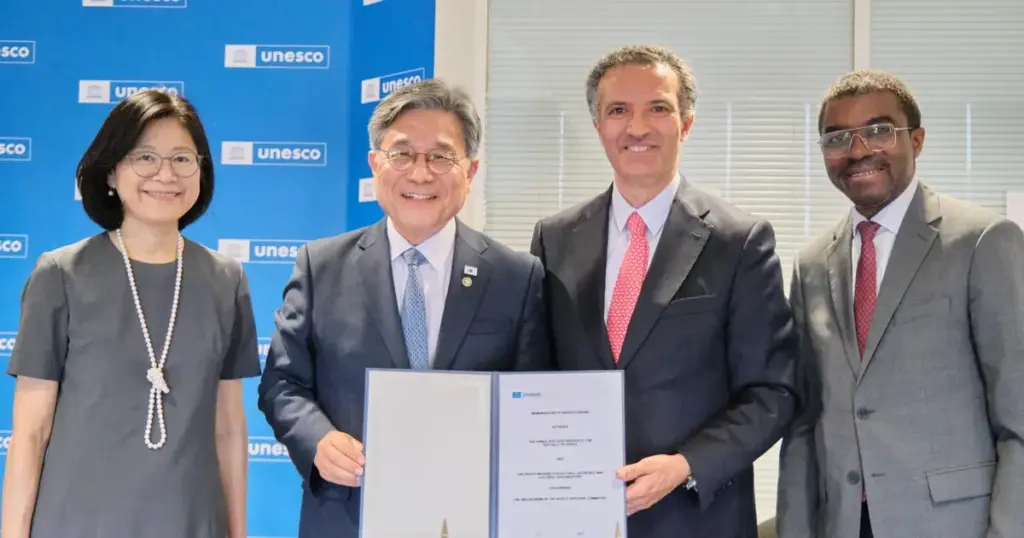
The formal reaffirmation of this enduring alliance took place at UNESCO Headquarters in Paris, France. The high-level proceedings brought together key figures from both institutions, including Mr. Huh Min, Administrator of the Korea Heritage Service; Mr. Nayef H. Al-Fayez, UNESCO Assistant Director-General for Culture; and Her Excellency Jihee Kim, Ambassador and Permanent Delegate of the Republic of Korea to UNESCO. This milestone event marks more than a quarter-century of robust collaboration between the South Korean government and the United Nations Educational, Scientific and Cultural Organization.
Building upon a preceding financial commitment of KRW 5.8 billion (approximately USD 3.85 million) executed between 2021 and 2025, the new funding framework is designed to tackle modern challenges facing international heritage conservation. The partnership will concentrate on vital thematic areas, ranging from World Heritage capacity-building and inclusive heritage interpretation to technical assistance for sites within the Korean Peninsula. Furthermore, the collaboration explicitly targets pressing global issues, including the implementation of the UNESCO Climate Action Policy for World Heritage, the facilitation of transboundary and regional cooperation, and the provision of preparatory assistance for under-represented States Parties seeking to nominate sites of exceptional universal value.
As the international community navigates an era defined by intensifying climate disruptions, geopolitical fragmentation, and rapid urbanization, South Korea’s proactive financial and intellectual investment underscores the indispensable role of multilateralism in protecting our shared human legacy.
Detailed Chronology: A Quarter-Century of Strategic Heritage Diplomacy
To fully appreciate the gravity of the 2026–2030 funding agreement, one must examine the evolutionary trajectory of the partnership between the Republic of Korea and UNESCO. Over the past twenty-five years, this relationship has matured from sporadic bilateral project support into an institutionalized, highly sophisticated engine of global heritage management.
The Formative Years (Late 1990s–2000s)
Following its rapid economic development in the latter half of the 20th century, South Korea sought to align its diplomatic footprint with its rich cultural identity. Having successfully inscribed its first properties onto the UNESCO World Heritage List in 1995—including the magnificent Seokguram Grotto and Bulguksa Temple, the Haeinsa Janggyeong Panjeon (depositories for the Tripitaka Koreana woodblocks), and the Jongmyo Shrine—Seoul recognized a reciprocal duty to assist the international community in safeguarding global heritage assets.
During the 2000s, initial collaborative efforts focused heavily on technical exchange, architectural conservation methodologies, and inventory building. South Korean experts, backed by targeted governmental grants, began working alongside international conservationists to document and stabilize vulnerable monuments across the Asia-Pacific region and beyond.
Institutionalization and the Funds-in-Trust Mechanism (2010s)
As the partnership deepened, both parties established structured financial frameworks, notably the UNESCO/KHS Funds-in-Trust (FiT) projects. These funds allowed for long-term strategic planning rather than reactive, short-term crisis management. During this decade, South Korea expanded its geographical focus. While the Asia-Pacific region remained a core priority due to shared historical ties and regional proximity, Korean-funded initiatives began reaching into Africa, Latin America, and Eastern Europe, providing crucial capacity-building workshops for local heritage professionals.
The 2021–2025 Funding Cycle and Resilient Adaptation
The previous funding cycle, valued at KRW 5.8 billion (USD 3,845,858), was negotiated and executed against the backdrop of unprecedented global upheaval, including the COVID-19 pandemic. Despite severe logistical constraints, the funding enabled UNESCO and the KHS to pivot toward digital heritage monitoring, virtual capacity-building initiatives, and remote technical assistance. This period proved critical in demonstrating the resilience of the partnership and cemented South Korea’s reputation as a reliable, forward-thinking donor state within the UNESCO framework.
The 2026–2030 Horizon: Institutional Continuity
The recent signing in Paris represents the logical culmination of this 25-year journey. By securing funding through 2030, the KHS and UNESCO have insulated vital conservation projects from short-term political and economic fluctuations, establishing a predictable runway for multi-year scientific research, site restorations, and policy deployments.
Supporting Context & Metrics: Where the Funding Goes
The allocation of the KRW 5 billion contribution is guided by a rigorous strategic framework. Rather than spreading resources thin across uncoordinated projects, the KHS-UNESCO partnership targets specific operational pillars designed to maximize structural impact.
+-----------------------------------------------------------------------+
|             KHS-UNESCO 2026–2030 STRATEGIC ALLOCATION PILLARS          |
+-----------------------------------------------------------------------+
|  1. World Heritage Capacity-Building & Inclusive Interpretation       |
|  2. Technical Assistance for Korean Peninsula Sites                   |
|  3. Transboundary & Regional Cooperation (Global Reach)               |
|  4. Climate Action Policy Implementation                              |
|  5. Preparatory Assistance for Under-Represented States Parties       |
+-----------------------------------------------------------------------+
1. World Heritage Capacity-Building and Inclusive Interpretation
A recurrent vulnerability in global heritage management is the shortage of trained local professionals. A significant portion of the annual KRW 1 billion disbursement will fund specialized training programs, workshops, and academic fellowships for site managers, conservators, and policymakers from developing nations.
Crucially, the partnership emphasizes "inclusive heritage interpretation." Modern heritage conservation transcends the physical stabilization of stones and mortar; it requires telling holistic, multivocal stories that engage local communities, indigenous groups, and marginalized populations. The funding will support the development of interpretive frameworks that ensure World Heritage sites reflect the diverse human experiences embedded within them.
2. Technical Assistance for World Heritage Sites in the Korean Peninsula
Regional stability and cultural diplomacy are inextricably linked on the Korean Peninsula. The partnership allocates dedicated resources for technical assistance and conservation projects within the Peninsula. These initiatives aim to preserve shared historical narratives, protect ancient architectural wonders, and foster professional dialogue across administrative divides, utilizing cultural heritage as a constructive bridge for regional understanding.
3. Transboundary and Regional Cooperation
Many of the world’s most significant ecosystems and cultural routes transcend modern geopolitical boundaries. The KHS-UNESCO framework places a premium on transboundary nominations and cooperative management regimes. By funding regional coordination meetings, scientific data-sharing platforms, and joint management committees, the partnership empowers neighboring nations to harmonize their conservation laws and pooling resources for mutual benefit.

4. Implementation of the Climate Action Policy for World Heritage
Climate change represents an existential threat to global heritage. Rising sea levels, prolonged droughts, catastrophic wildfires, and extreme weather events jeopardize iconic cultural monuments and delicate natural ecosystems alike.
The renewed funding will directly support the operationalization of the Climate Action Policy for World Heritage. This involves conducting climate vulnerability assessments at high-risk sites, developing emergency preparedness and rapid-response protocols, and integrating carbon-reduction and sustainable management practices into day-to-day site operations. Through these measures, South Korea and UNESCO are actively bridging environmental science with heritage conservation.
5. Supporting Under-Represented States Parties
Disparities on the UNESCO World Heritage List remain a pressing concern; certain regions—particularly parts of Africa, the Pacific, and the Caribbean—are historically under-represented due to resource constraints in preparing nomination dossiers. The partnership will provide targeted preparatory assistance, dispatching international experts to help under-represented nations identify, research, and professionally document their tentative heritage properties, thereby democratizing the World Heritage List.
Official Statements and Diplomatic Perspectives
The high-level gathering at UNESCO Headquarters in Paris provided a platform for leaders from both the Republic of Korea and the United Nations to articulate their shared vision for the next five years.
Mr. Huh Min, Administrator of the Korea Heritage Service, emphasized the ethical imperative underlying South Korea’s continuous international contributions:
"The preservation of humanity’s cultural and natural heritage is not merely a national responsibility; it is a shared global duty. Over the past twenty-five years, our partnership with UNESCO has demonstrated how focused, cooperative action can rescue endangered treasures and empower local communities. With this renewed commitment for 2026 through 2030, the Korea Heritage Service is proud to deepen its investment in our collective future, ensuring that the lessons of history remain accessible to generations yet unborn."
Echoing these sentiments, Mr. Nayef H. Al-Fayez, UNESCO Assistant Director-General for Culture, offered official institutional gratitude during the signing ceremony:
"I would like to express UNESCO’s deepest appreciation to the Republic of Korea, in particular to the Korea Heritage Service, for their sustained commitment and generous support. These sustained resources continue to contribute significantly to the safeguarding of World Heritage and the strengthening of international cooperation at a time when multilateralism faces profound global tests."
Her Excellency Jihee Kim, Ambassador and Permanent Delegate of the Republic of Korea to UNESCO, highlighted the strategic alignment between South Korea’s national ethos and UNESCO’s foundational ideals:
"As an active member of the international community, the Republic of Korea views cultural diplomacy and heritage preservation as vital instruments for peace and mutual understanding. This multi-year agreement reaffirms our unwavering dedication to UNESCO’s mandate. We look forward to working hand-in-hand with our international colleagues to address modern challenges—from climate change to sustainable regional development—through this exemplary partnership."
Future Outlook: Challenges and Opportunities in Global Heritage
As the KHS-UNESCO partnership looks ahead to the 2026–2030 implementation window, the broader landscape of heritage conservation is undergoing rapid transformation. The intersection of technological innovation, escalating environmental crises, and shifting geopolitical dynamics presents both formidable challenges and unprecedented opportunities.
The Technological Frontier in Conservation
Future operations under the Funds-in-Trust framework are expected to heavily integrate cutting-edge technologies. Geographic Information Systems (GIS), drone-based photogrammetry, artificial intelligence-driven structural health monitoring, and 3D digital twinning are rapidly transitioning from experimental tools to essential components of site management. The financial backing provided by the Republic of Korea will enable UNESCO to transfer these advanced technological methodologies to developing nations, closing the digital divide in heritage conservation.
Navigating the Anthropocene
The existential threat posed by climate change will undoubtedly test the resilience of heritage sites over the coming decade. The integration of the Climate Action Policy into KHS-supported projects serves as a crucial blueprint for proactive adaptation. Rather than merely repairing damage after a disaster occurs, future initiatives will focus on predictive modeling, ecosystem-based adaptation strategies, and community-led resilience planning.
Strengthening Multilateral Solidarity
In an international environment where nationalist tendencies occasionally threaten collaborative international frameworks, the enduring 25-year alliance between South Korea and UNESCO stands as a shining counter-example. By providing predictable, untied, and strategically targeted voluntary contributions, Seoul has established a gold standard for donor states.
Ultimately, the KRW 5 billion renewal for 2026–2030 is much more than a financial transaction; it is a profound declaration of faith in the enduring power of culture to unite humanity. Through the diligent execution of capacity-building programs, technical missions, and climate adaptation strategies, the Korea Heritage Service and UNESCO will continue to ensure that the monumental achievements of human history and the irreplaceable wonders of the natural world are preserved, protected, and passed on to future generations.