








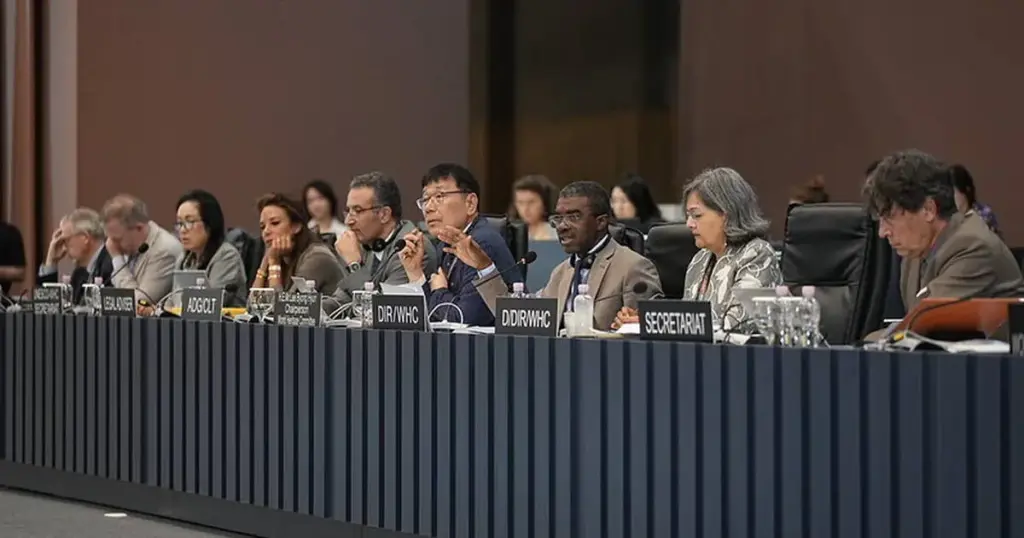
In a landmark development for global cultural and natural preservation, the 48th session of the UNESCO World Heritage Committee—convened in the vibrant coastal metropolis of Busan, Republic of Korea—has marked a watershed moment for underrepresented regions. For the first time in history, three sovereign nations—the Union of the Comoros, the Democratic Republic of São Tomé and Príncipe, and the Republic of South Sudan—have successfully inscribed properties onto the prestigious UNESCO World Heritage List.
This historic achievement represents far more than a bureaucratic expansion of an international registry; it signifies a profound structural correction in how humanity catalogs, acknowledges, and safeguards its shared legacy. For decades, the World Heritage List has faced sustained international critique for harboring a pronounced geographic and cultural bias, heavily favoring Western Europe and North America while systematically overlooking the rich tapestries of the Global South, particularly Africa and Small Island Developing States (SIDS).
The successful inscriptions in Busan—ranging from the intricate island-state sultanates of the Indian Ocean to the volcanic plantation landscapes of the Gulf of Guinea and the sprawling, wildlife-rich floodplains of East Central Africa—are the direct fruit of targeted multilateral intervention. Driven by UNESCO’s Priority Africa initiative, strategic institutional capacity-building, and sustained diplomatic engagement, the international community is actively dismantling historical inequities in heritage preservation.
Furthermore, this session brought sharp focus to the vulnerability of newly minted heritage sites, exemplified by South Sudan’s inclusion of a critical site directly onto the List of World Heritage in Danger. This decision underscores a dual commitment: not merely celebrating newly recognized treasures, but mobilizing immediate international rescue efforts for ecosystems and cultural zones threatened by conflict, climate volatility, and socio-economic stress. As the global community looks toward the implementation of the World Heritage Strategy for Small Island Developing States (SIDS) 2026–2034, the events in Busan signal the dawn of a more inclusive, globally representative era for international conservation.
Detailed Chronology: The Road to Representation in Busan
To fully appreciate the magnitude of the 48th session in Busan, one must examine the meticulous, multi-year diplomatic and technical groundwork that made these historic inscriptions possible. The journey from unrepresented status to World Heritage recognition is rarely swift; it demands rigorous scientific documentation, boundary demarcations, management plan formulation, and deep-seated political will from States Parties often grappling with immense domestic challenges.
The Decadal Struggle for Inclusivity
When the World Heritage Convention was adopted in 1972, its foundational aim was to protect cultural and natural sites of Outstanding Universal Value (OUV). However, the operationalization of the convention in its early decades inadvertently favored nations with established, highly-funded institutional frameworks for heritage management. Consequently, African nations and SIDS—many of which gained independence relatively late in the 20th century or have faced post-colonial instability—found themselves locked out of the global heritage discourse.
By the dawn of the 2020s, the disparity was stark. When the World Heritage Committee adopted the World Heritage Strategy for Africa (2022–2029) in 2021, a full twelve African nations possessed zero properties on the World Heritage List. This blank slate was not indicative of a lack of cultural or natural wealth, but rather a reflection of technical capacity gaps, financial constraints, and institutional deficits that hampered the preparation of complex nomination dossiers.
The 2021–2026 Acceleration Window
The intervening five years between the adoption of the 2022–2029 African strategy and the Busan session witnessed an unprecedented acceleration in technical assistance. UNESCO, alongside advisory bodies such as the International Council on Monuments and Sites (ICOMOS) and the International Union for Conservation of Nature (IUCN), deployed targeted advisory missions, capacity-building workshops, and peer-to-peer mentoring programs across the continent.
Through these intensive interventions, the number of African countries lacking representation on the World Heritage List was dramatically cut in half within just half a decade. Nations that had long languished on tentative lists—often waiting decades for their first breakthrough—were provided with the cartographic, anthropological, and ecological resources necessary to translate their national treasures into internationally compliant nomination dossiers.
The Busan Breakthrough: Three New Flags on the List
The deliberations in Busan served as the crucible where these years of preparation materialized into formal inscriptions. Three distinct nations crossed the threshold, each bringing a unique narrative to the global stage:
- The Comoros: With the inscription of the Medinas of the Historic Sultanates, this Indian Ocean archipelago nation showcased its unique position as a historic maritime crossroads where African, Arab, Persian, and Southeast Asian cultures converged. The dense, coral-stone urban fabrics of these historic settlements represent centuries of maritime trade, Islamic scholarship, and indigenous architecture.
- São Tomé and Príncipe: The inclusion of the Roças of São Tomé and Príncipe brought global visibility to the haunting, historically complex volcanic plantation landscapes of the Gulf of Guinea. These vast agricultural estates bear poignant witness to the harrowing history of colonial forced labor, the global agricultural commodity trade (particularly cocoa and coffee), and the unique socio-ecological adaptations that emerged in these isolated island ecosystems.
- South Sudan: Marking its debut as a World Heritage nation, South Sudan secured the inscription of the Boma-Badingilo Migratory Landscape. Representing one of the largest terrestrial mammal migrations on Earth—comparable in scale to the legendary Serengeti—this vast expanse of wooded grasslands and floodplains is a testament to the resilience of nature in a young nation recovering from decades of conflict. Notably, recognizing the acute pressures facing the region, the committee and the South Sudanese delegation proactively supported its simultaneous placement on the List of World Heritage in Danger, ensuring immediate international mobilization for its defense.
Supporting Context & Metrics: Closing the Global Heritage Gap
The achievements in Busan cannot be viewed in a vacuum; they are the mathematical and sociological result of structural policy shifts within UNESCO and its governing bodies. To understand the trajectory of the World Heritage List, one must analyze the quantitative dimensions of geographic representation and the strategic frameworks designed to correct historical imbalances.
Quantifying the Global South Deficit
For decades, the "Global North" dominated the World Heritage List, creating an asymmetric representation of human achievement and natural wonder. Sites in Europe and North America often enjoyed higher visibility, more robust state funding for conservation, and streamlined nomination pipelines. Conversely, African and SIDS nominations frequently stumbled at the preliminary evaluation stage due to stringent technical requirements, lack of baseline scientific data, and inadequate management infrastructure.
| Metric / Indicator | Historical Context (Pre-2021) | Current Status (Post-Busan 48th Session) | Strategic Direction |
|---|---|---|---|
| Unrepresented African Nations | 12 countries with zero properties | Reduced by 50% (6 countries remaining) | Continued implementation of Priority Africa (2022–2029) |
| Total Global Unrepresented States | 26 States Parties entirely absent from the List | Decreased following Busan historic inscriptions | Targeted capacity-building under new SIDS & African frameworks |
| SIDS Representation Focus | Historically marginalized due to small administrative footprints and unique vulnerability profiles | Centralized policy priority | Full roll-out of the SIDS Strategy (2026–2034) |
| In Danger Classifications | Often viewed purely punitively | Utilized as a strategic tool for emergency mobilization and resource channeling | Enhanced international solidarity and technical aid |
The Mechanics of the Priority Africa Initiative
The Priority Africa initiative serves as the overarching institutional umbrella guiding UNESCO’s programmatic interventions across the continent. Recognizing that heritage conservation is inextricably linked to sustainable development, poverty alleviation, and peacebuilding, the initiative recalibrates how international aid is distributed.
Rather than waiting for developing nations to independently produce flawless nomination dossiers, UNESCO’s Heritage Division, supported by extra-budgetary funds from donor member states, actively co-creates the institutional infrastructure required for long-term site management. This includes training local conservators, establishing university-level heritage management curricula, engaging indigenous local communities in participatory governance, and deploying advanced remote-sensing technologies to monitor environmental degradation.
Addressing the SIDS Vulnerability Matrix
Small Island Developing States face an existential crisis that compounds the challenges of heritage management. Ranging from rising sea levels and intense tropical cyclones to rapid coastal erosion and limited domestic tax bases, SIDS often struggle to maintain the physical integrity of cultural and natural sites.
The adoption of the World Heritage Strategy for Small Island Developing States (2026–2034) at the 48th session in Busan is a direct acknowledgment of these unique vulnerabilities. The strategy establishes a dedicated framework to assist the 26 remaining unrepresented States Parties—many of which are island nations in the Caribbean, Pacific, and Indian Oceans—by providing specialized risk-preparedness modules, climate adaptation funding, and streamlined legal assistance to help them navigate the complex mechanics of the 1972 World Heritage Convention.
Official Statements and Institutional Perspectives
The historic nature of the 48th session drew impassioned commentary from high-ranking international officials, state delegates, and conservation leaders, highlighting the deep emotional and geopolitical resonance of the Busan inscriptions.
South Sudan’s Historic Entry: A Dual Victory
In an address that resonated deeply across the plenary hall, representatives of the Republic of South Sudan framed their nation’s debut on the World Heritage List not merely as a technical triumph, but as an essential pillar of national identity and reconciliation. Addressing the committee regarding the inscription of the Boma-Badingilo Migratory Landscape, the delegation stated:
"The inscription of this property, including its placement on the World Heritage List in Danger, strengthens our resolve to work even more closely with UNESCO and the international community to conserve its Outstanding Universal Value for the benefit of present and future generations. Through this inscription, South Sudan joins the family of World Heritage nations. This inscription is not only a victory for our people but also a contribution to humanity’s shared heritage and our collective responsibility to protect it."
This official statement encapsulates the philosophical maturation of modern conservation: the understanding that designating a site as "in danger" is not an admission of failure, but a clarion call for international solidarity. By accepting international oversight alongside World Heritage status, South Sudan has signaled to the global community that its natural heritage belongs to all of humanity, requiring cross-border cooperation to safeguard the irreplaceable ecosystems of the White Nile basin and the Greater Upper Nile regions.
Leadership and Strategic Vision: Driving Structural Reform
The institutional momentum witnessed in Busan is heavily attributed to the strategic alignment between UNESCO’s leadership and the member states of the World Heritage Committee. Under the overarching stewardship of UNESCO Director-General Khaled El-Enany, the organization has placed a renewed, uncompromising emphasis on geographic equity.
Speaking on the sidelines of the Busan sessions, international heritage experts underscored that El-Enany’s administrative vision has centered on dismantling the systemic barriers that prevent under-resourced nations from accessing the normative frameworks of the 1972 Convention. By redirecting technical expertise toward the 26 remaining unrepresented States Parties, UNESCO is actively transforming the World Heritage List from an exclusive club of heavily documented monuments into a truly global inventory of human civilization and planetary biodiversity.
Furthermore, advisory bodies such as IUCN and ICOMOS praised the rigorous yet supportive evaluation processes deployed in Busan. Conservation scientists noted that the successful navigation of complex dossiers—such as the multi-component Roças of São Tomé and Príncipe or the fragile coral architectures of the Comoros—demonstrates that rigorous scientific standards can be maintained while simultaneously expanding geographic representation.
Future Outlook: The Horizon of Global Conservation
As the 48th session of the World Heritage Committee draws to a close, the international conservation community must look beyond the celebratory atmosphere of Busan and confront the formidable challenges that lie ahead. The inscription of properties in the Comoros, São Tomé and Príncipe, and South Sudan is not the destination, but the starting line for a new chapter in global heritage stewardship.
Implementing the SIDS Strategy (2026–2034)
The immediate operational test for UNESCO and its partners will be the rollout and implementation of the World Heritage Strategy for Small Island Developing States (2026–2034). With island nations standing on the absolute frontlines of anthropogenic climate change, the strategy must rapidly transition from a diplomatic text on paper into tangible, on-the-ground resilience projects.
This will require robust financial commitments from donor nations to capitalize the World Heritage Fund, specialized technical training for island-based heritage managers, and the integration of indigenous ecological knowledge into modern coastal defense and architectural conservation plans. The goal is clear: ensure that the next generation of SIDS nominations are not only successfully inscribed, but adequately armored against rising seas and extreme weather events.
The Campaign for the Remaining 26 Unrepresented States
While cutting the number of unrepresented African nations in half over five years is a monumental achievement, the broader global landscape still features 26 States Parties with zero representation on the World Heritage List. The momentum generated in Busan must be leveraged to sustain technical assistance missions to these remaining nations—spanning pockets of the Pacific, the Caribbean, Africa, and Central Asia.
Achieving universal representation is not merely a quantitative quota to be checked off a bureaucratic spreadsheet; it is an ethical imperative. Every human community, regardless of its current economic status or geopolitical influence, has contributed to the tapestry of human history and acts as a custodian of vital planetary ecosystems. Bringing these remaining 26 nations into the fold will fundamentally enrich our collective understanding of history, architecture, anthropology, and ecology.
Safeguarding Heritage in Zones of Fragility
The dual inscription of South Sudan’s Boma-Badingilo Migratory Landscape onto both the World Heritage List and the List of World Heritage in Danger serves as a sobering reminder of the intersection between conflict, instability, and conservation. In an era marked by geopolitical friction and regional conflicts, natural and cultural heritage sites frequently become collateral damage.
The international community must evolve its mechanisms for protecting heritage in fragile and post-conflict states. This demands innovative financing models, rapid-response conservation units, community-based ranger networks, and robust diplomatic engagement to ensure that armed conflict does not permanently erase irreplaceable chapters of human and natural history.
Conclusion
The 48th session of the World Heritage Committee in Busan will be remembered as the moment the international community took a decisive step toward true global inclusivity. By welcoming the Comoros, São Tomé and Príncipe, and South Sudan into the family of World Heritage nations, the world has acknowledged that humanity’s shared story is vast, diverse, and deeply interconnected. As we look toward the horizon of the Priority Africa milestones and the SIDS Strategy 2026–2034, the mandate for the global community is unmistakable: to identify, protect, celebrate, and keep alive the manifold treasures of our shared planet for all generations to come.