On June 25, 2026, the Castellers de Barcelona—one of Catalonia’s most prestigious human-tower building groups (colles castelleres)—achieved the unthinkable. At an staggering altitude of 3,454 meters (11,332 feet) above sea level, approximately 200 members of the colla successfully raised a traditional human tower (castell) at the Jungfraujoch, famously known as the "Top of Europe," nestled deep within the Swiss Alps.
This breathtaking feat shattered the previous world record for the highest altitude ever recorded for a full castell performance, a milestone previously held on the slopes of Spain’s Aneto peak. More than merely an exercise in athletic prowess and statistical achievement, the event served as a monumental cultural diplomacy mission. Supported by Switzerland Tourism and facilitated by sustainable public transit infrastructure—including the Swiss Travel Pass and the panoramic GoldenPass Express—the expedition wove together Catalan intangible cultural heritage, international solidarity, and alpine adventure.
Spanning historic sites from the shores of Lake Geneva to the Olympic capital of Lausanne and the urban elegance of Neuchâtel, the expedition transcended sports and folklore. It stood as a powerful testament to human cooperation, environmental mindfulness, and the boundless adaptability of a centuries-old tradition recognized globally by UNESCO as Intangible Cultural Heritage of Humanity.
Detailed Chronology: The Journey to the Top of Europe
The historic June 2026 expedition was meticulously planned, functioning as a multi-stage cultural and athletic odyssey across some of Switzerland’s most iconic landscapes. The chronology of the journey highlights not only the logistics of moving 200 castellers internationally but also the emotional and symbolic high points of their itinerary.
Phase 1: Arrival and Sustainable Mobility
The logistical backbone of the expedition relied heavily on sustainable, seamless public transportation. Upon arriving in Switzerland, the Castellers de Barcelona partnered with Switzerland Tourism to utilize the Swiss Travel Pass. This collaboration emphasized a shared commitment to eco-friendly tourism, allowing the massive troupe of nearly 200 participants to traverse Switzerland’s complex network of trains, buses, and boats without placing a heavy carbon footprint on the pristine alpine environment.
Before tackling the ultimate vertical challenge in the high mountains, the troupe boarded the legendary GoldenPass Express. This world-renowned panoramic train seamlessly connects Interlaken with Montreux, carrying passengers through dramatic elevation shifts, sweeping valley floors, and sun-drenched vineyards. For the castellers, the train journey served as both a team-building retreat and an immersive introduction to Swiss geography, setting the stage for the cultural exchanges that would follow.
Phase 2: The Shores of Lake Geneva and the Chillon Castle
The expedition’s first major public manifestation of Catalan culture took place at the historic Chillon Castle (Château de Chillon), dramatically situated on a rocky islet along the banks of Lake Geneva (Lac Léman) near Montreux.
Against the backdrop of medieval stone ramparts and the deep blue expanse of the lake framed by towering peaks, the castellers performed their initial displays. Passersby and international tourists watched in awe as the human structures rose effortlessly against centuries of European history, bridging medieval Swiss architecture with Catalan performance art.
Phase 3: The Olympic Spirit and Global Solidarity in Lausanne
Moving onward to Lausanne, the recognized Olympic capital of the world and home to the headquarters of the International Olympic Committee (IOC), the colla elevated their artistic mission into the realm of international diplomacy and historical memory.
Outside the majestic Olympic Museum, the Castellers de Barcelona raised multiple castells. This performance carried profound historical weight: the group proudly unfurled and utilized the exact same flag that had waved during the grand opening ceremony of the 1992 Barcelona Olympic Games, invoking an enduring spirit of global unity and peaceful competition.
In a poignant display of modern global empathy, the Lausanne performance also featured a specialized pillar (pilar) dedicated to the people of Venezuela, flying the Venezuelan flag in solidarity with the victims of a recent, devastating earthquake. This moment underscored a core ethos of the casteller movement: human towers are built on mutual trust, community care, and an unwavering sensitivity to human suffering across borders.
Phase 4: The Record-Breaking Ascent at Jungfraujoch
The apex of the entire expedition arrived on June 25, 2026, at the Jungfraujoch – Top of Europe. Situated at 3,454 meters, the Jungfraujoch houses the highest railway station in Europe, cutting through the core of the Eiger and Mönch mountains and opening up panoramic vistas of the UNESCO-protected Aletsch Glacier—the largest glacier in the Alps.
Performing at this altitude introduces physiological variables that few athletes or performers ever have to navigate. With significantly reduced atmospheric pressure and lower oxygen availability, the human body experiences rapid fatigue, dizziness, and shortness of breath. For a castell, where stability, precise balance, explosive strength, and absolute synchronization are matters of safety, these environmental hazards are multiplied exponentially.
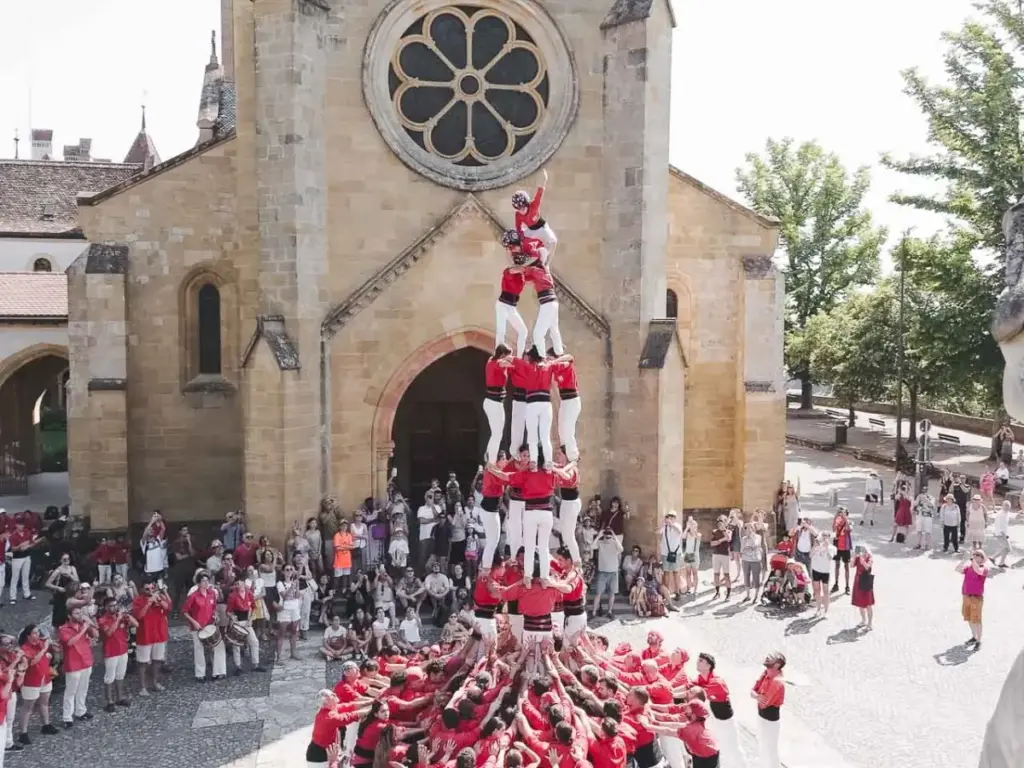
Yet, nearly 200 members of the Castellers de Barcelona executed their formations with clinical precision. When the crowning enxaneta (the young child who climbs to the very top) raised their hand to signal the completion of the tower (l’aleta), history was made. Surpassing the previous record set on the Aneto peak, the Jungfraujoch performance officially established the highest-altitude castell ever successfully completed in human history.
Phase 5: The Grand Finale in Neuchâtel
Following their triumphant descent from the roof of Europe, the expedition concluded in the charming lakeside city of Neuchâtel.
Blending urban culture with natural beauty, the colla performed multiple castells in the heart of the city’s historic center—flanked by the medieval stone towers of the Castle of Neuchâtel—as well as directly along the breezy quays of Lake Neuchâtel. It provided a jubilant, harmonious conclusion to a journey that had successfully taken Catalan culture from the Mediterranean coast to alpine glaciers and medieval lakeside towns.
Supporting Context & Metrics
To fully appreciate the magnitude of what the Castellers de Barcelona achieved at the Jungfraujoch, one must examine the logistical, technical, and environmental metrics underlying the endeavor.
The Physics and Physiology of High-Altitude Castells
Oxygen Level: At this elevation, atmospheric pressure drops significantly, reducing the effective oxygen intake by roughly 30% compared to sea level.
Participant Count: Approximately 200 active members of the colla traveled to Switzerland, requiring synchronized coordination for lodging, transport, safety equipment, and nutrition.
Previous Record: The prior altitude benchmark was achieved on the Aneto peak (3,404 meters in the Pyrenees), making the Jungfraujoch ascent a breakthrough into a harsher, more rarefied ecological zone.
Sustainable Tourism and Infrastructure
The partnership with Switzerland Tourism and the reliance on the Swiss Travel Pass were not incidental details, but rather core components of the expedition’s philosophy. Transporting 200 people across international borders and through sensitive alpine biospheres carries a substantial ecological footprint. By committing exclusively to Switzerland’s world-class public electric rail networks—including mountain cogwheel trains and panoramic coaches like the GoldenPass Express—the Castellers de Barcelona minimized their carbon emissions, proving that large-scale cultural tourism and ecological stewardship can coexist harmoniously.
Official Statements and Cultural Reflections
The unprecedented success in Switzerland elicited widespread praise from cultural institutions, tourism boards, and leadership within the casteller community.
"Reaching 3,454 meters is not merely a number or a line in a record book; it is a testament to what human resilience, collective trust, and deep-rooted cultural identity can accomplish," noted a senior representative of the Castellers de Barcelona during the post-expedition gala. "When you build a human tower, you are entirely dependent on the person beside you, beneath you, and above you. Doing that where the air is thin, surrounded by the eternal ice of the Alps, amplifies the symbolic power of our tradition tenfold."
Cultural analysts have similarly lauded the initiative as a masterclass in modern cultural diplomacy. By embedding their traditional folklore within the institutional framework of Lausanne’s Olympic heritage, the historic narrative of Chillon Castle, and the breathtaking geography of the Jungfraujoch, the castellers demonstrated that traditional intangible heritage does not belong solely in museums or local town squares. Instead, it is a living, breathing language capable of fostering international dialogue, ecological awareness, and cross-cultural empathy.
Future Outlook: The Global Horizon of Castells
The successful conquest of the Jungfraujoch marks a watershed moment for the global casteller movement. Over the past three decades, human towers have evolved from a fiercely guarded regional tradition of rural and urban Catalonia into a recognized global phenomenon, with colles establishing roots in cities as diverse as London, Paris, Montreal, Sydney, and New York.
By pushing the geographical and physical boundaries of where a castell can be erected, the Castellers de Barcelona have opened a new chapter for the tradition. Future expeditions will undoubtedly look to challenge new frontiers, but the 2026 Swiss tour has set an exceptionally high bar—both literally and figuratively.
As climate change and environmental degradation increasingly threaten delicate alpine ecosystems, the expedition’s strict adherence to sustainable rail transit also establishes a crucial precedent for future cultural tours. It signals to international arts organizations and athletic bodies that large-scale global mobility can, and must, prioritize environmental preservation.
Ultimately, the image of nearly two hundred individuals locking arms, lifting one another onto their shoulders, and raising a fragile, living tower of human solidarity against the blinding white majesty of the Swiss Alps will endure. It is a powerful reminder that regardless of whether one stands at sea level in the Mediterranean or on the roof of Europe at 3,454 meters, the most resilient structures we build are those rooted in trust, community, and shared humanity.