









When tracking a long-haul international flight on a modern in-flight entertainment map, passengers frequently notice their aircraft tracing a path far to the north, occasionally appearing to graze the geographic North Pole. Major trunk routes linking North America, Europe, and Asia routinely cut across Greenland, northern Canada, and the high-altitude expanses of the Arctic Ocean. Yet, despite the steady normalization of polar routing in the Northern Hemisphere, scheduled commercial airliners almost never fly over Antarctica—even when completing ultra-long-haul journeys connecting major population centers in the Southern Hemisphere.
While both polar regions share extreme cold, isolation, and stark topography, only the Arctic has evolved into a practical, highly efficient, and economically viable corridor for contemporary commercial aviation. The absence of routine commercial flight paths across Antarctica is not the result of a single prohibitive rule, but rather the convergence of complex geographic realities, global travel demand, stringent safety mandates, severe environmental hazards, and historical development patterns.

The Geography of Flight: Great Circles and Earth’s Asymmetry
To understand why aircraft fly over the Arctic but avoid Antarctica, one must first examine how pilots chart their courses. Airplanes do not navigate along the flat, straight lines depicted on standard Mercator map projections. Instead, they follow great-circle routes, which represent the absolute shortest distance between two points on the surface of a three-dimensional sphere.
On a standard flat map, a great-circle route often appears dramatically curved, arching upward toward the poles. Because the landmasses and economic powerhouses of the Northern Hemisphere—specifically North America, Europe, and East Asia—are tightly clustered around northern latitudes, great-circle routing naturally pulls intercontinental flights into the high north.
For instance, flights operating between major global aviation hubs such as New York (JFK) and Hong Kong (HKG), London Heathrow (LHR) and Tokyo Haneda (HND), or Chicago O’Hare (ORD) and Beijing Capital (PEK) find that a transarctic trajectory slashes hundreds of miles off their total trip distance compared to lower-latitude alternatives.

+-------------------------------------------------------------------------+
|                  TYPICAL TRANSARCTIC VS. SOUTHERN ROUTING               |
+--------------------------+----------------------------------------------+
| Northern Hemisphere      | Great-circle routes naturally pass through   |
| (Arctic Corridors)       | high latitudes, saving hundreds of miles     |
|                          | and significant fuel burn.                   |
+--------------------------+----------------------------------------------+
| Southern Hemisphere      | Major city pairs (e.g., Sydney to Santiago)  |
| (Antarctic Corridors)    | curve southward, but shortest paths remain   |
|                          | over open ocean rather than the continent.   |
+--------------------------+----------------------------------------------+
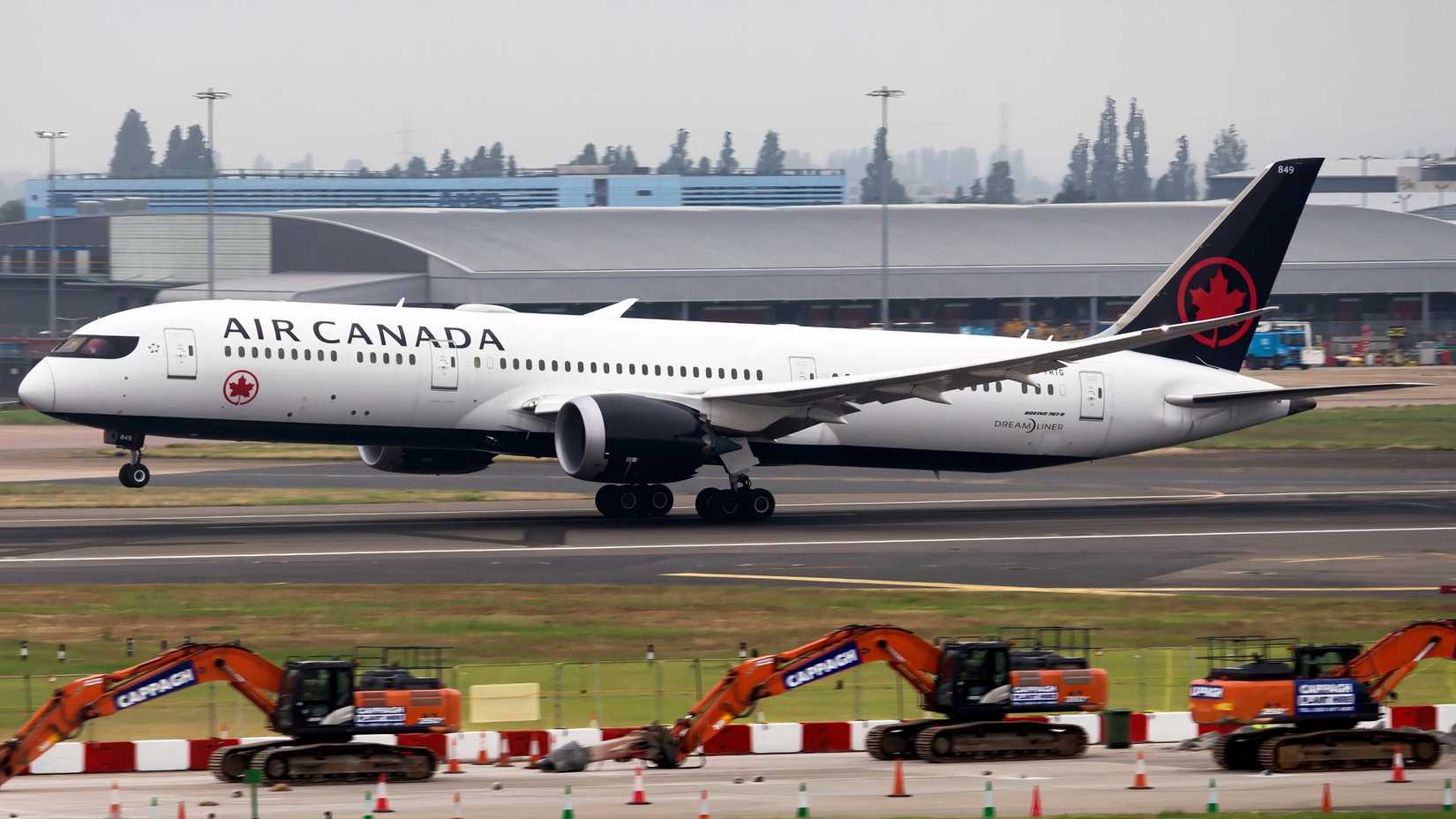
These distance savings translate directly into reduced fuel burn, shorter block times, and substantially lower operating costs. Consequently, major international operators—including Cathay Pacific, All Nippon Airways, Korean Air, United Airlines, Air Canada, and Lufthansa—routinely utilize polar tracks to maintain competitive schedules.
In the Southern Hemisphere, however, global geography dictates a completely different geometry. Major metropolitan centers such as Sydney, Johannesburg, Santiago de Chile, and Auckland are positioned in such a way that great-circle routes connecting them do curve southward, but typically not far enough to justify crossing the Antarctic landmass. In most cases, the absolute shortest path remains over open, deep ocean waters rather than across the continent itself.
Global Travel Demand and Economic Realities
The prominence of the Arctic in modern aviation is heavily reinforced by global demographics and economic output. The Northern Hemisphere accounts for the overwhelming majority of the world’s human population, industrial production, and commercial air travel demand—both in terms of passenger volume and high-value cargo.

The airspace connecting North America, Europe, and Asia is consequently among the busiest and most heavily instrumented on Earth. This immense traffic flow supports frequent, highly optimized intercontinental schedules.
Antarctica, by sharp contrast, possesses no permanent indigenous population, no municipal infrastructure, and virtually zero commercial passenger demand. There are no origin or destination consumer markets to justify scheduled airline service, and very few global city pairs would benefit in a meaningful way from an Antarctic overflight. Without baseline commercial demand to underwrite operational costs, airlines have no financial incentive to absorb the immense risks and regulatory hurdles associated with establishing routes across the southernmost continent.
ETOPS Constraints and the Divergence of Diversion Infrastructure
Modern long-haul commercial aviation operates under some of the strictest safety regulations in transportation history, chief among them being ETOPS (Extended-range Twin-engine Operational Performance Standards). ETOPS governs how far a twin-engine aircraft—such as the Boeing 787 Dreamliner or Airbus A350—is legally permitted to fly from a suitable, fully certified diversion airport in the event of an engine failure, onboard fire, or medical emergency.

Depending on its precise regulatory certification, a modern widebody aircraft may be cleared to operate 180, 240, or even 330 minutes away from an alternate airport. However, even with extended ETOPS ratings, flight dispatchers must always have access to a network of reliable, fully equipped diversion airports along or adjacent to the route.
The Arctic Advantage
The Arctic benefits from a robust ring of established diversion infrastructure situated across northern Canada, Alaska, Greenland, Iceland, and Scandinavia. Airports such as:
- Ted Stevens Anchorage International (ANC) and Fairbanks International (FAI) in Alaska, USA
- Iqaluit Airport (YFB) in Nunavut, Canada
- Keflavík International Airport (KEF) in Iceland
- Svalbard Airport (LYR) in the high Arctic of Norway
These facilities are fully instrumented, continually maintained, and manned by personnel capable of handling widebody emergency diversions. While operating conditions in these regions can be severe, they provide a vital safety net that satisfies regulatory authorities.
The Antarctic Void
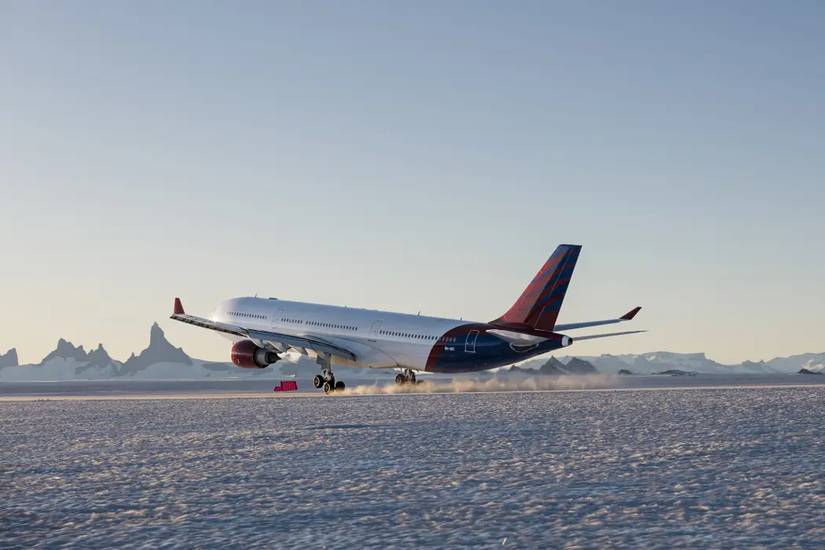
Antarctica offers no comparable network. The continent features only a scattering of military, governmental, and scientific research airstrips. Many of these landing sites are constructed directly on glacial blue ice, operate purely on a seasonal basis, lack advanced instrument landing systems, and remain completely at the mercy of volatile polar weather.
Because these makeshift airstrips are entirely uncertified for commercial airline operations, an aircraft flying across Antarctica would find itself operating in a vast ETOPS dead zone—an area with virtually zero viable diversion options. For airline safety departments and civil aviation authorities, this absence of infrastructure makes Antarctic flight planning a non-starter.
Severe Environmental Challenges and Operational Hazards
While both polar caps are synonymous with freezing temperatures, the Antarctic environment is structurally and meteorologically more extreme than its northern counterpart.

Antarctica is officially the coldest, driest, and windiest continent on Earth. Surface temperatures across the high interior plateau can plummet below -60°C (-76°F), while katabatic winds regularly sweep down the slopes at hurricane force, generating sudden, blinding whiteout conditions. Furthermore, meteorological forecasting over the Antarctic interior is inherently imprecise due to a chronic shortage of permanent surface observation stations and radar coverage.
+-------------------------------------------------------------------------+
|                  COMPARISON OF POLAR AVIATION ENVIRONMENTS              |
+------------------+--------------------------+---------------------------+
| Feature          | Arctic Operations        | Antarctic Operations      |
+------------------+--------------------------+---------------------------+
| Infrastructure   | Robust network of        | Minimal/non-existent;     |
|                  | certified diversion      | seasonal ice strips       |
|                  | airports                 | uncertified for airlines  |
+------------------+--------------------------+---------------------------+
| Weather          | Moderated by surrounding | Extreme winds (katabatic),|
| Predictability   | landmasses and oceans;   | temperatures below -60°C, |
|                  | extensive radar coverage | sparse observation posts  |
+------------------+--------------------------+---------------------------+
| Solar Conditions | Normal polar day/night   | Months of near-total      |
|                  | cycles with established  | darkness during Southern  |
|                  | communication relays     | Hemisphere winter         |
+------------------+--------------------------+---------------------------+
By contrast, the Arctic benefits from surrounding landmasses and warmer oceanic currents that partially moderate regional extremes. Decades of institutional aviation experience, coupled with dense satellite tracking and meteorological data sharing, allow flight dispatchers to manage Arctic operations with high confidence.
Additionally, extreme seasonal darkness poses unique operational hazards. During the Southern Hemisphere winter, Antarctica experiences months of uninterrupted polar night. In an emergency scenario, conducting a forced landing or executing a search-and-rescue operation in pitch darkness over featureless, frozen terrain introduces unacceptable risks.

Historical Context and Cold War Catalysts
Commercial polar aviation is a relatively recent phenomenon. Early piston-engine and early-generation jet aircraft lacked the range, fuel efficiency, navigation redundancy, and cold-weather reliability required to operate safely over isolated wilderness.
The acceleration of Arctic aviation was heavily catalyzed by geopolitical tensions during the Cold War. Military planners in North America recognized that the shortest strategic flight paths between the United States and the Soviet Union cut directly across the Arctic Circle. This realization drove heavy government and military investment into northern navigation aids, weather stations, and communications networks.
When commercial deregulation and technological advancements converged in the 1990s, airlines like Northwest Airlines capitalized on this pre-existing infrastructure to pioneer modern transpolar routes linking North America directly to Asian mega-cities. Using long-range widebody workhorses such as the McDonnell Douglas DC-10 and Boeing 747-400, carriers proved that polar shortcuts were commercially viable and operationally secure.

Antarctica, conversely, never experienced a comparable geopolitical or strategic push during the formative decades of commercial jet aviation. Unshackled from Cold War transit imperatives, the southernmost continent remained strictly preserved for international scientific cooperation under the Antarctic Treaty, entirely bypassing the developmental trajectory of global airline routes.
Modern Southern Hemisphere Operations: Near, But Not Over
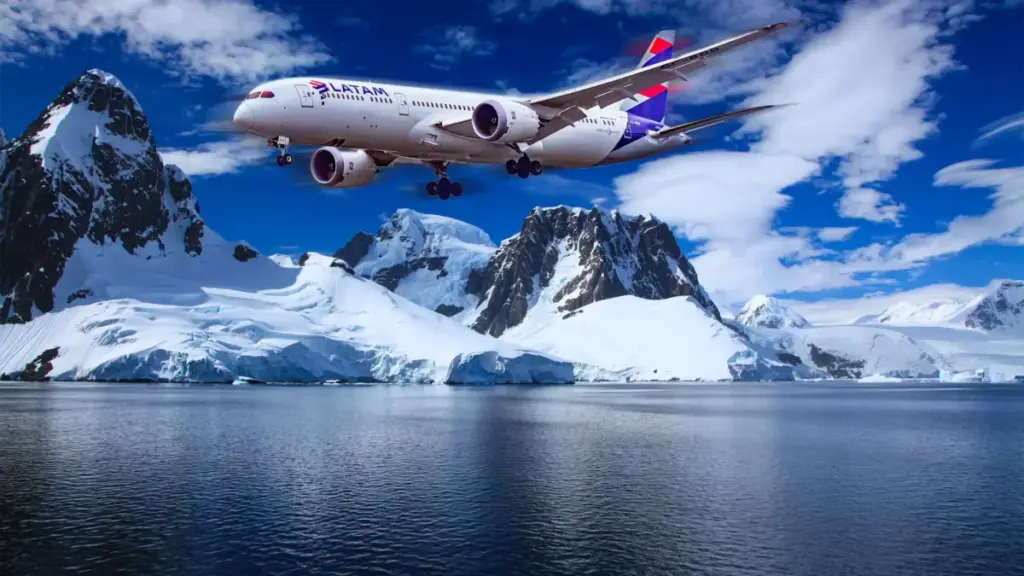
While scheduled commercial airliners avoid flying directly across the Antarctic landmass, certain ultra-long-haul routes in the Southern Hemisphere pass close enough to its periphery to offer passengers distant views of the continent’s icy margins.
Prominent examples include trans-Tasman and trans-Pacific services operated by carriers such as Qantas and LATAM Airlines. Flights linking Sydney (SYD) to Santiago (SCL), or Auckland (AKL) to Santiago, frequently dip far to the south, riding high-altitude jet streams that skirt the edge of Antarctic airspace depending on daily weather conditions.

Fleet Profiles for Southern Long-Haul Routes
These demanding routes are predominantly operated by highly efficient widebody twins, such as the Boeing 787-9 Dreamliner. Below is a comparative breakdown of the Boeing 787-9 fleet and cabin configurations utilized by primary operators on these deep-south corridors:
| Airline | Aircraft Type | Active Fleet | On Order | Business Class | Premium Economy | Economy Class | Total Capacity |
|---|---|---|---|---|---|---|---|
| Qantas | Boeing 787-9 | 14 | 4 | 42 | 28 | 166 | 236 |
| LATAM Airlines | Boeing 787-9 | 25 | 15 | 30 | 57 | 216 | 303 |
Source: Airline fleet data and aeroLOPA configurations.
The Shadow of History: Flight 901
Specialized aviation does occur over Antarctica, but it is strictly restricted to government logistics, scientific support missions utilizing specialized military transports like the C-17 Globemaster and ski-equipped LC-130, and highly regulated expeditionary tourism.
The inherent dangers of Antarctic aviation were tragically underscored on November 28, 1979, during Air New Zealand Flight 901. The flight was a popular sightseeing excursion operating a McDonnell Douglas DC-10 from Auckland across the Ross Dependency and back, carrying 257 passengers and crew on a low-altitude scenic loop over the continent.
While descending through cloud cover near Mount Erebus on Ross Island, the aircraft struck the snow-covered mountainside, resulting in the loss of all souls on board. Subsequent investigations revealed that a late-night digital adjustment to the aircraft’s flight management coordinates, combined with a severe whiteout optical illusion, caused the flight crew to believe they were flying over flat sea ice rather than rising volcanic terrain. The disaster permanently halted commercial sightseeing flights to Antarctica and cemented the aviation industry’s cautious approach toward the region’s unique geographical hazards.
Future Outlook
Looking ahead, the operational paradigm separating the two polar regions is unlikely to shift. While advancements in satellite communications, avionics, and ultra-long-range aircraft engineering continue to expand the boundaries of commercial route planning, the fundamental economic and geographical drivers remain firmly entrenched.
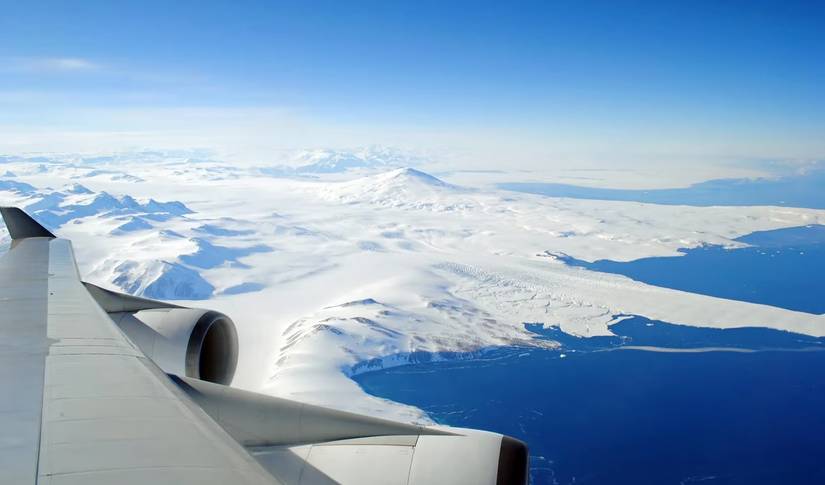
The Arctic will continue to serve as a vital, highly optimized global highway connecting the major economic powerhouses of the Northern Hemisphere, saving carriers millions of gallons of fuel annually. Antarctica, protected by its remote geography, extreme meteorological volatility, absolute lack of diversion infrastructure, and absence of local market demand, will remain an untouched frontier—an awe-inspiring expanse glimpsed only from afar by passengers soaring across the southern oceans.