





Yet, within just four days, Strawberry was back online.
The remarkably swift recovery was not the result of a dense crisis-management binder or a rigid regulatory framework. Instead, Kari Anna Fiskvik, Strawberry’s Chief Digital and Technology Officer, credits the human element: a team of agile professionals who knew exactly what systems mattered most and possessed the autonomy to act.
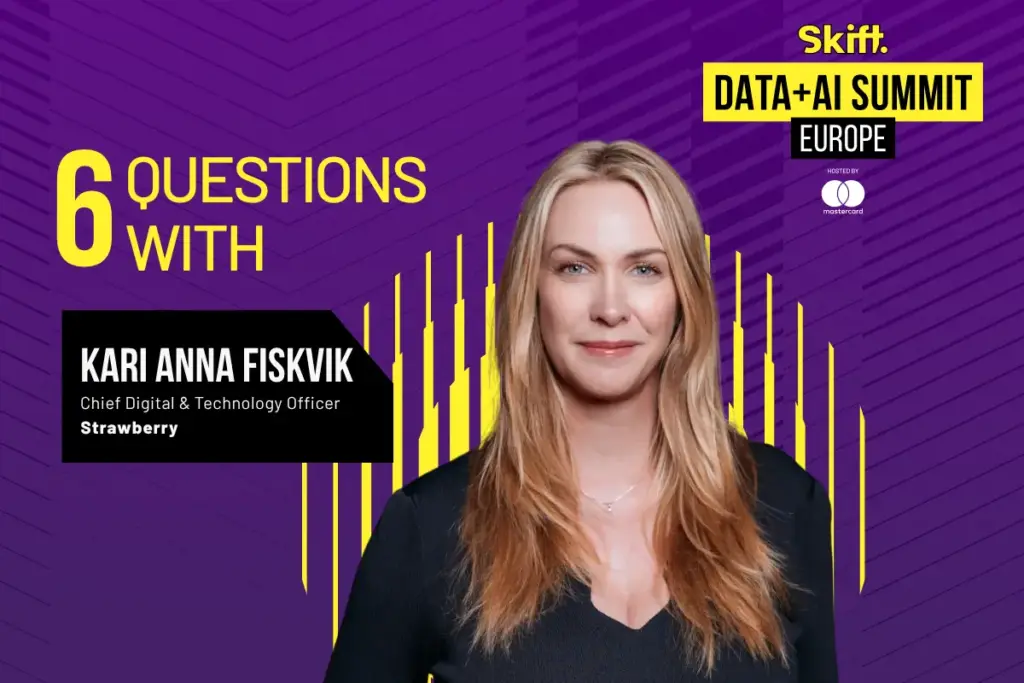
This trial by fire shaped Fiskvik’s pragmatic, grounded approach to technology—an approach she will bring to the stage at the upcoming Skift Data + AI Summit Europe on October 6, 2026, at Mastercard London. Speaking alongside industry heavyweights like Bryan Batista of Skyscanner and Benjamin Cany of Amadeus, Fiskvik is set to challenge the prevailing hype surrounding artificial intelligence in travel.
Ahead of the summit, Fiskvik shared her insights on why clean data architecture must always precede the deployment of complex AI models, the realities of European tech regulation, and where AI must first prove its financial worth.
The Danger of "Faster Chaos": Why Infrastructure Outranks the Model
In the current tech landscape, travel brands are racing to adopt generative AI models, often viewing them as a silver bullet for customer service and operational efficiency. However, Fiskvik warns that this rush is built on a fundamental misunderstanding of how artificial intelligence operates.
"If I have to pick the single most important factor for successfully scaling AI in travel operations, it is unified, clean data and the architecture that lets it move freely between systems," Fiskvik says. While she acknowledges that organizational curiosity, resources, and a willingness to experiment are vital, she emphasizes that these efforts yield nothing if the underlying data remains fragmented across disconnected, legacy silos.
Fiskvik describes AI not as a magic cure, but as a force multiplier. "Multiply clean, structured, real-time guest data and you get faster, better decisions," she explains. "Multiply chaos—inconsistent records, systems that don’t talk to each other, three departments each holding a different piece of the guest’s history—and you just get faster chaos."
This perspective refutes the popular industry narrative that mid-sized travel brands can simply build proprietary AI models to bypass major distribution platforms. Fiskvik calls this ambition naive. In an era where tech giants like Google are integrating direct hotel bookings into advanced AI interfaces, the properties that succeed will not be those with the most complex proprietary algorithms, but those whose underlying data is clean and structured enough to feed these external platforms seamlessly.
"The model is rapidly becoming a commodity," Fiskvik argues. "Your data, and the plumbing underneath it, are not. A broken guest journey is almost always an architecture, data, and infrastructure problem wearing a costume."
Lessons From the 2021 Conti Attack: Human Agency Over Bureaucracy
Fiskvik’s skepticism toward rigid, paperwork-heavy solutions is deeply rooted in Strawberry’s response to the 2021 Conti ransomware attack. As European regulators increasingly focus on establishing strict guardrails for artificial intelligence through frameworks like the EU AI Act, Fiskvik cautions against confusing administrative compliance with genuine security and operational resilience.
While she acknowledges that regulatory standards—such as labeling AI-generated content and conducting rigorous risk assessments to prevent prompt injections—are necessary to protect consumer interests, she believes there is a critical disconnect in how these policies are enforced.
"I would be lying if I said the paperwork never stings," Fiskvik admits. "But where I would push back is on the assumption that more paperwork automatically means more safety. It doesn’t."
Reflecting on the 2021 crisis, she notes that no compliance binder could have substituted for the rapid, decisive actions of her team. "What got us back online within four days wasn’t a compliance binder; it was people who understood exactly what mattered and acted on it. I would like to see regulators spend as much energy on whether a rule actually works as they currently spend on whether it is documented."
For travel leaders, this distinction is critical. Implementing AI policies on paper does not guarantee protection against sophisticated cyber threats or systemic operational failures. True resilience requires cultivating human expertise and deep contextual understanding alongside technological guardrails.
Deconstructing the AI Vendor Hype in Hospitality
The hospitality sector has been inundated with tech vendors pitching AI-driven tools promised to revolutionize everything from revenue management to guest relations. Fiskvik urges travel operators to approach these pitches with a healthy dose of skepticism.
"The most common misconception is that more AI automatically translates to greater efficiency or an elevated guest experience," she says. At Strawberry, every proposed technological integration is subjected to a simple but rigorous test: Does this tool genuinely provide tangible value to guests or employees, or are we building it simply because the technology exists?
"Those are two very different projects wearing the same jacket," Fiskvik notes.
Furthermore, Fiskvik points out that the incentives of tech vendors do not always align with the operational realities of running a hotel group. "It is worth saying plainly: a good number of the AI vendors approaching hotels right now are not primarily in the business of fixing your guest journey. They are in the business of raising their next funding round."
Ultimately, hospitality remains a physical business. While digital interfaces can streamline search, discovery, and check-in processes, the core of the hotel experience is delivered by human beings on property. Fiskvik warns against automating away the human touch that defines high-quality service: "Just because we can build a model capable of replacing a person doesn’t mean we should."
The Social Responsibility of Automation: Safeguarding the Next Generation
As AI automates routine tasks, it raises significant questions about the future of employment in hospitality—a sector historically celebrated for providing accessible entry-level jobs. For Strawberry, which operates under a "people, planet, profit" corporate philosophy, this shift is approached with immense caution.
"The biggest threat is what AI does to us as employers, which is a very important role we have in society," Fiskvik says. "We don’t want AI to replace all junior roles. Young people deserve to work, and they have to start and learn somewhere."
If entry-level administrative and customer service roles are completely automated, the pipeline for developing future industry leaders could dry up. To counter this, Strawberry is actively designing strategies that leverage AI to increase operational efficiency without eliminating the vital learning opportunities that junior roles provide. Fiskvik believes it is the responsibility of every major employer to actively manage this transition, ensuring that technological progress does not come at the cost of social sustainability.
The Battleground of Conversion: Turning Inquiries into Bookings
When asked where AI can deliver the most immediate and significant return on investment, Fiskvik points directly to conversion. The primary financial opportunity for hotels lies in using AI to eliminate friction during the booking process, turning immediate guest inquiries into finalized reservations.
Strawberry has already proven the viability of this approach at its upscale property, Villa Copenhagen. Visitors to the hotel’s website interact with "Vivi," an AI-driven digital concierge. Unlike traditional chatbots that offer generic assistance or prompt users to "contact the property for availability," Vivi is integrated directly into the hotel’s reservation architecture.
If a guest asks Vivi for a double room in October, the AI returns real-time, dynamic pricing and packages within seconds, accompanied by a direct booking link. This capability transforms a casual inquiry into an immediate transactional moment.
Beyond direct brand websites, the rise of "agentic" AI is poised to reshape how travelers discover and book accommodation over the next two years. In the United States, Google has introduced agentic booking capabilities within its AI Mode, allowing virtual assistants to search, compare cash rates against loyalty points, and assemble travel itineraries on behalf of users.
While the consumer still retains final payment approval, the heavy lifting of searching and filtering is entirely managed by AI. Fiskvik notes that this shift will have profound implications for digital discoverability, making it increasingly difficult for independent hotels and smaller regional groups to capture direct traffic without robust, highly structured data pipelines. Additionally, she anticipates that these agentic tools will heavily disrupt the meetings, incentives, conferences, and exhibitions (MICE) sector, which has historically relied on manual, labor-intensive booking processes.
With Meta also entering the arena with its own travel application, the battle for digital discoverability is intensifying. For hotel operators, the message is clear: the future belongs to those who master their data plumbing today.
Hear Kari Anna Fiskvik speak live alongside other industry pioneers at the Skift Data + AI Summit Europe on October 6, 2026, at Mastercard London.