









Executive Overview
The transatlantic aviation market has experienced a notable shift with the announcement of a new discounted fare structure linking the Pacific Northwest to the heart of Scandinavia. Travelers eyeing a trip to Stockholm, Sweden (ARN)—renowned for its historic architecture, vibrant culinary scene, and archipelago of thousands of coastal islands—can now take advantage of significantly reduced airfares originating from Portland International Airport (PDX).
Market analysts tracking airline pricing models have identified two distinct promotional tiers for this route, operated primarily via partnership networks involving carriers like Icelandair. The baseline offering enters the market at an ultra-competitive $431 for a Basic Economy or Economy Light ticket, while a more comprehensive package is priced at $551. These price points represent a strategic effort by airlines to stimulate off-season and shoulder-season demand, balancing capacity utilization on northern European corridors.
However, navigating these promotional fares requires a careful evaluation of ancillary costs. Modern airline unbundling practices mean that headline prices no longer tell the whole story. Travelers must weigh the immediate savings of a stripped-down ticket against potential baggage fees, seat selection policies, and frequent flyer mileage accrual rules. This report provides an exhaustive breakdown of the Stockholm fare sale, analyzing the structural differences between the pricing tiers, the mechanics of booking, the strategic value for loyalty program members, and what this trend signals for the broader landscape of transatlantic travel economics.
Detailed Chronology: Unpacking the Stockholm Fare Structure
The discovery of the Portland-to-Stockholm promotional pricing highlights the dynamic and often complex nature of contemporary airline yield management. Fare filings of this magnitude typically appear during off-peak booking windows as carriers look to secure advance bookings.

The $431 Basic Economy / Economy Light Tier
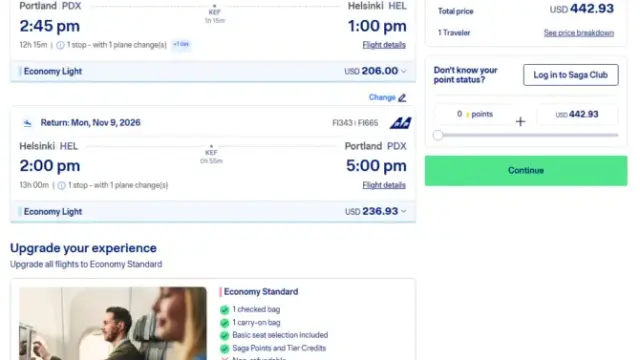
At the lowest entry point, travelers can secure a round-trip itinerary from Portland (PDX) to Stockholm (ARN) for $431. Structurally, this fare corresponds to an Economy Light or Basic Economy classification.
- Inclusions: The ticket price covers advance seat assignment, one carry-on bag weighing up to 22 pounds (10 kilograms), and one personal item that fits underneath the seat ahead.
- Exclusions: Checked luggage is strictly excluded from this baseline price.
- The Catch: Passengers who purchase the $431 tier and subsequently decide to check a bag at the airport check-in counter will face a steep ancillary fee of $69 each way ($138 round-trip). For travelers packing light, this tier maximizes savings; for those requiring checked baggage, the math changes significantly.
The $551 Standard Economy Tier
For travelers who require more flexibility or traditional baggage allowances, the $551 fare tier offers a more inclusive package.
- Inclusions: This fare includes one checked bag within the base price, alongside the standard carry-on allowance, personal item, and advance seat selection.
- Cost-Benefit Analysis: When comparing the $551 fare to the $431 option, the $120 price difference must be weighed against the cost of checking a bag on the lower fare. Because checking a bag on the Basic Economy ticket costs $69 each way ($138 total), passengers who definitely plan to check a bag will actually save money overall by booking the $551 tier upfront, where the checked bag fee is effectively reduced to a $120 differential that also buys additional peace of mind and ticket flexibility.
Supporting Context & Metrics: Decoding Ancillaries, Routing, and Loyalty
To fully understand the value of this deal, frequent flyers and budget-conscious travelers must look beyond the base fare and examine routing, alliance partnerships, and baggage economics.
Routing and Operational Mechanics
Itineraries from Portland to Stockholm under these fare classes typically route through major northern European or North Atlantic transit hubs—most notably Keflavík International Airport (KEF) when utilizing carriers like Icelandair. These single-connection itineraries offer a balanced travel time while keeping operational costs low for the operating carriers, savings that are theoretically passed down to the consumer in the form of promotional pricing.

Frequent Flyer Mileage Accrual
For loyalty program enthusiasts, understanding airline partnerships is critical. Icelandair maintains a strategic partnership with Alaska Airlines, a dominant carrier in the Pacific Northwest through its Portland and Seattle hubs. Consequently, passengers booking these promotional fares may be eligible to earn elite-qualifying and redeemable miles through the Alaska Airlines Mileage Plan, depending on the specific fare class code issued at booking.
Travelers should always cross-reference their ticket’s fare class against the current partner earning charts on Alaska Airlines’ official portal. Earning miles on a discounted transatlantic ticket enhances the overall value proposition, turning a leisure trip into progress toward elite status or future award travel.
The True Cost of Air Travel Unbundling
The structure of this Stockholm sale exemplifies the modern "a la carte" pricing model that has come to dominate commercial aviation. Over the past decade, legacy and hybrid carriers alike have adopted low-cost carrier tactics, unbundling products to cater to hyper-sensitive price shoppers while monetizing ancillary services.
| Fare Tier | Base Price | Carry-On Included | Checked Bag Included | Onboard Seat Selection | Airport Checked Bag Fee |
|---|---|---|---|---|---|
| Basic Economy / Light | $431 | Yes (up to 22 lbs) | No | Yes | $69 each way |
| Standard Economy | $551 | Yes (up to 22 lbs) | Yes (1 bag) | Yes | Included |
As demonstrated in the matrix above, consumers must audit their travel habits before selecting a tier. Packing discipline—such as restricting luggage to a single 22-pound rolling bag and a personal item—unlocks the true $431 bargain. Conversely, failing to account for baggage needs prior to purchase can quickly erode the savings.

Official Statements & Industry Perspectives
While individual fare sales are driven by automated yield management systems responding to supply and demand algorithms, industry stakeholders and consumer advocates offer broader perspectives on how these sales impact the market.
Airline revenue management teams maintain that unbundled fare structures democratize air travel. By lowering the entry-level price point to $431, airlines make international travel accessible to demographics that might otherwise be priced out, such as students, solo backpackers, and budget-conscious families. Proponents argue that unbundling ensures passengers only pay for the specific services they consume, rather than subsidizing baggage space for other travelers.
Conversely, consumer advocacy groups and travel economists often caution against the hidden frictions of unbundled pricing. Complex fee structures at check-in counters can create confusion, lead to gate-score surprises, and complicate corporate or group travel expense reporting. Furthermore, the steep penalty for checked bags on basic economy tickets ($69 each way) has been criticized as an aggressive ancillary revenue mechanism.
Travel experts universally advise consumers to utilize meta-search engines and real-time alert platforms—such as specialized subscription newsletters that track price drops minutes after publication—to capitalize on these fleeting inventory adjustments before airlines recalibrate their pricing engines.

Future Outlook: Transatlantic Pricing Trends and Recommendations
Looking ahead, the transatlantic market is expected to remain highly volatile yet rich with promotional opportunities. As airlines grapple with fluctuating fuel costs, seasonal demand curves, and shifting corporate travel patterns, flash sales to European gateways like Stockholm (ARN), Copenhagen (CPH), and Oslo (OSL) will likely continue to surface sporadically from North American hubs like Portland (PDX).
Strategic Recommendations for Travelers
- Define Luggage Requirements Early: Before committing to the $431 Basic Economy fare, audit your packing needs. If you require a checked bag, calculate whether the $551 standard tier offers better financial and logistical value.
- Leverage Real-Time Tracking: Fare sales of this caliber rarely linger. Inventory in lower booking classes (such as restricted economy buckets) is strictly limited. Subscribing to real-time deal alerts ensures immediate notification when prices drop, bypassing the delays inherent in standard social media feeds.
- Maximize Alliance Benefits: Always input your frequent flyer account details—particularly with partner programs like Alaska Airlines when flying carriers such as Icelandair—to secure valuable miles on discounted itineraries.
- Read the Fine Print: Pay close attention to change fees, refundability clauses, and carry-on weight limits (noting that international carriers often enforce strict 22-pound ceilings on overhead luggage compared to more lenient domestic U.S. standards).
By approaching these fare sales with a analytical mindset and a clear understanding of unbundled airline economics, travelers can unlock remarkable value and explore iconic European destinations without overpaying for unnecessary extras.