

Executive Overview
For generations, outdoor enthusiasts and modern RV travelers have searched for the elusive "holy grail" of camping: locations that combine breathtaking natural beauty, modern creature comforts, spacious footprints, and absolute affordability. While private mega-resorts routinely demand $75 to $100 per night—and popular national parks book out months in advance—a vast, federally managed network hiding in plain sight offers an exceptional alternative.
Operated by the United States Army Corps of Engineers (USACE), these hundreds of campgrounds situated across more than 40 states represent some of the finest public recreation assets in the nation. Originally engineered for flood control, navigation, and national defense, these waterways have transformed into premier outdoor destinations.
Characterized by unbeatable nightly rates ranging generally from $10 to $30, spacious sites capable of accommodating Class A motorhomes and large fifth-wheels, and idyllic waterfront positions, Army Corps of Engineers campgrounds have earned a fiercely loyal following. This report provides an exhaustive, authoritative breakdown of what these campgrounds are, their historical roots, why they appeal uniquely to the modern RV community, and how travelers can optimize their stays within this sprawling federal network.
Detailed Chronology: From Military Engineering to National Recreation
To understand why Army Corps of Engineers campgrounds occupy such pristine, waterside acreage, one must look deep into the annals of American military and civil history. The journey of the USACE is a foundational chapter in the development of the United States infrastructure.
The Revolutionary Origins (1775–1802)
The lineage of the Army Corps of Engineers traces back to the very birth of the nation. In 1775, General George Washington recognized an urgent operational need for specialized military engineers to assist in the Revolutionary War effort. These early engineers were tasked with designing fortifications, bridging rivers, and planning tactical operations.
Following the conclusion of the war, the military recognized the ongoing utility of engineering expertise. Consequently, on March 16, 1802, President Thomas Jefferson formally established the Corps of Engineers as a permanent branch of the military, stationed at West Point, New York. Their initial peacetime directives were clear: construct and maintain coastal defensive forts, clear canals, and improve navigation harbors along the burgeoning nation’s commercial waterways. If goods or troops needed to move via water, the USACE was tasked with ensuring the pathway was clear and stable.
The Shift to Flood Control and Hydroelectric Power (20th Century)
As the United States industrialized rapidly through the late 19th and early 20th centuries, the nation faced a mounting environmental and economic crisis: catastrophic flooding. Major floods along the Mississippi, Ohio, and other critical river systems devastated communities, destroyed infrastructure, and cost thousands of lives.
Congress responded by passing a series of landmark Flood Control Acts—most notably in 1936, 1944, and subsequent decades—that vastly expanded the jurisdiction and responsibilities of the Army Corps of Engineers. The agency was ordered to construct massive networks of dams, levees, and reservoirs across the American landscape.
During this era, the USACE also became a primary provider of hydroelectric power, engineering complex dams that harnessed river currents to electrify rural and urban communities alike. Simultaneously, the agency retained its vital mandate to respond to national emergencies and natural disasters.
The Unintentional Birth of Recreation Paradigms
The massive infrastructural projects of the mid-20th century transformed the geography of the United States. Valley floors were deliberately flooded to create massive reservoirs, lakes, and regulated river systems designed to hold millions of gallons of water in reserve.
However, these engineering marvels produced an unintended byproduct: breathtaking landscapes. The newly formed reservoirs created thousands of miles of pristine, deep-water shoreline, often nestled within remote, heavily forested valleys or rugged canyon country.
Recognizing the immense public demand for outdoor access, the federal government authorized the USACE to develop recreational infrastructure around these water projects. What began as informal fishing access points and picnic areas slowly evolved through the 1960s, 1970s, and 1980s into structured, highly maintained public campgrounds. Today, the USACE is one of the nation’s leading federal providers of outdoor recreation, managing millions of acres of land and water.
Supporting Context & Metrics: The Modern USACE Campground Ecosystem
To appreciate the scale and value of the Army Corps of Engineers recreation program, it is helpful to examine the quantifiable metrics that define the network.
- Geographic Reach: USACE campgrounds operate in more than 40 U.S. states, ensuring that travelers across the Southeast, Midwest, Pacific Northwest, and beyond have access to these facilities.
- Pricing Structure: While private campground rates have climbed sharply—frequently topping $75 to $100 per night for full-hookup sites—USACE nightly fees typically range from $10 to $30, making long-term or budget-conscious travel feasible.
- Discountary Programs: Holders of specific federal passes, such as the Interagency Senior Pass or Access Pass, are eligible for a 50% discount on campsite fees at eligible USACE-operated facilities, though the standard America the Beautiful Pass does not universally waive site fees.
- Site Dimensions: Built largely during the late 20th-century expansion of American highway and RV travel, these campgrounds feature larger average pad sizes than many cramped, historic state or municipal parks, successfully accommodating modern oversized rigs.
Why RV Travelers and Outdoor Enthusiasts Prefer USACE Facilities
While tent campers appreciate the quiet settings and robust bathhouse facilities, the RV community has developed a particular affinity for Army Corps of Engineers campgrounds. This preference is driven by distinct structural and logistical advantages.
1. Superior Site Spacing and Modern Footprints
Many legacy state parks and municipal campgrounds were constructed in the early-to-mid 20th century when campers utilized canvas tents or compact, vintage travel trailers. Consequently, navigating these older loops with a modern 40-foot Class A motorhome or a massive fifth-wheel can be an exercise in frustration.
Because USACE campgrounds experienced their major expansions throughout the 1960s, 70s, and 80s—concurrent with the boom of modern recreational vehicles—their engineering specifications anticipated larger towables and motorhomes. Access roads are typically wider, turning radii are more generous, and individual parking pads offer the length and width required by contemporary rigs. Furthermore, these broader layouts translate to enhanced privacy buffers and ample outdoor space for awnings, patio furniture, and recreation equipment.
2. Unrivaled Waterfront Access
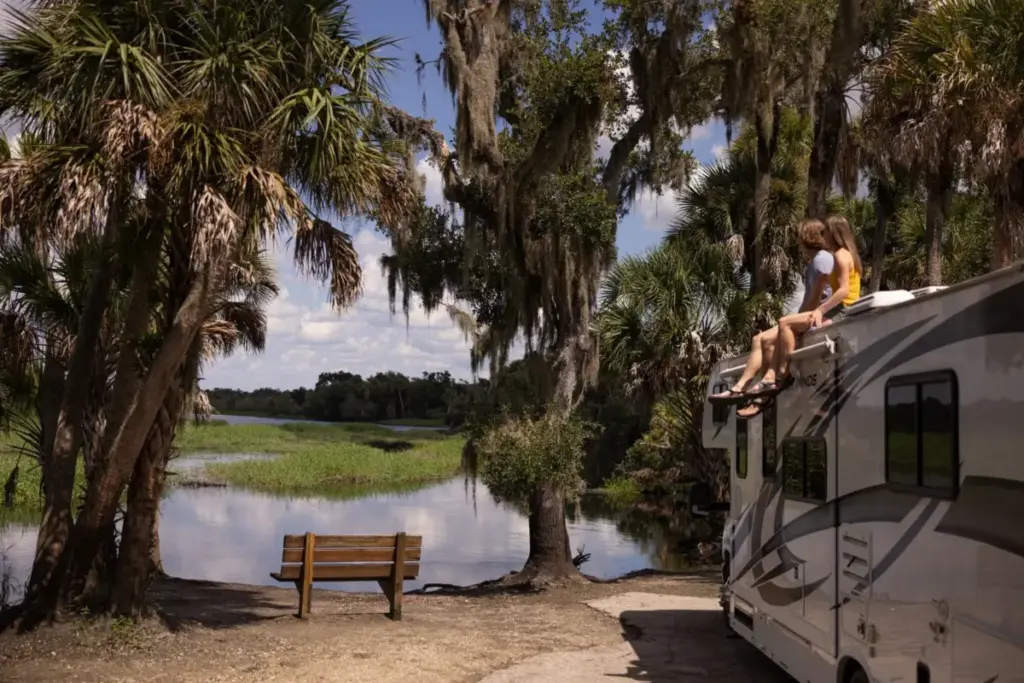
The defining characteristic of almost every USACE campground is its proximity to water. Because these sites were originally engineered around flood control reservoirs, hydroelectric dams, and navigable river channels, they sit directly on the shores of major aquatic ecosystems.
For RVers, this translates to immediate, unimpeded access to boating, kayaking, waterskiing, sport fishing, and swimming. Unlike private campgrounds situated miles from open water or commercialized resort strips dominated by dense boat traffic, USACE properties often preserve a wilder, more serene aesthetic. Waking up to misty water views and stepping directly from your RV step onto a shoreline path is a standard experience at these facilities.
3. Exceptional Value and Partial Hookups
Budget management is a core competency for long-term RV travelers. Private campgrounds with full hookups often strain travel budgets, particularly during peak summer months. While most USACE campsites offer partial hookups—typically combining 30-amp or 50-amp electrical service with potable water spigots—the modest $10 to $30 price tag represents an incredible return on investment.
Though full hookups (including direct sewer connections) are less common within the USACE inventory, most campgrounds feature conveniently located, well-maintained dump stations that allow travelers to service their holding tanks efficiently upon departure.
Official Guidelines and Operational Realities
Navigating the federal booking system and understanding campground amenities requires preparation. Agency representatives and seasoned campers emphasize several operational guidelines to ensure a seamless experience.
Reservation Protocols
The vast majority of USACE campsites can—and should—be reserved in advance. The federal government centralizes these reservations through Recreation.gov. Campers can search for specific lake projects, view high-resolution site maps, check exact hookup specifications (such as amperage limitations), and book sites up to 180 days in advance. Alternatively, reservations can be secured telephonically via the Recreation.gov call center.
Despite the robustness of the online booking engine, many USACE campgrounds retain a designated percentage of sites as first-come, first-served options. Travelers willing to arrive early—particularly mid-week or during shoulder seasons—can often secure prime waterfront real estate without a prior reservation. During peak summer weekends, however, relying on walk-up availability is strongly discouraged.
Amenities and Infrastructure
While standards vary by specific location, standard amenities across the USACE campground network generally include:
- Paved or gravel RV parking pads with electrical and water hookups.
- Flush restrooms and heated shower facilities.
- Potable water fill stations and sanitary dump facilities.
- Boat launch ramps, fish cleaning stations, and designated swimming beaches.
- Picnic pavilions, fire rings, and reliable trash collection services.
Pet owners will find that the vast majority of USACE campgrounds explicitly welcome domestic animals, provided they remain leashed, controlled, and cleaned up after at all times.
Future Outlook: Protecting and Sustaining Public Waterside Infrastructure
As the demand for outdoor recreation surges to unprecedented levels across the United States, the role of Army Corps of Engineers campgrounds becomes increasingly critical. State and federal park systems face mounting budgetary pressures, aging infrastructure, and overcrowding in premier destinations.
Looking forward, the USACE faces both opportunities and challenges in maintaining its vast recreational inventory. Modernizing older electrical grids to support the heavy power demands of today’s luxury RVs—such as dual-zone air conditioning units and electric vehicle charging—is an ongoing priority for federal land managers. Additionally, balancing intensive recreational use with vital flood control and environmental conservation mandates requires careful stewardship.
Nevertheless, federal commitments to maintaining these assets remain strong. Investments through modern recreation funding initiatives continue to flow into upgrading bathhouses, expanding Wi-Fi connectivity in select zones, and reinforcing boat ramps.
For the modern traveler, Army Corps of Engineers campgrounds stand as a testament to intelligent public resource management. By transforming utilitarian flood-control projects into pristine, affordable, and accessible natural habitats, the USACE has ensured that generations of campers can experience the splendor of America’s waterways without breaking the bank. Whether utilizing a personal rig or picking up an RVshare rental for a weekend getaway, exploring the USACE network offers an unmatched window into the nation’s great outdoors.