







For years, the global aviation industry’s luxury arms race was fought at the very front of the aircraft. International carriers poured hundreds of millions of dollars into developing increasingly opulent first-class suites, complete with sliding doors, personal minibars, and onboard showers, alongside business-class cabins featuring fully flat beds and direct aisle access.
Now, however, the primary front in this competitive landscape has shifted a few rows back.
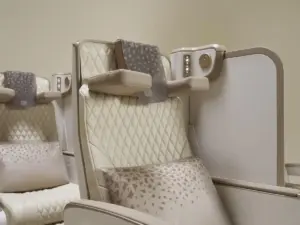
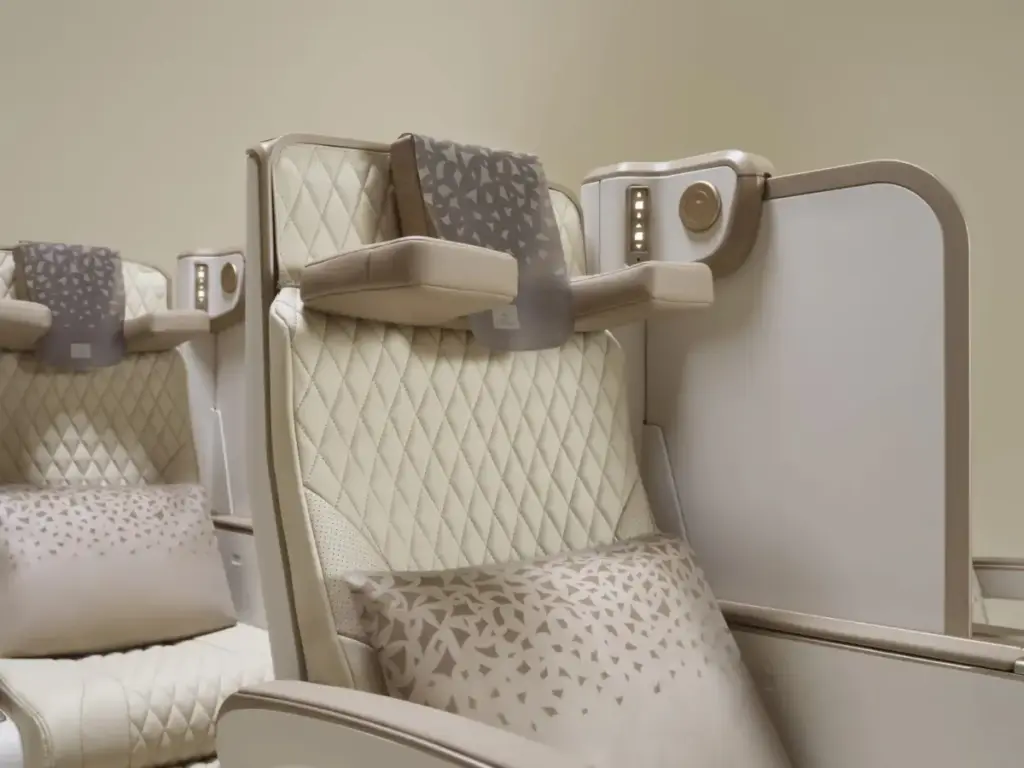
On Thursday, Dubai-based Emirates raised the stakes in the mid-cabin market by launching a highly advanced premium economy seat. This new product is equipped with a feature historically reserved for premium business-class cabins: a full-height, electrically operated privacy divider that passengers can raise and lock using a personal control pad.
This innovative seat, designed for the airline’s new-generation Airbus A350 widebody jets, represents a significant leap forward in cabin design. Beyond the headline-grabbing privacy screen, the seat features electric recline functionality with preset modes optimized for lounging and dining, a leather U-shaped headrest, a deployable footrest, integrated wireless charging capabilities, and a high-definition 4K inflight entertainment screen.
The rollout of this high-spec product comes at a critical juncture for the commercial aviation sector. As the industry enters a period of slower, more mature expansion, airlines are pivoting their strategies. With global passenger revenue projected to approach $900 billion by 2027, but annual growth settling into steady, low single digits, the post-pandemic recovery phase has officially run its course. Consequently, airlines are focusing less on rapidly expanding their capacity and more on maximizing the yield and profitability of every square foot of cabin space.
The Micro-Engineering of Comfort: Inside the New Emirates A350 Seat
Emirates’ decision to introduce a motorized privacy screen to its premium economy cabin is a calculated move to redefine passenger expectations. Traditionally, premium economy has been marketed as an upgraded economy experience—offering a bit more legroom, a wider seat, and slightly better catering. By introducing physical, electronic barriers between passengers, Emirates is effectively pulling premium economy closer to the business-class experience.
The mechanics of the seat reflect a deep focus on industrial design and passenger ergonomics:
- The Privacy Divider: Controlled via an intuitive digital control pad, the divider allows passengers to isolate themselves from their immediate neighbors. It can be fully lowered during boarding and taxiing to comply with safety regulations, then raised to its full height once in flight.
- Intelligent Recline: Unlike traditional manual levers that require passengers to push back with their body weight, the new seat uses electric actuators. Preset "lounge" and "meal" modes allow travelers to transition seamlessly between activities at the touch of a button.
- Connectivity and Entertainment: Recognizing the demands of modern travelers, the seat integrates wireless charging pads alongside traditional USB ports. The visual experience is anchored by a sharp 4K screen, designed to complement the airline’s extensive inflight entertainment library.
- Ergonomic Support: A tailored, U-shaped leather headrest provides lateral neck support, reducing the need for bulky travel pillows, while a robust, deployable footrest supports a more natural resting posture during long-haul flights.
By deploying this product on its new Airbus A350 fleet, Emirates is positioning these medium-to-long-haul twin-engine jets to capture high-yield traffic on routes where deploying its double-decker Airbus A380s or larger Boeing 777s might not be economically viable.
The Macroeconomics of Aviation: Why the "Revenge Travel" Era is Over
The introduction of such a highly engineered mid-cabin product is not merely a play for passenger satisfaction; it is a direct response to a fundamental shift in global macroeconomic conditions.
During the immediate post-pandemic years, international airlines enjoyed unprecedented demand. Travelers, flush with savings and eager to make up for lost time, engaged in "revenge travel," driving ticket prices and airline yields to record highs. During this phase, airlines focused heavily on restoring capacity, securing aircraft, and rehiring staff to meet the surging demand.
However, that phase of rapid, double-digit recovery has concluded. Industry analysts point to several factors shaping the new operational reality:
The Slowdown to Single-Digit Growth
While absolute revenues remain strong—with the global industry on track to approach the $900 billion mark by 2027—the rate of year-over-year growth is cooling into the low single digits. Airlines can no longer rely on market expansion alone to boost their bottom lines.
Persistent Supply Chain Constraints
Aircraft manufacturers like Airbus and Boeing continue to grapple with supply chain disruptions, engine maintenance backlogs, and regulatory hurdles. Because airlines cannot acquire new aircraft as quickly as they might like, they must optimize the configuration of their existing and incoming fleets to generate maximum revenue from limited airframes.
Rising Operational Costs
Labor, fuel, and airport infrastructure costs have climbed significantly. To maintain profitability in a high-cost environment, carriers must shift their focus from high-volume, low-margin passengers to high-margin segments.
The Financial Sweet Spot: The Unmatched Margins of Premium Economy
From a revenue management perspective, premium economy has quietly become the most profitable real estate on a commercial aircraft.
+-------------------------------------------------------------------+
|                     CABIN PROFITABILITY COMPARISON                |
+----------------------+---------------------+----------------------+
| Cabin Class          | Space Required      | Average Fare Premium |
+----------------------+---------------------+----------------------+
| Economy              | Baseline (1x)       | Baseline (1x)        |
| Premium Economy      | ~1.4x to 1.6x       | 2.0x to 3.0x         |
| Business Class       | ~3.0x to 4.0x       | 5.0x to 10.0x        |
+----------------------+---------------------+----------------------+
As the table illustrates, a business-class seat requires three to four times the physical footprint of a standard economy seat to accommodate lie-flat mechanisms, direct aisle access, and console space. While business-class fares are high, the space efficiency is relatively low.
Premium economy, by contrast, requires only about 40% to 60% more space than a standard economy seat, yet airlines can routinely command fares that are double or triple the price of a basic economy ticket. This mathematical reality makes the cabin incredibly lucrative. For airlines operating under tight capacity constraints, replacing a few rows of economy seats with a high-margin premium economy section is an effective way to boost unit revenues without increasing the physical size of the aircraft.
Demographics of the Mid-Cabin: Who is Buying These Seats?
The target audience for Emirates’ new A350 premium economy seat is diverse, bridging the gap between two distinct types of travelers who have found themselves priced out of or restricted from traditional business-class cabins.
The Self-Funding "Premium Leisure" Traveler
The rise of the affluent leisure traveler has been one of the most resilient trends of the decade. These are individuals traveling for vacations, family reunions, or retirement who desire a higher level of comfort but cannot justify spending $5,000 to $10,000 of their own money on a business-class ticket. A premium economy product that offers genuine privacy and comfort at a more accessible price point represents an appealing compromise.
The Corporate Traveler Under Strict Policy Constraints
In an era of corporate belt-tightening and increased scrutiny on environmental, social, and governance (ESG) metrics, many multinational corporations have revised their travel policies. Middle managers and consultants who were once permitted to fly business class on long-haul routes are now frequently restricted to premium economy. By offering a seat with a privacy divider, wireless charging, and quiet workspace features, Emirates is directly appealing to these business travelers who need to remain productive in flight.
Fleet Diversification and the Strategic Role of the Airbus A350
The decision to debut this advanced seat on the Airbus A350 is highly symbolic of Emirates’ evolving fleet strategy. Historically, the airline’s brand was built on the sheer scale of the Airbus A380 and the Boeing 777. These massive aircraft allowed Emirates to funnel millions of passengers through its mega-hub at Dubai International Airport.
However, the Airbus A350 offers a different set of capabilities. As a highly efficient, medium-capacity, long-range twin-engine jet, the A350 allows Emirates to:
- Serve Secondary Markets: The A350 can profitably operate routes to mid-sized cities in Europe, Asia, and Africa that do not have the demand to fill a 500-seat A380.
- Optimize Frequency: On highly competitive business routes, flying a slightly smaller aircraft more frequently throughout the day is often more attractive to corporate travelers than a single daily flight on a larger jet.
- Deploy Tailored Configurations: By equipping the A350 with a world-class premium economy cabin, Emirates can target markets with high concentrations of premium leisure and corporate traffic, ensuring that every seat configuration matches the specific demand profile of the route.
The Future of In-Flight Segmentation
As Emirates begins rolling out its new A350 premium economy product, the rest of the aviation industry will undoubtedly watch closely. The introduction of a motorized privacy divider in a non-business class cabin represents a clear disruption of the traditional hierarchy of flight.
In the coming years, the distinction between cabin classes will likely continue to blur. As airlines seek out new ways to differentiate their products in a slower-growth market, features that were once considered the exclusive domain of the ultra-wealthy—such as noise-canceling technology, advanced ergonomics, and personal privacy—will continue to migrate backward into the mid-cabin.
For global travelers, this shift promises a new era of choice, where comfort and privacy are no longer locked behind a five-figure price tag, but are increasingly accessible to those willing to pay a sensible premium for a better experience at 35,000 feet.