
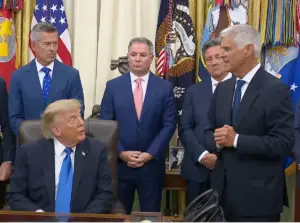







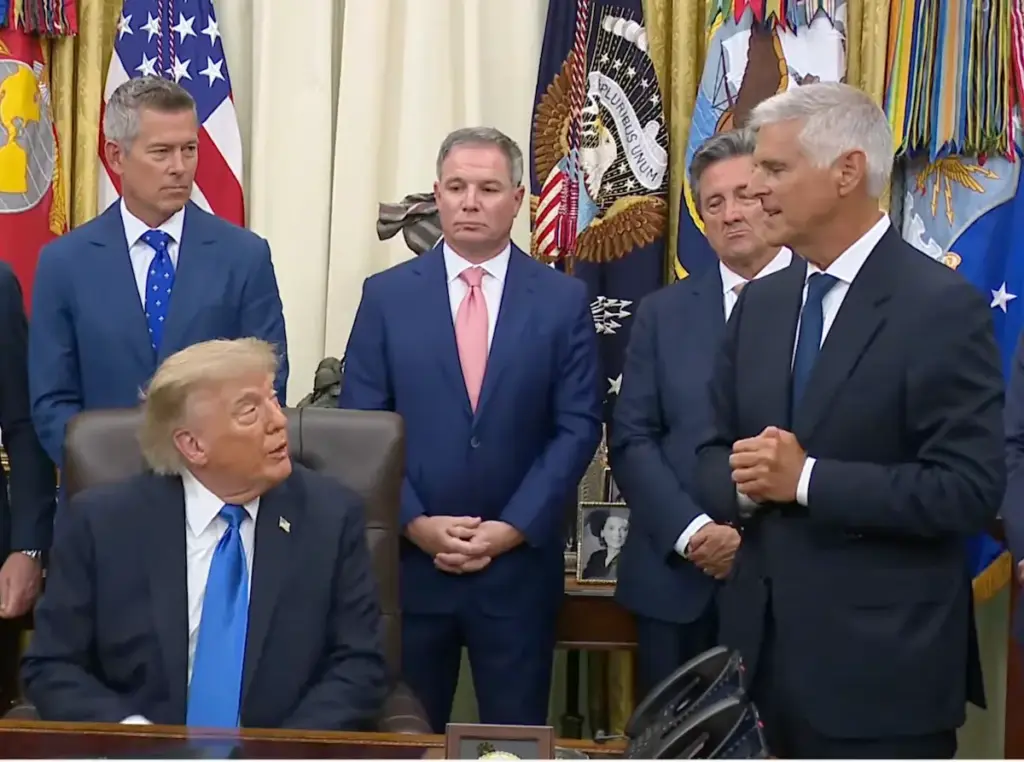
During a high-level White House meeting, a delegation of top-tier travel executives formally requested that the administration commit to a bold national target: attracting just over 100 million international visitors annually by the year 2030. Achieving this milestone would not only represent a historic high-water mark for American tourism but would also secure the title of the world’s most-visited country—a designation long monopolized by France.
The ambitious proposal was pitched directly to President Donald Trump during a private session. The delegation at the table represented a coalition of the country’s most powerful travel, hospitality, and aviation brands, including the U.S. Travel Association, Hilton, Marriott International, American Airlines, and Booking Holdings, among other industry leaders.
To reach the 100 million visitor threshold, the United States will have to engineer an aggressive acceleration in international arrivals. The target demands a staggering 46% increase in international visitation compared to projected 2025 levels. Furthermore, the goal sits approximately 25% higher than the country’s pre-pandemic peak, representing a massive expansion of the American tourism footprint that will require coordinated federal policy, infrastructure modernization, and aggressive global marketing.
A High-Stakes Coalition at the White House
The composition of the executive delegation underscores the urgency of the industry’s appeal. By bringing together the chief executives and representatives of major hotel chains, a dominant domestic airline, a global digital booking giant, and the industry’s primary advocacy group, the sector presented a united front.
For brands like Marriott and Hilton, international visitors represent a premium customer segment. Overseas travelers typically stay longer and spend significantly more per trip than domestic leisure travelers. For American Airlines, robust international inbound corridors are critical to maximizing the profitability of long-haul routes and supporting hub-and-spoke operations across major gateway airports. Meanwhile, digital platforms like Booking Holdings rely on a seamless global flow of travelers to drive volume across their accommodation and transport networks.
The U.S. Travel Association has long argued that international inbound travel is a vital export for the American economy. When an international tourist buys a plane ticket on a U.S. carrier, stays in an American hotel, dines in local restaurants, or shops in retail districts, that expenditure acts as foreign direct investment directly benefiting local communities. Industry advocates view the 100 million visitor goal not merely as a point of national pride, but as a critical macroeconomic engine capable of generating hundreds of thousands of jobs and billions of dollars in tax revenue.
Decoding the Math of the 100 Million Target
The 100 million target is as mathematically daunting as it is strategically ambitious. To understand the scale of the challenge, industry analysts point to the recovery trajectory of the U.S. travel sector following the disruptions of the early 2020s.
While domestic travel in the U.S. rebounded rapidly, fueled by pent-up demand and flexible remote-work policies, international inbound travel has lagged. The projected baseline for 2025 serves as the launching pad for this new initiative, meaning the country must find a way to spur a 46% growth rate over a five-year span.
Overcoming the Pre-Pandemic Peak
Historically, the high-water mark for U.S. inbound tourism hovered well below the 100 million mark. Pushing the needle 25% past that pre-pandemic peak requires more than just a return to normal; it demands the cultivation of entirely new traveler demographics and the drastic reduction of friction points that currently deter international tourists.
The French Connection: The Battle for the Top Spot
For decades, France has consistently secured the title of the world’s most-visited country, frequently drawing around 90 million or more international visitors annually. France benefits from its central geographic location in Europe, high-speed rail connectivity with neighboring nations, and a highly coordinated national tourism strategy.
For the United States to surpass France, it must overcome its geographical reality as a long-haul destination for many of the world’s highest-spending travelers. This means the U.S. must make the journey as seamless and appealing as possible, neutralizing the advantages of European competitors through superior service, streamlined entry, and unmatched marketing appeal.
Navigating the Persistent Inbound Tourism Slump
The industry’s push for a lofty 2030 target comes at a time of friction for U.S. inbound tourism. Despite overall economic resilience, the country has been grappling with a persistent slump in overseas arrivals.
According to industry data, visitation from key overseas markets was down year-over-year during the crucial summer months of June and July. This decline during the peak travel season highlighted the vulnerability of the U.S. tourism export sector. Factors such as unfavorable exchange rates, high costs of lodging and dining in major U.S. cities, and prolonged visa processing delays in critical emerging markets have all contributed to the sluggish performance.
For travel executives, this current slump is not a reason to scale back ambitions, but rather an urgent signal that federal intervention is required. The industry argues that without a formal, administration-backed target and a corresponding commitment to policy reform, the U.S. risks falling permanently behind more agile global competitors who are actively courting international globetrotters.
The World Cup as a Catalyst and Operational Blueprint
To bridge the gap between the current slump and the 100 million visitor target, industry executives are looking to major international events as vital catalysts. Chief among these is the FIFA World Cup, which was hosted across 11 U.S. cities and five other key markets in Canada and Mexico.
While the tournament itself did not instantly reverse the year-over-year inbound tourism declines observed in June and July, it served a far more critical long-term purpose: acting as a massive real-world test case for the nation’s travel infrastructure.
Both the Trump administration and travel industry leaders have deemed the tournament a major operational success, specifically pointing to its role in showcasing "streamlined entry" procedures. The influx of hundreds of thousands of international sports fans forced federal agencies and private operators to collaborate with unprecedented efficiency.
During the tournament, key entry gateways implemented advanced processing technologies, optimized customs staffing, and established dedicated corridors to handle massive waves of arrivals. The success of these measures proved to both the government and the private sector that the U.S. is capable of processing large volumes of international visitors without sacrificing national security or creating paralyzing airport bottlenecks. Industry leaders are now urging the administration to codify these temporary tournament-era efficiencies into permanent national policy.
The Policy Reforms Needed to Reach the 2030 Goal
To transform the 100 million visitor target from a lofty pitch into a reality, travel executives emphasized that the federal government must address several systemic bottlenecks. The discussions between the Trump administration and industry leaders touched on several critical policy areas:
- Visa Processing Modernization: Prolonged wait times for first-time visitor visa interviews in key growth markets—such as India, Brazil, and Colombia—remain a primary barrier to entry. Industry leaders are advocating for increased consular staffing, digital visa processing options, and waived interview requirements for low-risk renewals.
- Expansion of the Visa Waiver Program (VWP): Adding more secure, high-income nations to the VWP would instantly make the U.S. more competitive, allowing millions of potential travelers to bypass the traditional visa application process entirely.
- Customs and Border Protection (CBP) Staffing: To maintain the "streamlined entry" showcased during the World Cup, airports require consistent, optimal CBP staffing and the wider deployment of biometric processing technologies to reduce wait times at major international gateways.
- Robust Funding for Brand USA: As the nation’s public-private tourism marketing arm, Brand USA is critical to telling the story of America’s diverse destinations. Executives are calling for sustained, competitive funding to counter the aggressive marketing campaigns of rival nations.
A Vision for Coordinated Growth
The meeting between President Trump and the country’s top travel executives represents the starting gun for a highly coordinated, multi-year campaign. By aligning the commercial interests of hospitality, aviation, and digital travel giants with the policy-making power of the federal government, the U.S. travel sector believes it can successfully close the gap on its international rivals.
The road to 100 million visitors by 2030 is steep, requiring a complete reversal of recent inbound declines and a sustained, double-digit growth trajectory over the back half of the decade. However, armed with the operational lessons of the World Cup and a renewed commitment to streamlining the international arrival process, the American travel industry is betting that the United States can finally claim the title of the world’s most-visited nation.