








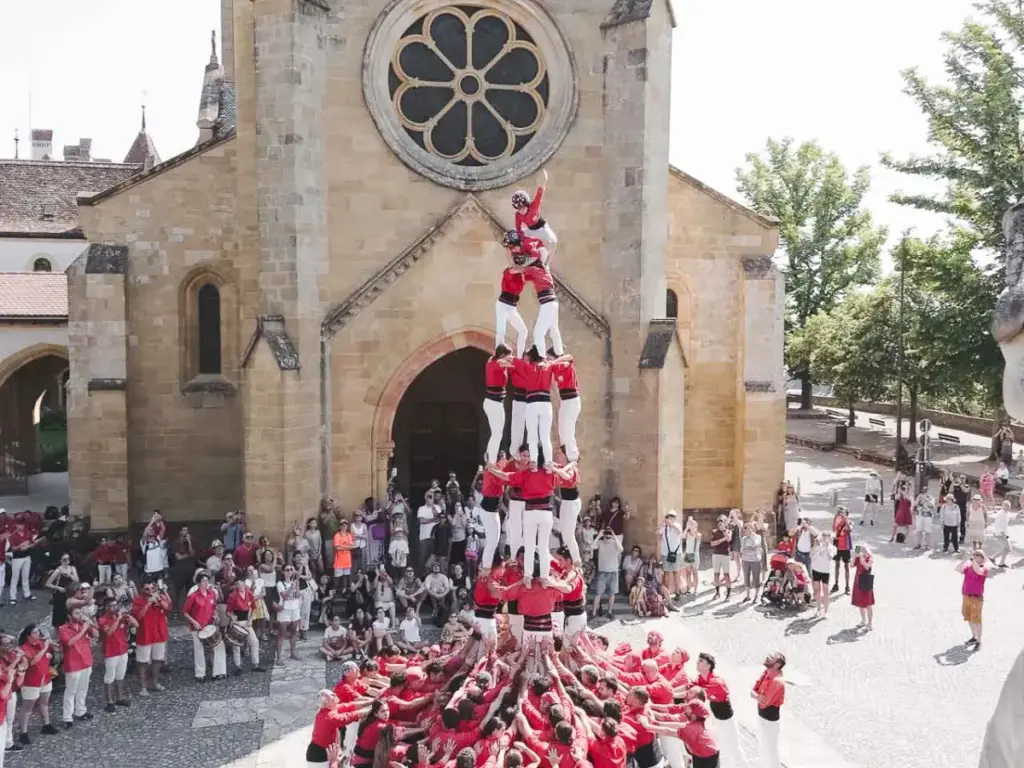
On June 25, the cultural fabric of traditional Catalan performance art merged with the breathtaking, unforgiving topography of the high Alps in a feat that will be remembered for generations. The Castellers de Barcelona—one of Catalonia’s premier human tower (castell) groups—successfully raised a fully formed human tower at the Jungfraujoch – Top of Europe in Switzerland. Standing at a staggering 3,454 meters (11,332 feet) above sea level, this performance shattered the previous world record for the highest altitude ever recorded for a traditional castell, a milestone previously held by an ascent on the Aneto peak in the Pyrenees.
This unprecedented achievement was far more than a simple exercise in altitude-chasing. Comprising an expedition of nearly 200 castellers, the journey was a complex logistical, physical, and diplomatic triumph. Supported by Switzerland Tourism and facilitated by sustainable public transport networks like the Swiss Travel Pass and the panoramic GoldenPass Express, the group transformed their Alpine expedition into a cultural dialogue. Traversing the Swiss landscape from the glacial heights of the Bernese Oberland to the Olympic capital of Lausanne and the historic shores of Lake Neuchâtel, the Castellers de Barcelona proved that intangible cultural heritage—recognized by UNESCO—knows no borders.
This comprehensive report details the chronology of the expedition, the extreme physiological and structural challenges of building human towers in thin mountain air, the rich cultural stops along their Swiss itinerary, and the broader implications of projecting Catalan identity onto the global stage.
Detailed Chronology: A Week of Culture, Rail, and Altitude
The Ascent to the "Top of Europe" (June 25)
The crowning moment of the expedition occurred on June 25 at the Jungfraujoch, a saddle connecting two major peaks of the Bernese Alps: the Jungfrau and the Mönch. Home to the highest railway station in Europe at 3,454 meters, the Jungfraujoch overlooks the Aletsch Glacier, a colossal river of ice designated as a UNESCO Natural World Heritage site.

For nearly 200 members of the colla (group), the day began long before the actual construction of the castell. Operating at an altitude where atmospheric pressure is significantly lower and oxygen levels are reduced requires careful physiological preparation. The cold, crisp Alpine air posed an immediate environmental hurdle for performers dressed in traditional lightweight whites (camises blanques) and black trousers, anchored by the traditional faixa (the heavy waist sash designed to protect the lower back).
Despite the environmental adversity, the team synchronized their movements with clinical precision. As crowds of international tourists watched in stunned silence, the pinya (the broad base and supportive crowd of people underpinning the structure) locked arms. Layer by layer, the troncs (the trunk) climbed upward, culminating in the crowning enxaneta raising their hand at 3,454 meters. The roar that echoed across the snow-capped peaks signaled not just a new world record, but a profound psychological victory over the elements.
The Swiss Itineraries: Rail, Castles, and Lakes
Long before and after the record-breaking climb, the Castellers de Barcelona embarked on a carefully curated cultural route across Switzerland, emphasizing sustainable mobility through a partnership with Switzerland Tourism.
- The GoldenPass Express Journey: Moving away from carbon-heavy private transport, the group utilized Switzerland’s world-renowned rail network. Aboard the luxurious, panoramic GoldenPass Express, members traveled seamlessly from Interlaken to Montreux, cutting through the dramatic valleys and passes of the pre-Alps while enjoying floor-to-ceiling views of Swiss landscapes.
- The Chateau de Chillon (Lake Geneva): The first major cultural stop brought the Catalan tradition to the doorstep of the Château de Chillon, an architectural masterpiece nestled on an isolated rock on the shores of Lake Geneva (Lac Léman). Against the backdrop of medieval stone walls and deep blue waters, the colla performed dynamic pillars and smaller towers, drawing a bridge between Swiss medieval history and Catalan folk tradition.
- Lausanne and Olympic Memory: The expedition then rolled into Lausanne, the global capital of the Olympic Movement and home to the International Olympic Committee (IOC). In front of the Olympic Museum, the castellers raised several towers in a deeply resonant gesture of international unity. Notably, the group unfurled the exact flag that had flown during the opening ceremony of the 1992 Barcelona Olympic Games—a poignant nod to Catalonia’s modern history on the world stage. Furthermore, in a moving display of global solidarity, a separate pillar was raised bearing the flag of Venezuela to honor the victims of a recent devastating earthquake.
- Neuchâtel and the Finale: The cultural tour concluded in the picturesque canton of Neuchâtel. Here, the colla brought their art directly into the urban fabric, performing before the imposing façade of the medieval Château de Neuchâtel and later right at the edge of the lake’s serene harbor.
Supporting Context & Metrics: Breaking Down the Alpine Feat
To understand the magnitude of what the Castellers de Barcelona achieved at the Jungfraujoch, one must examine the intersection of structural engineering, human physiology, and environmental constraints.

The Physics and Physiology of High-Altitude Castells
A castell is fundamentally a living architectural marvel. It relies entirely on human balance, core strength, precise weight distribution, and unshakeable collective trust. Every tier added to a human tower exponentially increases the load borne by the base (pinya and primera faixa).
Performing at 3,454 meters introduces severe physiological variables:
- Hypoxia (Oxygen Deprivation): At this altitude, atmospheric pressure drops, meaning each breath yields roughly 30% fewer oxygen molecules than at sea level. For members exerting maximal anaerobic effort—such as those holding the base or climbing the trunk—the onset of fatigue is accelerated drastically.
- Thermal Stress: While summer in the valleys of Switzerland can be warm, the Jungfraujoch is characterized by sub-zero temperatures, icy winds, and blinding glacial glare. Maintaining grip with cold, stiff fingers presents a severe safety hazard during the construction of a human tower.
- Surface Stability: Unlike the flat, traditional stone or asphalt plazas of Catalonia, Alpine terrain or specialized viewing platforms require hyper-vigilance regarding footing and spatial orientation.
Comparative Altitude Milestones in Casteller History
While human towers have occasionally been built in mountainous regions as adventurous exhibitions, official records are tightly scrutinized by cultural anthropologists and casteller historians.
| Location | Mountain Range | Altitude | Year / Status |
|---|---|---|---|
| Jungfraujoch, Switzerland | Bernese Alps | 3,454 meters | 2026 – Current World Record |
| Pico Aneto, Spain | Pyrenees | ~3,404 meters | Previous high-altitude benchmark |
| Montserrat, Spain | Catalan Pre-Coastal Range | ~725 meters (Monastery) | Frequent traditional high-ground site |
By pushing the ceiling past the 3,400-meter mark into the heart of the Swiss glaciated peaks, the Castellers de Barcelona have set a high-water mark that will likely stand for decades.

Official Statements and Cultural Significance
The ripples of the expedition extended far beyond the immediate participants, prompting reflections from cultural leaders, tourism boards, and municipal representatives across both Spain and Switzerland.
"This is not merely about breaking a numeric record on a thermometer or an altimeter," noted a senior representative of the Castellers de Barcelona during the post-performance celebrations in Lausanne. "This is about testing the limits of our collective resilience. A castell is impossible without solidarity. When you build a tower at 3,454 meters, you are trusting the person beneath you and above you with your life, regardless of whether you are standing in Plaça de Jaume in Barcelona or surrounded by the glaciers of the Alps."
Switzerland Tourism officials also praised the partnership, emphasizing the alignment of values between Swiss sustainable mobility and Catalan cultural preservation. Through the integration of the Swiss Travel Pass and panoramic rail links, the massive logistics operation of moving nearly 200 people across multiple cantons was executed with zero private vehicular emissions—underscoring a shared commitment to ecological preservation in fragile alpine environments.
Cultural anthropologists observing the tour noted the profound soft-power implications of the event. By engaging directly with international landmarks—from the Olympic headquarters in Lausanne to the medieval fortifications of Chillon—the colla successfully framed Catalan culture not as a static museum piece, but as a dynamic, living, and globally engaged tradition capable of adapting to the most extreme environments on Earth.

Future Outlook: What the Record Means for the Future of Castells
As the Castellers de Barcelona return home to Catalonia with their record securely etched into history, the cultural landscape of the món casteller (the castell world) is left to ponder what comes next.
- Redefining Geographical Limits: While scaling higher altitudes physically crosses into mountaineering territory, the success at Jungfraujoch proves that traditional structures can be safely and successfully erected under extreme climatic duress given rigorous preparation.
- International Expansion and Partnerships: The seamless collaboration with Swiss institutions paves the way for future transnational cultural exchanges. It demonstrates to international tourism boards that folk traditions can be powerful drivers of sustainable, respectful cultural tourism.
- Inspiration for Younger Generations: For the enxanetes (the children who crown the towers) and the rising generation of castellers, seeing their team perform at the "Top of Europe" serves as an enduring testament to ambition, teamwork, and the pursuit of the impossible.
The image of a fragile yet unbreakable human tower rising toward the azure Alpine sky against a backdrop of eternal snow will endure as one of the defining cultural moments of the decade—a poignant reminder that when communities pull together, even the highest summits on Earth are within reach.