








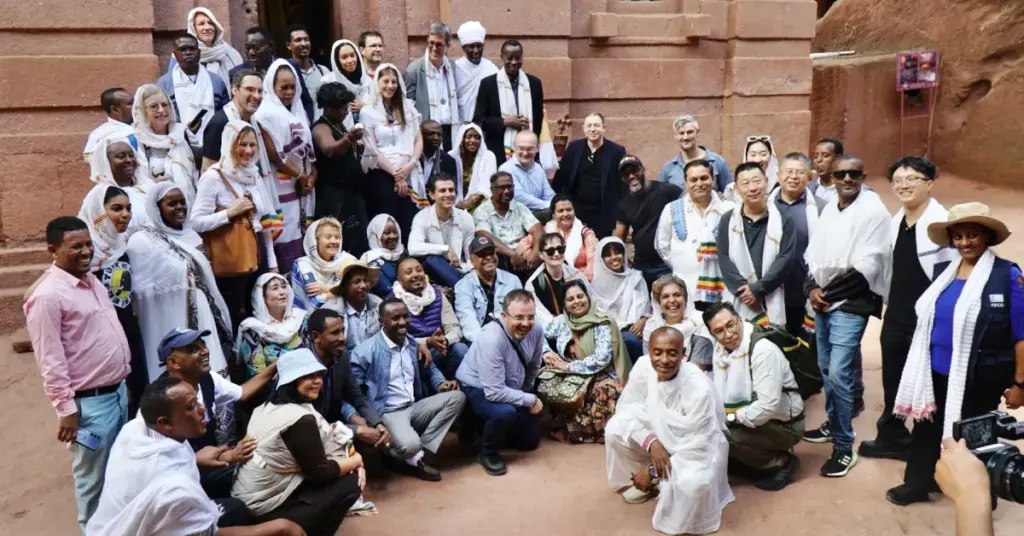
LALIBELA, ETHIOPIA — In a resounding testament to the unifying power of cultural diplomacy, over 70 high-ranking representatives from more than 40 foreign embassies, United Nations agencies, and international development organizations converged on the historic highlands of northern Ethiopia for a high-level, two-day diplomatic mission. Held from July 3 to July 4, 2026, the visit focused on the awe-inspiring Rock-Hewn Churches of Lalibela—a UNESCO World Heritage site universally described by visiting dignitaries as an architectural marvel that feels utterly "out of this world."
Organized through a formidable multi-stakeholder coalition led by the UNESCO Addis Ababa Liaison Office, the mission brought together key national and regional entities. These included the Ministry of Tourism of the Federal Democratic Republic of Ethiopia, the Ethiopian Heritage Authority, the Ethiopian Orthodox Tewahedo Church, the Amhara Regional Government, and the Lalibela City Administration. Crucially, the initiative also highlighted international cooperation via the Sustainable Lalibela Project, a vital preservation effort heavily supported by the Government of France.
The primary objective of the July gathering was twofold: to immerse global leaders in the profound spiritual and historical dimensions of one of Africa’s crown jewels, and to galvanize renewed international commitment, technical expertise, and financial resources toward the long-term preservation of a fragile, living monument. As climate pressures, natural weathering, and socio-economic transitions threaten ancient structures worldwide, the Lalibela summit served as a timely reminder that the safeguarding of shared human heritage transcends borders, uniting the global community in a collective covenant with future generations.
Detailed Chronology of the Diplomatic Mission
Day 1: Arrival, Welcome, and the Northern Cluster Exploration
The diplomatic delegation arrived in the crisp highland air of Lalibela on the morning of July 3, 2026, welcomed by a reception committee comprising federal tourism officials, regional leaders, and clergy of the Ethiopian Orthodox Tewahedo Church. Following a brief orientation session detailing the conservation history of the site, the delegation embarked on an intensive walking tour of the first major architectural cluster.
Traversing the rugged terrain that mirrors the sacred topography of the Holy Land, the ambassadors and UN delegates descended into the subterranean trenches that house the northern group of churches. The tour commenced with Bete Medhane Alem (House of the Savior of the World), widely recognized as the largest monolithic church in the world. Walking beneath its imposing exterior colonnade, delegates marveled at the sheer scale of the engineering feat—carved entirely from a single block of pink volcanic tuff, with its interior divided into five majestic aisles.
The journey continued to Bete Mariam (House of Mary), the most frequented and perhaps most delicately ornamented of the complex. Here, diplomats paused to examine the intricate exterior relief carvings, early Christian symbols, and the mesmerizing frescoes that adorn the interior capitals and arches. Local monastic guides explained the theological significance of Bete Mariam, noting its status as a focal point for profound personal devotion during major religious festivals like Genna (Ethiopian Christmas).
As the afternoon light cast golden shadows across the volcanic rock, the delegation explored other architectural masterpieces within the northern and western clusters, including Bete Meskel (House of the Cross), Bete Denagil (House of the Virgins), and the double-naved structures of Bete Golgotha Mikael, which holds immense spiritual gravity as a restricted sanctuary housing ancient imperial tombs and sacred reliefs. Throughout Day 1, discussions between diplomats and local custodians focused on the physical mechanics of the stone-cutting process, the historical context of the Zagwe Dynasty, and the daily liturgical rhythms that keep these structures vibrantly alive.
Day 2: The Jordan River Crossing, Bete Ghiorgis, and Strategic Dialogues
The second day of the mission, July 4, opened with an exploration of the southeastern complex across the symbolic Jordan River—a man-made trench carved deep into the bedrock to separate the northern and southern groups of churches, mirroring the geography of Jerusalem.
The delegation first visited Bete Amanuel (House of Emmanuel), renowned for its striking Aksumite architectural style, characterized by alternating bands of stone and timber recesses, and Bete Qeddus Mercoreus (House of Saint Mercurius), which offers a labyrinthine layout featuring partially subterranean tunnels and ancient mural fragments.
The undisputed crescendo of the day—and indeed of the entire diplomatic visit—was the arrival at Bete Ghiorgis (House of Saint George). Isolated within its own deep, vertical pit and shaped in the precise geometry of a Greek cross, the church rose before the visiting dignitaries in breathtaking isolation. As ambassadors stood on the rim of the excavation pit looking down upon the pristine, cruciform roof, multiple delegates openly echoed the sentiment that the structure appeared "out of this world," defying the technological limitations of the 13th century.
Following the morning’s visual and spiritual immersion, the afternoon of July 4 transitioned into high-level roundtables. Held in collaboration with local stakeholders, heritage experts, and municipal leaders, these closed-door and plenary sessions addressed the pressing realities of conservation management. Diplomats engaged directly with religious custodians to discuss the delicate balance between welcoming global tourism and preserving the sanctity of an active place of worship. The chronology of the visit concluded with a formal debriefing dinner, where participating nations expressed formal interest in bolstering technical and financial partnerships for the Sustainable Lalibela Project.
Supporting Context & Metrics: History, Architecture, and Preservation
The Historical and Architectural Tapestry
Inscribed on the prestigious UNESCO World Heritage List in 1978, the Rock-Hewn Churches of Lalibela represent an unparalleled pinnacle of medieval engineering, religious fervor, and architectural innovation. Commissioned by King Lalibela of the Zagwe Dynasty during the late 12th and early 13th centuries, the 11 monolithic and semi-monolithic churches were conceived as a visionary "New Jerusalem." Following the conquest of Jerusalem by Muslim forces, King Lalibela sought to establish an alternative holy pilgrimage site for Ethiopian Christians, meticulously replicating the topography of the Holy Land within the rugged Wollo mountains of northern Ethiopia.
Unlike traditional masonry architecture, where materials are assembled piece by piece, the Lalibela churches were carved subtractionally—artisans meticulously chipped away thousands of tons of living volcanic red scoria rock from the top down, leaving behind hollowed sanctuaries, internal pillars, arched windows, drainage systems, and cavernous courtyards. The precision required was absolute; a single miscalculation with a chisel meant structural failure, yet the builders achieved acoustic resonance, structural integrity, and aesthetic symmetry that continues to baffle modern civil engineers.
The Imperative of "Living Heritage"
A critical metric underscored during the July 2026 diplomatic mission is Lalibela’s classification as a living heritage site. Unlike archaeological ruins preserved merely as tourist attractions or museums, Lalibela’s churches remain the beating heart of the Ethiopian Orthodox Tewahedo Church. Every day, thousands of priests, deacons, monks, and pilgrims gather within these stone walls for prayer, chanting, and the celebration of the Divine Liturgy.
This dynamic status introduces unique preservation challenges. The natural footfall of pilgrims and tourists, combined with the burning of incense, candle soot, and the ambient humidity generated by human gatherings, accelerates the degradation of ancient rock surfaces and fragile interior wall paintings. Furthermore, regional climate shifts—characterized by unpredictable heavy rainfall and extreme thermal expansion—have exacerbated cracking and structural fatigue within the porous volcanic stone.
Financial and Technical Frameworks: The Sustainable Lalibela Project
Safeguarding a site of this magnitude requires robust international solidarity. The Sustainable Lalibela Project, spearheaded by UNESCO and backed significantly by the Government of France alongside other multilateral development partners, represents a comprehensive framework addressing these multi-faceted vulnerabilities.
Key metrics and components of ongoing preservation efforts include:
- Geotechnical Monitoring: Installation of advanced sensor arrays to measure rock stability, moisture migration, and micro-fracture propagation across all 11 churches.
- Drainage Management: Overhauling surface water runoff systems to prevent seasonal rains from pooling in the subterranean courtyards and eroding building foundations.
- Protective Shelters: Evaluating and maintaining large-scale, tensioned protective roofing structures originally erected to shield vulnerable churches from direct UV radiation and torrential downpours.
- Capacity Building: Training local conservators, stone-masons, and site managers in advanced heritage conservation methodologies to ensure community-led stewardship.
Official Statements and Diplomatic Perspectives
The gravity of the diplomatic mission was captured in numerous reflections shared by participating ambassadors, UN officials, and Ethiopian state representatives.
Dr. Emanuella Richardson, Head of the UNESCO Addis Ababa Liaison Office, emphasized the profound synergy between heritage protection and international peacebuilding:
"Lalibela is not merely an Ethiopian treasure; it is a monument to the boundless creative potential of human civilization. When we bring over 70 diplomats from every corner of the globe to stand shoulder-to-shoulder in these ancient subterranean courtyards, we are doing more than showcasing history. We are forging a shared moral responsibility. The challenges facing Lalibela—from climate pressures to conservation logistics—are formidable, but they are surmountable when the international community unites in common purpose."
Reflecting the sentiments of the visiting dignitaries, Ambassador Jean-Luc Moreau of France, representing a nation deeply invested through the Sustainable Lalibela Project, remarked on the emotional and spiritual resonance of the site:
"Visiting these churches leaves you quite literally speechless. To walk among structures carved directly from the earth by the sheer force of human faith and intellect in the 13th century is, as many of my colleagues noted, truly ‘out of this world.’ France is immensely proud to stand alongside UNESCO, the Ethiopian government, and local communities to ensure that this fragile masterpiece endures for the next thousand years."
Speaking on behalf of the host nation, Ethiopian tourism and heritage authorities underscored the vital role of tourism as a bridge for cultural understanding and economic resilience. In a joint statement released by the Ministry of Tourism and the Ethiopian Heritage Authority, officials noted:
"For centuries, the Ethiopian Orthodox Tewahedo Church and the local community of Lalibela have acted as the devoted guardians of the New Jerusalem. We welcome our international partners not only as guests, but as co-stewards of our national identity. This high-level mission reaffirms that Ethiopia’s heritage is a global public good, requiring sustained, collaborative investment to protect against the ravages of time and environmental change."
Local religious custodians also voiced their appreciation for the diplomatic engagement, emphasizing that international support must respect the spiritual sanctity and operational traditions of the monastic community. Senior clergy members led prayer sessions for international peace and cooperation during the delegates’ tour of Bete Medhane Alem, reinforcing the spiritual ethos that underpins all conservation efforts.
Future Outlook: A Roadmap for Sustainable Preservation
As the two-day diplomatic delegation concluded on the evening of July 4, 2026, the focus immediately shifted from reflection to actionable execution. The insights gathered during the site visits and stakeholder roundtables have laid the groundwork for a renewed strategic roadmap for Lalibela’s future.
Key Priorities Moving Forward
- Expanded Resource Mobilization: Building upon the commitments made by the more than 40 participating embassies and UN bodies, UNESCO and the Ethiopian government plan to establish a dedicated multi-donor trust fund aimed at accelerating phase-two interventions of the Sustainable Lalibela Project.
- Climate Adaptation Strategies: Given shifting weather patterns in the Horn of Africa, upcoming conservation protocols will heavily prioritize climate-resilient engineering, including enhanced subterranean drainage networks and non-invasive rock consolidation techniques designed to withstand intense seasonal precipitation.
- Community-Centric Heritage Management: Future preservation frameworks will increasingly empower local youth, artisans, and religious custodians, ensuring that economic benefits from heritage tourism flow directly back into the Lalibela community while fostering grassroots expertise in preventive conservation.
- Digital Archiving and Monitoring: Plans are underway to deploy high-resolution 3D laser scanning and digital photogrammetry across all 11 churches. This will create a permanent digital twin of the site, facilitating precise structural monitoring and providing a failsafe historical record in the event of unforeseen environmental crises.
The July 2026 diplomatic mission to Lalibela has successfully reset the global dialogue on heritage preservation in East Africa. By bridging local tradition with international diplomacy, the event demonstrated that the preservation of ancient wonders like the Rock-Hewn Churches of Lalibela is not merely an exercise in architectural maintenance, but a profound affirmation of our shared human story—ensuring that the "New Jerusalem" continues to inspire awe, faith, and unity for generations yet unborn.