









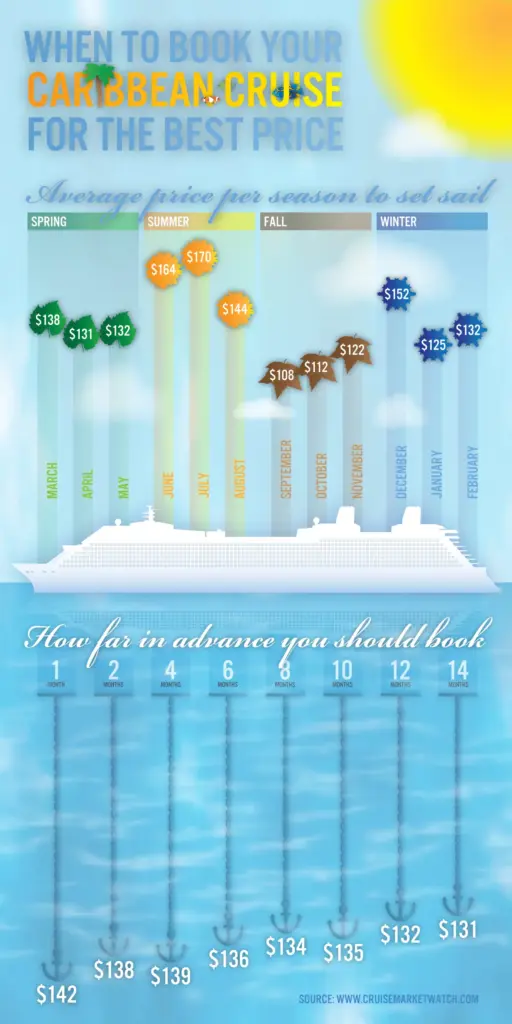
For millions of vacationers, the allure of turquoise waters, white-sand beaches, and sun-drenched islands makes the Caribbean and the Bahamas the undisputed epicenter of global cruising. However, navigating the labyrinth of cruise line pricing can often feel like trying to hit a moving target. When is the absolute best time to book a Caribbean cruise? How far in advance must a traveler commit to secure the most competitive rate? And do the traditional rules of thumb—such as waiting for last-minute fire-sale discounts—actually apply to tropical itineraries?
To answer these questions with empirical certainty, Cruise Market Watch conducted an exhaustive, large-scale data analysis spanning three years, capturing market behaviors across an immense cross-section of the cruise industry. By examining actual pricing metrics from September 1, 2010, to November 30, 2013, researchers analyzed 26 distinct cruise lines, operating 144 individual cruise ships, and encompassing more than 7,500 unique sailings throughout the Caribbean and the Bahamas.
The findings upend conventional wisdom regarding travel procurement. Unlike European itineraries—where pricing models often fluctuate wildly and late-breaking discounts can occasionally yield incredible bargains—Caribbean and Bahamian cruises follow a fundamentally different economic trajectory. Most notably, Caribbean cruises become progressively more expensive with each passing month as the sail date draws closer.
This comprehensive report breaks down the foundational data behind Caribbean cruise pricing, offering travelers a strategic framework to optimize their vacation budgets. By understanding how advance booking timelines, seasonal shifts, ship segmentation, and cabin categories intersect, consumers can leverage early planning to dramatically reduce their per-person, per-day expenditures without sacrificing the quality of their voyage.
Detailed Chronology & Methodology: How the Data Was Built
To truly appreciate the value of strategic booking, one must understand the rigorous methodology underpinning the research. The insights presented in this analysis are not based on anecdotal observations or promotional marketing claims; they are derived from a massive historical dataset tracking real-world transactions and published weighted-average pricing.
The Scope of the Study
The data set compiled by Cruise Market Watch represents one of the most comprehensive cross-sectional analyses of the contemporary cruise industry ever undertaken. Spanning a 39-month observation window, the study captured the operational and pricing realities of:
- 26 Cruise Lines: Ranging from contemporary, mass-market operators to premium and ultra-luxury lines.
- 144 Cruise Ships: Representing diverse vessel classes, passenger capacities, and onboard amenity packages.
- Over 7,500 Sailings: Covering every major sub-region of the Caribbean (Eastern, Western, and Southern) as well as short and extended Bahamian itineraries.
Defining the Metrics: Per-Person, Per-Day Pricing
To establish an equitable baseline for comparison across different ship segments and itinerary lengths, researchers utilized total weighted average pricing calculated on a per-person, per-day (PPPD) basis across all cabin categories. This metric normalizes the cost of a cruise, allowing travelers to directly compare a three-night weekend getaway to the Bahamas with a fourteen-night Southern Caribbean odyssey.
The Chronological Evolution of Booking Windows
The core objective of the study was to map out the chronological evolution of cruise ticket pricing relative to the departure date. By tracking how fares shifted from the moment bookings opened (often 18 to 24 months in advance) down to the final weeks before embarkation, researchers were able to plot clear pricing curves.
The historical chronology revealed a distinct, highly predictable market rhythm:
- The Early-Bird Window (12+ Months Out): Characterized by maximum inventory availability, choice cabin selections, and the lowest baseline PPPD rates. Cruise lines utilize introductory pricing to lock in baseline occupancy and secure forward-looking capital.
- The Mid-Range Plateau (6 to 11 Months Out): As initial blocks of inventory sell, prices begin a steady, incremental upward climb. Promotional perks (such as onboard credit, prepaid gratuities, or beverage packages) are occasionally bundled in, but the underlying fare continues to rise.
- The Late-Stage Compression (3 to 5 Months Out): High-demand categories (suites, balconies, and mid-ship locations) begin to sell out. The remaining inventory commands higher rates, reflecting tightening supply against steady consumer demand.
- The Final Countdown (0 to 2 Months Out): Contrary to popular myth, prices reach their absolute peak during this window. Far from offering steep last-minute discounts to fill empty cabins, contemporary cruise lines rely on sophisticated revenue management algorithms that penalize procrastination.
Supporting Context & Market Metrics: Why the Caribbean Differs From Europe
A critical takeaway from the Cruise Market Watch comparative analysis is that geographical context dictates booking strategy. Travelers cannot apply a one-size-fits-all approach to global cruising.
The European Counterpart Contrast
In a companion study analyzing European cruise markets, researchers found a vastly different pricing ecosystem. European itineraries—heavily dependent on international air travel, complex port logistics, and fluctuating currency exchanges—often exhibit erratic pricing curves. In certain European markets, if a cruise line experiences softer-than-expected demand weeks before departure, aggressive price-dropping can occur to fill empty berths.
The Caribbean Reality: Zero Penalty for Early Planning
For the Caribbean and the Bahamas, however, the economic rules are inverted. Because these destinations enjoy year-round popularity, shorter travel distances for North American source markets, and predictable seasonal weather patterns, demand remains remarkably stable and robust.
As a result:
- Prices scale upward consistently: Every month a traveler waits closer to the sail date, the baseline PPPD rate edges higher.
- Inventory diminishes rapidly: The best staterooms—particularly family-friendly adjoining cabins, coveted aft-facing balconies, and luxury suites—disappear long before departure.
- No last-minute safety net: Waiting for a "last-minute deal" in the Caribbean is a high-risk gamble that almost always results in paying a premium price for less desirable cabin locations, while simultaneously facing inflated airfare costs.
The Framework for Planning
Armed with these empirical insights, travelers can utilize a structured framework to orchestrate their vacation planning. The process should follow a logical sequence, moving from macro-level timing down to micro-level details:
- Determine the Ideal Season: Align your vacation schedule with seasonal pricing troughs (such as the shoulder periods between major holidays) to capture the lowest base rates.
- Establish the Booking Horizon: Commit to locking in your reservation well in advance—ideally 9 to 12 months prior to sail date—to bypass inflationary pricing tiers.
- Select the Destination & Duration: Narrow down whether an Eastern, Western, or Southern Caribbean route best fits your travel style and available time off.
- Choose the Ship Segment & Cabin Type: Evaluate whether you prefer a massive, resort-style megaship packed with modern attractions, a mid-sized traditional vessel, or an intimate luxury yacht. Match your selection with your cabin preference (interior, oceanview, balcony, or suite), keeping in mind that weighted average pricing accounts for all categories.
Official Industry Perspectives & Expert Commentary
To contextualize these findings within the broader travel industry, travel economists, cruise line executives, and consumer advocates have weighed in on how revenue management has evolved over the past decade.
Industry analysts point out that modern cruise lines no longer rely on guesswork when pricing inventory. The adoption of advanced Revenue Management Systems (RMS)—similar to those utilized by major commercial airlines and global hotel chains—has fundamentally altered consumer behavior.
"The days of the desperate last-minute cruise fire sale are largely a relic of the past," notes a prominent cruise industry analyst. "Cruise lines have fine-tuned their inventory algorithms. They would rather sail with a slightly optimized passenger load at a higher average yield than slash prices and degrade their brand value. For the consumer, this means the penalty for waiting is very real."
Furthermore, travel advisors emphasize that early booking offers protections that go beyond mere ticket costs. When travelers book a year in advance, they secure priority access to coveted onboard experiences long before embarkation day. This includes:
- Shore Excursions: Popular third-party and cruise-line-operated tours in ports like Cozumel, St. Thomas, and Nassau fill up months in advance.
- Specialty Dining Reservations: Prime-time slots at onboard specialty restaurants (steakhouses, French bistros, and teppanyaki grills) are secured by early planners.
- Spa and Entertainment Bookings: High-demand wellness treatments and tickets to signature theatrical or water-show performances are easily managed when the cruise is booked early.
Consumer advocacy groups also highlight the financial safety net provided by early booking. Many cruise lines offer "Best Price Guarantees" or allow passengers to re-fare their booking if a promotion drops the price before final payment is due. By booking early, travelers lock in their preferred stateroom while retaining the flexibility to capitalize on promotional adjustments if market conditions shift.
Future Outlook: The Evolution of Cruise Pricing in a Post-Pandemic World
As the global travel sector continues to mature in the wake of historic industry shifts, the fundamental laws of supply and demand governing Caribbean cruises remain stronger than ever. Looking toward the future, several emerging trends will continue to impact how travelers book and experience tropical voyages.
1. The Expansion of Private Island Destinations
Major cruise corporations—including Royal Caribbean, Carnival Cruise Line, Disney Cruise Line, and MSC Cruises—have invested billions of dollars into developing exclusive private islands and destinations in the Caribbean and Bahamas (such as Perfect Day at CocoCay, Castaway Cay, and Ocean Cay Marine Reserve). These private destinations command immensely high consumer satisfaction scores and drive intense demand. As more megaships are deployed to service these exclusive stops, stateroom inventory will face even tighter compression, making early booking an absolute necessity.
2. The Rise of Sustainable and Modern Fleet Replacements
The ongoing introduction of next-generation, eco-friendly vessels powered by Liquefied Natural Gas (LNG) and equipped with cutting-edge recreational amenities has created a clear bifurcation in the market. While older ships are occasionally repositioned or retired, brand-new megaships generate unprecedented consumer enthusiasm. Travelers eager to experience these state-of-the-art floating resorts must secure their reservations far in advance, as inaugural seasons sell out rapidly.
3. Dynamic Pricing and Artificial Intelligence
Cruise lines are increasingly integrating artificial intelligence and machine learning into their booking engines. These systems analyze real-time search trends, macroeconomic indicators, and historical booking curves to adjust ticket prices with granular precision. As these technologies become more sophisticated, the traditional linear price climb identified in the Cruise Market Watch study will only accelerate. Consumers who delay their purchasing decisions will face increasingly aggressive algorithmic price hikes.
Summary Recommendation for Travelers
The empirical data is unequivocal: when it comes to planning a Caribbean or Bahamian cruise, procrastination is costly. By leveraging the insights of comprehensive historical market data, travelers can take control of their vacation budgets. Book early, target the optimal seasonal windows, secure your preferred stateroom category, and enjoy the peace of mind that comes with outsmarting the cruise line’s dynamic pricing engine.