






By day, Wyoming stands as an untamed playground without fences—a sprawling sanctuary where mountain biking, alpine hiking, backcountry fly-fishing, off-highway adventuring, and quiet picnics amid carpets of native wildflowers define the American outdoor ethos. Yet, the state’s ecological narrative does not conclude when the sun dips below the western horizon. As dusk settles over the high plains and jagged ranges, Wyoming unveils a nocturnal spectacle largely lost to the light-polluted corridors of modern civilization.
Out where pronghorn antelope vastly outnumber human residents and a glowing campfire serves as the sole beacon of illumination for miles, the cosmos awakens with breathtaking clarity. Here, travelers experience a profound solitude defined solely by their rig, the open road, and a vault of stars so deep and unobstructed that the ancient, luminous ribbon of the Milky Way materializes with startling definition.
Boasting some of the darkest, most pristine night skies remaining in the Lower 48 states, Wyoming has rapidly emerged as a premier destination for astrotourism and RV-based exploration. Whether equipped with professional-grade aperture telescopes or simply seeking a visceral connection to the starry canopy our ancestors took for granted before the advent of Edison’s bulb, travelers find that the Cowboy State offers an unmatched network of dark-sky RV camping locales. This comprehensive report examines the geography, infrastructure, and strategic planning necessary to experience Wyoming’s premier nocturnal landscapes.
Detailed Chronology: The Evolution of Wyoming’s Dark-Sky Designations
The formal preservation of Wyoming’s nocturnal darkness is the result of decades of conservation advocacy, ecological monitoring, and community-led initiatives aimed at protecting public lands from encroaching light pollution. Understanding how these sites transformed into world-class astrotourism destinations requires tracing key milestones across the state’s protected areas.
The Preservation Timeline
- Pre-Settlement to Mid-20th Century: Indigenous nations, including the Northern Plains Tribes, maintain deep spiritual and astronomical connections to geological features like Mato Tipila (Devils Tower), utilizing stellar movements for navigation, seasonal tracking, and ceremonial practices.
- The Mid-Century Park Establishment Era: Major geological and wilderness regions, including Devils Tower (America’s first national monument, established in 1906) and the expansive Wind River Range, are set aside for conservation, preserving vast expanses of undeveloped land that inherently guard against urban light spill.
- The Turn of the 21st Century: As municipal growth accelerates along the Interstate 80 corridor and surrounding regions, conservationists recognize night skies as a fragile natural resource requiring active stewardship, setting the stage for formal dark-sky certifications.
- Recent Decades (International Dark Sky Classifications): Sinks Canyon State Park and Devils Tower National Monument achieve formal recognition as International Dark Sky Parks. These certifications require rigorous light-management policies, retrofitting of outdoor lighting fixtures, and the establishment of regular public astronomy programming, cementing Wyoming’s status as a global hub for stargazing.
Supporting Context & Metrics: The Geography of Wyoming Stargazing
To fully appreciate Wyoming’s nocturnal appeal, one must examine the geographic and atmospheric variables that contribute to its exceptional night-sky quality. The state’s high average elevation, low relative humidity, sparse population density, and vast tracts of federally managed public lands create optimal conditions for astronomical observation.
Atmospheric and Geographic Advantages
- Elevation: Much of Wyoming sits at high altitudes—ranging from 6,000 to over 12,000 feet above sea level—particularly within mountain systems like the Snowy Range, Wind River Range, and Medicine Bow Mountains. Higher elevations place observers above a significant portion of the Earth’s lower atmospheric moisture, particulate matter, and thermal turbulence, resulting in sharper stellar images and minimal atmospheric scintillation (twinkling).
- Population Density: With a population of roughly 580,000 residents spread across nearly 98,000 square miles, Wyoming maintains one of the lowest population densities in the country. This lack of dense urban centers translates directly to an absence of artificial light domes, keeping large swaths of the state well within Class 1 and Class 2 designations on the Bortle Dark-Sky Scale.
- Public Land Stewardship: Over 48% of Wyoming’s surface area is managed by federal and state agencies, including the Bureau of Land Management (BLM), the U.S. Forest Service, and the National Park Service. This robust public land framework ensures that expansive tracts remain permanently undeveloped and shielded from commercial light encroachment.
Premier Dark-Sky RV Destinations Across Wyoming
Sinks Canyon State Park: The Wind River Amphitheater
Tucked into the eastern slope of the rugged Wind River Range near Lander, Sinks Canyon State Park is named for a geologic anomaly: the Popo Agie River abruptly vanishes into a massive limestone cavern system known as "The Sinks," only to reappear several miles downstream at "The Rise."
As Wyoming’s first designated International Dark Sky Park, Sinks Canyon utilizes its towering limestone canyon walls as a natural architectural amphitheater. These towering geological formations block stray light from nearby communities while framing the nocturnal sky in dramatic fashion. The park actively fosters public engagement through ranger-led astronomy programs during the summer months.
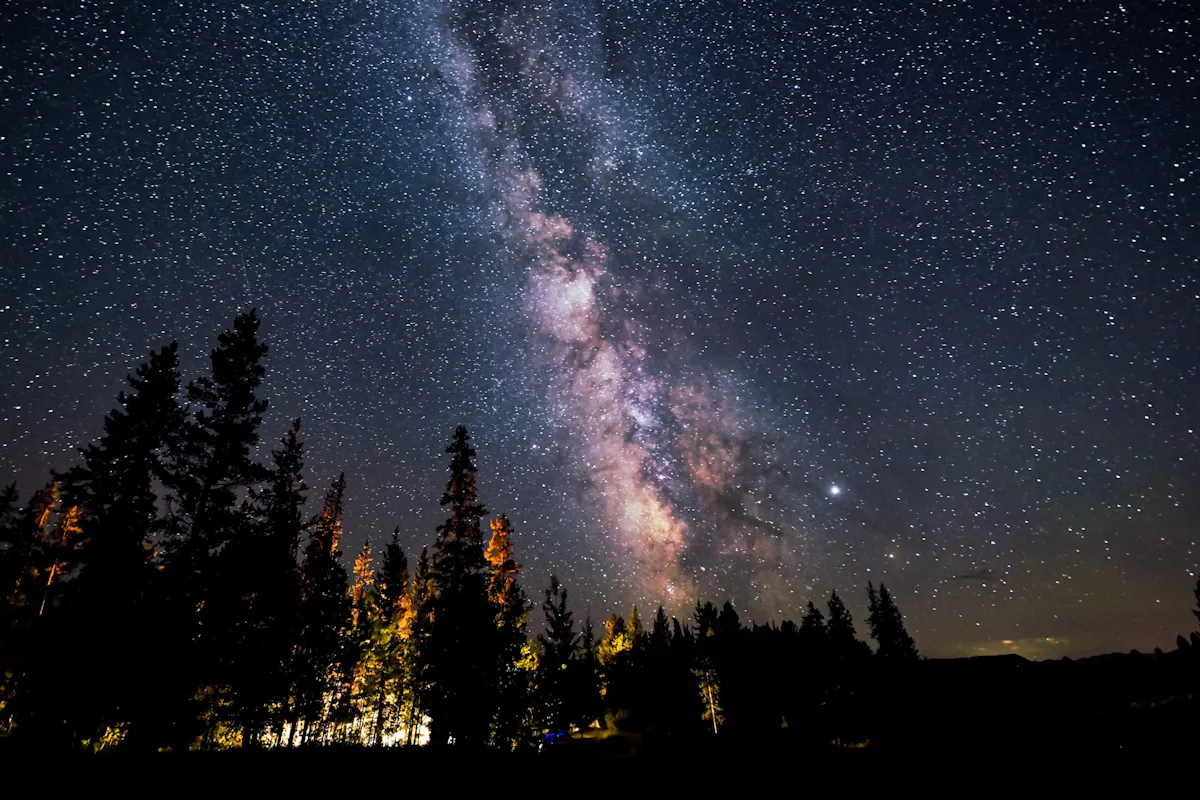
For RV travelers, the park offers well-maintained campsites at The Sawmill and Popo Agie campgrounds. Summer expeditions can be strategically timed to coincide with annual celestial events, such as the Perseid meteor shower, offering visitors thousands of opportunities to witness shooting stars streaking across the canyon rim.
Devils Tower National Monument: A Monolith Beneath the Cosmos
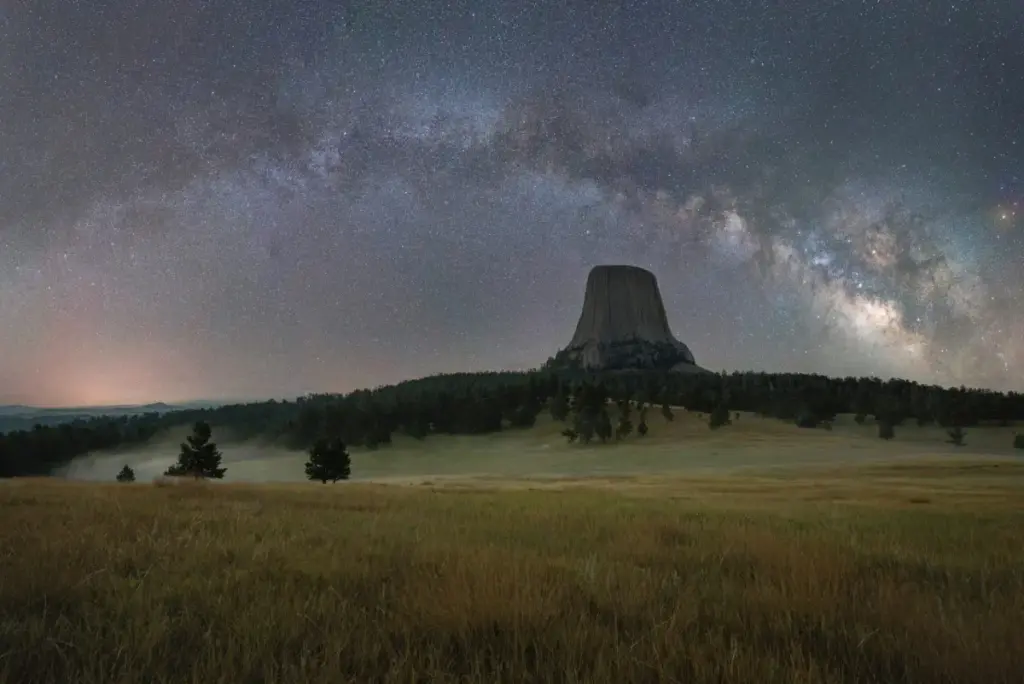
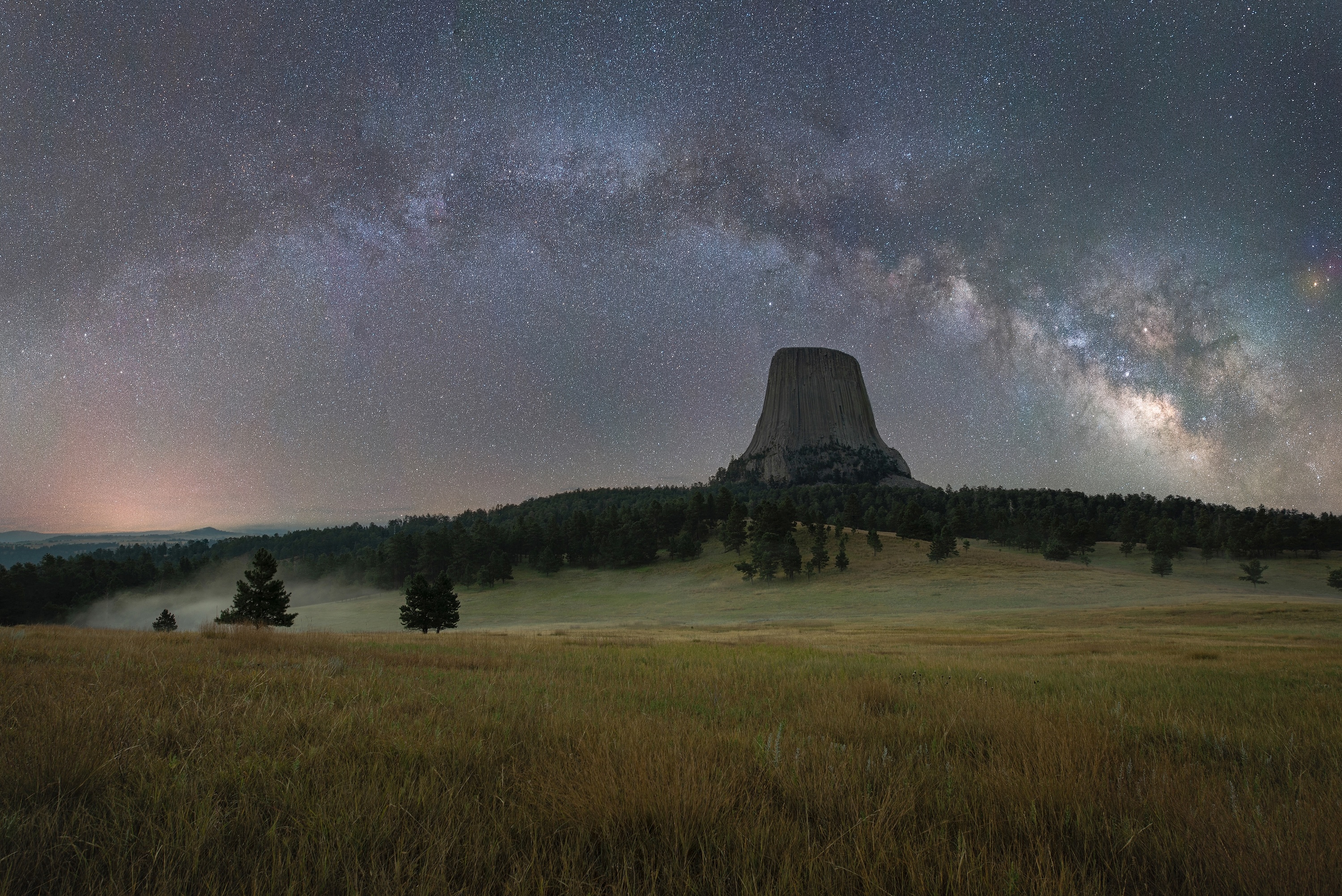
Rising 867 feet above the rolling prairie of northeastern Wyoming—with a summit area roughly the size of a football field—Devils Tower is an imposing geological marvel by day. By night, this monolithic igneous intrusion, held deeply sacred by the Northern Plains Tribes, transforms into a celestial pivot point around which planets and constellations wheel.
Designated as America’s first national monument by President Theodore Roosevelt in 1906, Devils Tower is also recognized as an International Dark Sky Park. The Belle Fourche River Campground, situated directly at the base of the monument, provides full RV hookups capable of accommodating rigs up to 35 feet in length. The National Park Service hosts frequent evening astronomy programs, complete with professional-grade telescopes and knowledgeable rangers who guide visitors through deep-space navigation.
Curt Gowdy State Park: Accessible Wilderness Near the Laramie Mountains
Situated just 24 miles west of Cheyenne, Curt Gowdy State Park proves that world-class stargazing does not require sacrificing modern convenience. Straddling the granite-carved Laramie Mountains, the park was named in honor of the legendary sports broadcaster and avid fly fisherman Curt Gowdy.
For RVers seeking an amenity-rich basecamp with minimal transit hassle, Curt Gowdy offers access to three distinct reservoirs and 12 designated camping areas capable of accommodating large rigs up to 50 feet. Specifically, the Granite Springs and Lakeview campgrounds feature electric hookups and open, elevated perches that afford sweeping horizons for tracking the eastern rise of constellations.
Medicine Bow–Routt National Forest: High-Elevation Purity
For travelers seeking total immersion in untamed wilderness, the Medicine Bow–Routt National Forest represents Wyoming in its purest iteration. Spanning high-elevation terrain between 8,000 and 12,000 feet along the Snowy Range Scenic Byway, this region offers an exceptionally thin, dry atmosphere free from light scatter.
The corridor provides access to dozens of dispersed camping sites welcoming self-contained RVs. While dispersed sites lack hookups and developed facilities, they deliver absolute solitude and unobstructed panoramic views. For RVers requiring developed amenities, campgrounds such as Pelton Creek, North Fork, and Silver Lake offer structured sites capable of accommodating larger recreational vehicles amidst dense subalpine pine forests.
Killpecker Sand Dunes: The Singing Sands of the Red Desert
Encompassing the largest living sand dune erg in North America, the Killpecker Sand Dunes offer an otherworldly stargazing landscape characterized by shifting topography and acoustic "singing" sands that boom and resonate when disturbed. Located deep within Wyoming’s Red Desert, the nearest municipality (Rock Springs) lies 32 miles away, effectively eliminating light pollution.
The Open Play Area Campground managed by the Bureau of Land Management is free to use and accessible to rugged RV setups. Beyond nocturnal observation, visitors can explore daytime geologic and cultural treasures, including the White Mountain Petroglyphs and the towering volcanic plug known as Boar’s Tusk.
Fremont Lake: Alpine Mirror of the Stars
Positioned at the foot of the Wind River Range near Pinedale, Fremont Lake is Wyoming’s second-largest natural lake, resting at an elevation of 7,400 feet. The surrounding camping infrastructure offers private, lakeside, RV-accessible sites that prioritize natural integration over dense development.
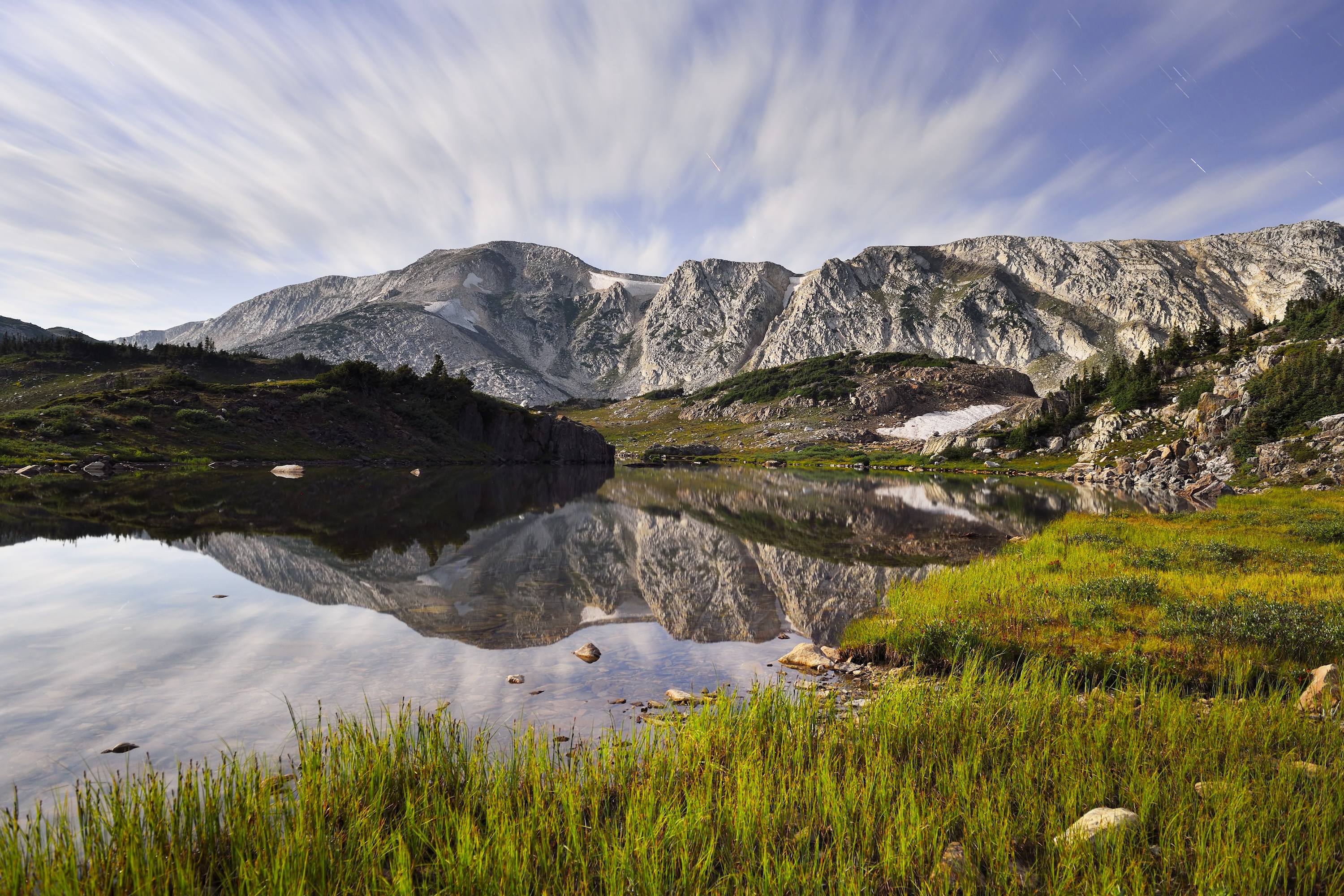
Because Pinedale has actively positioned itself as a premier astrotourism hub, municipal and county lighting codes are strictly managed to preserve the night sky. The waters of Fremont Lake act as a natural mirror, reflecting the starry canopy in absolute symmetry. For unobstructed horizon views, astronomers recommend heading down to the Fremont Lake Lower Boat Dock for a sunset viewing session followed by deep-sky observation.
Official Statements and Conservation Perspectives
As astrotourism gains momentum across the American West, land managers, tourism officials, and conservationists are increasingly vocal about the delicate balance between public access and environmental preservation.
"People frequently celebrate Wyoming for its wide-open terrestrial landscapes, but the grandest expanse of all lies straight up," notes a spokesperson for the Wyoming Office of Tourism. "By championing International Dark Sky designations in state parks and national monuments, we are safeguarding a vital natural resource. We invite travelers to experience not just our mountains and rivers, but the timeless heritage of our unblemished night skies."
Environmental scientists monitoring regional dark skies emphasize that preserving nocturnal darkness is not merely an aesthetic endeavor, but an ecological necessity. Artificial light at night (ALAN) disrupts the circadian rhythms, navigation patterns, and foraging behaviors of nocturnal wildlife—including migratory birds, bats, and native pollinators. By keeping campgrounds unlit and encouraging the use of shielded, low-impact lighting, Wyoming’s land management agencies are actively protecting local biodiversity while enhancing the visitor experience.
Future Outlook: The Trajectory of Astrotourism in the Cowboy State
Looking ahead, the intersection of RV infrastructure development and dark-sky conservation is poised to shape the future of Wyoming’s outdoor recreation economy. Several key trends will define this evolution over the coming decade:
- Expansion of Certified Dark-Sky Places: Municipalities and public land trusts across Wyoming are actively evaluating regional lighting ordinances to pursue additional International Dark Sky Association (IDA) certifications, expanding the geographic footprint of protected night skies.
- Infrastructure Upgrades for Sustainable Tourism: As demand for off-grid RV camping surges, public agencies are balancing the need for solar-friendly, sustainable campground upgrades with the preservation of dark-sky horizons, ensuring that increased visitation does not degrade the nocturnal environment.
- Educational Integration: Park systems are expanding their interpretive programming, integrating advanced telescopes, astrophotography workshops, and cultural storytelling that honors the astronomical traditions of Indigenous peoples.
Ultimately, Wyoming’s commitment to dark-sky preservation ensures that future generations of travelers can still look upward from the campfire circle and witness the same celestial majesty that guided ancient travelers across the North American continent.
Practical Guidelines for Your Wyoming Dark-Sky RV Adventure
To maximize safety, comfort, and astronomical enjoyment during a nocturnal expedition in Wyoming, travelers should adhere to the following best practices:
- Strategic Scheduling: Plan excursions around the lunar cycle. The two-week window surrounding the new moon provides the darkest skies, as even a quarter moon emits enough light to wash out faint nebulae and distant galaxies.
- Equip Digital Tools with Red Filters: Utilize astronomy applications such as SkySafari or Stellarium to identify constellations, planets, and celestial events. Always switch these devices to night mode (red-light screen) to prevent white light from destroying your night vision.
- Prepare for Extreme Thermal Dips: Due to high elevations and arid desert climates, Wyoming temperatures can plummet by 30 to 40 degrees Fahrenheit immediately after sunset, even during peak summer months. Pack comprehensive cold-weather layers for late-night observation sessions.
- Allow for Ocular Dark Adaptation: It takes the human eye approximately 20 to 30 minutes to achieve full dark adaptation. Protect this adjustment by utilizing low-intensity red flashlights rather than standard white-light torches when navigating around your RV campsite.
This article is sponsored by the Wyoming Office of Tourism.