







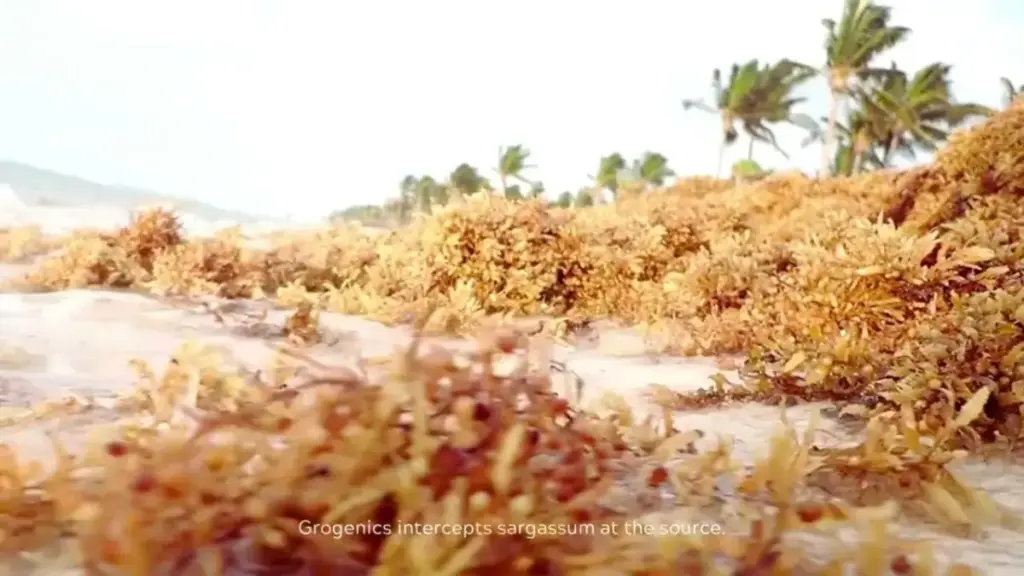
Along the sun-drenched coastlines of the Mexican Caribbean, a silent ecological and economic crisis washes ashore daily. Massive, unprecedented waves of golden-brown macroalgae known as sargassum are inundating pristine beaches from Cancun to Tulum. What was once a vital pelagic habitat in the Sargasso Sea has transformed into an aggressive, suffocating tide. Driven by warming ocean temperatures, shifting oceanic currents, and agricultural runoff rich in nitrogen and phosphorus, these record-breaking sargassum blooms have become a persistent environmental hazard.
When mountains of decaying seaweed pile up on tropical shores, they release potent greenhouse gases—most notably methane and hydrogen sulfide—while smothering nesting sea turtles, eroding beaches, and poisoning nearshore coral reefs with toxic leachate. Furthermore, the rotting mats emit a noxious sulfurous odor that has devastated the region’s multi-billion-dollar tourism industry, threatening the livelihoods of thousands of local residents.
Enter the Sargassum Recovery for Clean Coasts project, a pioneering initiative funded and championed through the Sustainable Travel International Climate Impact Portfolio. Rather than viewing the seaweed as an unmanageable waste product destined for crowded landfills, this initiative treats sargassum as an untapped resource. By intercepting the algae directly from the water or immediately upon landfall before the decomposition process begins, the project halts the emission of greenhouse gases at the source.
Through an innovative process of local collection and advanced biological detoxification—known as bioremediation—the harvested sargassum is fundamentally transformed. It is converted into a high-grade, biochar-enriched compost that not only revitalizes nutrient-depleted local soils and supports regional farmers, but also permanently sequesters carbon deep within the earth. This comprehensive, closed-loop model exemplifies the true potential of a circular blue economy, proving that economic development, tourism preservation, and climate resilience can successfully coexist.
Detailed Chronology: From Pelagic Paradise to Coastal Catastrophe
To fully understand the gravity of the current intervention, one must examine the timeline of how sargassum evolved from an obscure oceanic phenomenon into a continental crisis.
The Shift (2011–2014): The Birth of the Great Atlantic Sargassum Belt
For decades, sargassum existed primarily in the Sargasso Sea—a region of the Atlantic Ocean bounded by four currents. It served as a critical nursery, feeding ground, and habitat for fish, turtles, marine birds, and whales. However, oceanographers mark 2011 as a historic turning point. Due to a confluence of shifting wind patterns, unusually warm sea-surface temperatures, and massive nutrient plumes pouring out of the Amazon and Congo rivers, sargassum began proliferating wildly across the central Atlantic. This marked the birth of the "Great Atlantic Sargassum Belt," a sprawling mass stretching from the coast of West Africa all the way to the Gulf of Mexico.
Escalation and Crisis (2015–2019): Overwhelming the Riviera Maya
By the mid-2010s, Caribbean nations began experiencing the devastating effects of this new oceanic reality. In Mexico, the state of Quintana Roo found itself on the front lines. Tourism operators watched in horror as pristine white-sand beaches were buried beneath meters of rotting, foul-smelling seaweed. Traditional removal methods proved entirely inadequate. Heavy machinery compacted the sand, destroyed turtle nests, and accelerated beach erosion. Millions of dollars were spent on emergency manual cleanups, yet the tide remained relentless, arriving earlier and staying longer each year.
The Pandemic Pause and Resurgence (2020–2022)
While global human activity ground to a halt during the COVID-19 pandemic in 2020, nature continued unabated. Sargassum blooms broke previous records, blanketing nearshore waters and suffocating marine life. As international travel slowly resumed in 2021 and 2022, Mexican authorities and local stakeholders realized that temporary, reactive measures were futile. A systemic, sustainable, and scientifically rigorous approach was urgently required to intercept the seaweed before it struck the coast and began its toxic decay cycle.
The Genesis of the Intervention (2023–Present)
Recognizing the ecological and economic imperative, environmental innovators and local stakeholders joined forces to launch structured interventions like the Sargassum Recovery for Clean Coasts initiative. By integrating advanced bioremediation techniques developed in partnership with organizations like Grogenics, the project moved past simple cleanup efforts. It established a formalized pipeline: intercepting the algae at sea or immediately upon touching the shore, neutralizing its heavy metals and high salt content through biological processes, and transforming it into valuable agricultural amendments. Today, this initiative stands as a global benchmark for turning climate threats into circular economic opportunities.
Supporting Context & Metrics: The Science of the Sargassum Threat
The necessity of the Sargassum Recovery for Clean Coasts project becomes strikingly clear when examining the hard data surrounding sargassum blooms, their chemical composition, and their wide-ranging environmental impacts.
Ecological and Chemical Impacts
Sargassum is naturally hyper-accumulative, meaning it acts as a sponge for heavy metals—including arsenic, cadmium, lead, and mercury—present in polluted ocean waters. When millions of tons of this heavy-metal-laden seaweed wash ashore and begin to decompose in the tropical sun, two major catastrophes unfold:
- Atmospheric Degradation: Anaerobic bacteria break down the organic matter, releasing massive quantities of methane ($textCH_4$)—a greenhouse gas with a global warming potential significantly higher than carbon dioxide over a 20-year period—alongside hydrogen sulfide ($textH_2textS$), which poses severe respiratory risks to humans and wildlife.
- Leachate Runoff: As rain falls on rotting coastal sargassum piles, it creates a toxic dark liquid (leachate) that seeps back into the coastal water table and nearshore coral reefs. This runoff introduces lethal doses of salt, heavy metals, and nutrients, triggering massive algae blooms, coral bleaching, and coastal dead zones.
Quantitative Metrics of the Intervention
The Sargassum Recovery project utilizes precise metrics to gauge its ongoing success:
- Carbon Sequestration Efficiency: Through the production of biochar—created by pyrolyzing (heating in the absence of oxygen) stabilized sargassum biomass—carbon that would otherwise return to the atmosphere as $textCO_2$ or methane is locked into a stable, solid form for hundreds of years.
- Soil Restoration Metrics: Field trials in agricultural regions of Mexico indicate that biochar-enriched sargassum compost significantly improves soil water-retention capacity by up to 30%, reduces the need for synthetic nitrogen fertilizers by 25%, and raises overall crop yields for local farmers cultivating staple crops like maize and tropical fruits.
- Volume Intercepted: Modern operational efforts target the removal of thousands of wet metric tons of sargassum annually from vulnerable ecological zones, directly preventing metric tons of methane from entering the atmosphere.
Official Statements and Stakeholder Perspectives
The multi-faceted nature of the Sargassum Recovery for Clean Coasts project requires close collaboration between environmental scientists, conservationists, local agricultural communities, and international travelers.
Dr. Elena Vasquez, a marine ecologist specializing in Caribbean coastal systems, highlights the urgency of upstream interception:
"For years, we treated sargassum like an inconvenient trash problem on our beaches. We failed to recognize that once this biomass begins to rot, it is an active climate bomb. By intercepting the algae before decay sets in and utilizing advanced bioremediation, we neutralize its toxic heavy metal profile and protect our coral reefs from catastrophic leachate runoff. This is not just coastal maintenance; it is frontline marine defense."
Mateo Gomez, a regional agricultural cooperative leader working closely with the project, emphasizes the direct benefits to local farming communities:
"For generations, our soils have been degraded by intensive chemical farming and prolonged dry spells. The conversion of sargassum into biochar-enriched compost has been nothing short of revolutionary for our crops. We are seeing healthier root systems, better moisture retention during droughts, and—most importantly—we are taking a massive environmental problem off our beaches and putting it to work right here in our fields."
Representatives from Sustainable Travel International underscore the role of responsible tourism and carbon offset integration:
"Our Climate Impact Portfolio is designed to back projects that deliver verifiable, systemic benefits across multiple dimensions of sustainability. The Sargassum Recovery project perfectly encapsulates our vision. It protects coastal tourism economies, empowers local farmers, restores depleted soils, and provides high-integrity carbon removal. It proves that travelers and local communities can actively contribute to a thriving circular blue economy."
Future Outlook: Scaling the Blue Economy
As climate change continues to alter oceanic conditions, scientists project that massive sargassum blooms will remain a recurring, if not permanent, fixture of the tropical Atlantic and Caribbean. Consequently, the long-term success of the region relies entirely on moving away from temporary, reactive crisis management and toward permanent, scalable infrastructural solutions.
Technological Innovations and Processing Expansion
Future phases of the Sargassum Recovery initiative aim to scale up bioremediation facilities across the entire Riviera Maya and expand into neighboring Central American and Caribbean nations facing identical challenges. Innovations in mechanical harvesting vessels, coupled with low-carbon drying and pyrolysis technologies, will streamline the transition from raw seaweed to certified organic biochar. Furthermore, ongoing research is exploring advanced biochemical applications for sargassum extracts, including biodegradable bioplastics, natural animal feed additives, and pharmaceutical compounds.
Integrating Tourism, Agriculture, and Climate Finance
The ultimate promise of this project lies in its blueprint for a true circular blue economy. By bridging the gap between coastal tourism—which generates the economic engine of the region—and inland agriculture—which feeds the population—the project creates a self-sustaining financial loop. Carbon offset contributions from travelers and corporations directly subsidize the high costs of maritime collection and bioremediation. In turn, this clean input is returned to the earth as a valuable commodity, closing the loop on a waste stream that once threatened to overwhelm an entire ecosystem.
Ultimately, the Sargassum Recovery for Clean Coasts project demonstrates that humanity’s most daunting environmental challenges can become catalysts for profound innovation. By transforming a coastal catastrophe into agricultural gold, this initiative offers a hopeful vision of resilience, proving that our oceans and communities can not only survive, but ultimately thrive together.