








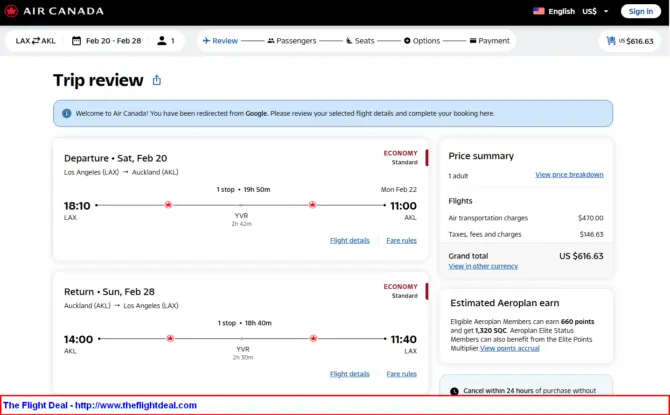
The transpacific aviation market has long served as a crucial economic and tourism bridge linking North America to the southern hemisphere. Recently, travel analysts and value-seeking globetrotters have turned their attention toward a notable development in airline pricing: a competitively priced regular economy fare connecting the United States to Auckland, New Zealand (AKL). This newly surfaced offering breaks away from the traditionally prohibitive cost structure often associated with long-haul oceanic routes, presenting an accessible entry point for travelers looking to explore New Zealand’s dramatic landscapes, vibrant indigenous culture, and bustling urban centers.
Unlike ultra-low-cost carrier tickets that strip away essential amenities, this fare includes a standard checked bag, preserving the baseline comfort and convenience modern travelers expect on journeys exceeding twelve hours in the air. For budget-conscious wanderers and corporate travelers alike, uncovering these pricing adjustments requires continuous monitoring of global distribution systems, fare basis codes, and yield management strategies utilized by major international carriers.
As the global aviation industry continues its post-pandemic realignment, airlines are constantly recalibrating capacity, adjusting route networks, and experimenting with dynamic pricing models to stimulate demand during shoulder seasons. This report provides an in-depth, authoritative analysis of the current market conditions surrounding flights to Auckland, the mechanics of securing competitive economy airfares, and the broader economic trends shaping transpacific commercial aviation.
Detailed Chronology
The Evolution of Transpacific Pricing Strategies
To understand the significance of current fare adjustments, one must examine the historical trajectory of commercial air travel between North America and New Zealand. For decades, the route was characterized by limited competition, heavily dominated by legacy flag carriers operating wide-body aircraft with high operational overhead. Consequently, economy tickets to Auckland commanded premium prices, often acting as a deterrent for budget-conscious leisure travelers.

In recent years, however, the competitive landscape has shifted dramatically. The introduction of new market entrants, increased point-to-point frequencies, and the deployment of ultra-long-range, highly fuel-efficient aircraft—such as the Boeing 787 Dreamliner and Airbus A350 families—have altered airline cost structures. Carriers gained the operational flexibility to test new pricing thresholds, leading to periodic fare drops designed to stimulate demand in historically lower-yielding travel windows.
Recent Market Movements and Fare Discoveries
The identification of attractive economy fares to Auckland highlights the reactive nature of modern yield management. Airlines frequently file flash sales and localized promotional fares to balance loads on specific transpacific corridors. These pricing events often materialize without advance warning, creating a fast-paced environment where proactive travelers must act decisively.
[Timeline of Transpacific Fare Monitoring & Acquisition]

 ┌────────────────────────┐     ┌────────────────────────┐     ┌────────────────────────┐
 │   Inventory Release    │ ──> │  Real-Time Detection   │ ──> │   Immediate Booking    │
 │ (Dynamic Yield Adjust) │     │ (Automated Aggregators)│     │  (Securing Bag Inclus) │
 └────────────────────────┘     └────────────────────────┘     └────────────────────────┘
When monitoring these fluctuations, industry observers note that fares including a checked baggage allowance are becoming increasingly valuable. As ancillary fees for luggage, seat selection, and onboard services continue to mount across the industry, an all-inclusive baseline economy fare provides transparent, predictable travel costs for consumers navigating complex international itineraries.
Supporting Context & Metrics
Economic Fundamentals of Long-Haul Aviation
Operating a commercial flight across the Pacific Ocean is a capital-intensive undertaking. Airlines must balance astronomical fuel expenditures, aircraft leasing or depreciation costs, navigation fees, airport landing charges, and crew compensation. The profitability of an economy-class cabin relies heavily on high seat-factor utilization—filling every available square foot of the aircraft to offset the low yield per individual passenger compared to premium cabins.

- Fuel Burn and Efficiency: Transpacific routes require immense fuel loads, making jet fuel price volatility a primary determinant of baseline economy pricing. Modern twin-engine wide-body aircraft have improved fuel burn metrics per available seat mile (ASM), giving carriers the margin needed to offer promotional fare discounts during periods of softened demand.
- Ancillary Revenue Models: Modern airlines increasingly rely on unbundled pricing, where basic economy tickets exclude checked bags and advance seat assignments. The discovery of a fare that includes a checked bag represents a notable consumer advantage in an era where ancillary fees can easily add $100 to $200 to a round-trip journey.
Strategic Travel Planning and Fare Intelligence
For travelers seeking to capitalize on fluctuating international airfares, reliance on traditional, manual search methods is rarely sufficient. The speed at which airlines adjust inventory requires sophisticated tracking mechanisms and dedicated alert systems.
- Real-Time Subscriptions vs. Public Feeds: Premium fare tracking services employ automated scrapers to monitor Global Distribution Systems (GDS) around the clock. Subscribers to real-time notification channels often receive alerts up to an hour before deals are published on public-facing websites or social media platforms. In competitive fare environments, this time differential can mean the difference between successfully booking a discounted seat and facing a sold-out inventory class.
- Cabin-Class Segmentation: While economy deals attract the highest volume of leisure travelers, parallel monitoring systems cater to those seeking business class, premium economy, or first-class products. These distinct market segments operate under entirely different yield management rules, requiring specialized alert networks to capture premium promotional inventory.
Official Statements and Industry Insights
Perspectives from Airline Revenue Management Executives
Commercial aviation executives emphasize that promotional pricing is not a random occurrence, but rather the result of sophisticated mathematical modeling and predictive analytics.
"Yield management is about filling the airplane at the highest possible average price point, but it also requires aggressive tactical intervention when forward-booking curves dip below projected models," explains a veteran airline pricing strategist who spoke on the condition of anonymity. "When we introduce promotional economy inventory on long-haul routes like the transpacific corridor, we are targeting price-sensitive discretionary travelers who would otherwise defer their travel plans."
Industry analysts also point out that international aviation partnerships—such as global airline alliances (Star Alliance, Oneworld, SkyTeam) and joint-business ventures—play a critical role in fare setting. Partner airlines coordinate schedules and share revenue on specific routes, allowing them to collectively manage capacity and introduce targeted promotional fares without destabilizing core market yields.

Consumer Advocacy and Transparency
Consumer protection groups and travel watchdogs frequently monitor airline pricing transparency, particularly regarding ancillary fees and baggage policies. The inclusion of a checked bag in a baseline economy promotional fare aligns with consumer advocacy goals of providing clear, upfront pricing without hidden surprises at the check-in counter. Travel experts consistently advise consumers to review the fine print of any international airfare, paying close attention to change fees, cancellation policies, and fare basis rules before completing a purchase.
Future Outlook
The Future of Transpacific Air Travel
Looking ahead, the market for flights between North America and destinations like Auckland is poised for continued evolution. Several key trends will dictate how airfares behave in the coming years:
- Fleet Modernization and Ultra-Long-Range Capabilities: As manufacturers continue to deliver next-generation aircraft capable of flying further with greater fuel efficiency, airlines may introduce new nonstop city pairs. This decentralization of transpacific traffic could introduce competitive pressures that drive down economy fares across a broader array of origin airports.
- Technological Integration and AI-Driven Pricing: Artificial intelligence and machine learning are increasingly integrated into airline pricing algorithms. Future fare fluctuations will likely occur with greater frequency and precision, reacting instantly to macroeconomic indicators, currency fluctuations, and shifting consumer sentiment.
- Sustainability Mandates and Carbon Pricing: The global aviation industry faces mounting pressure to reduce its carbon footprint through the adoption of Sustainable Aviation Fuels (SAF) and carbon offset initiatives. As regulatory frameworks tighten—particularly in regions like the European Union and parts of the Asia-Pacific—these compliance costs will inevitably be factored into baseline ticket prices, potentially altering the frequency and depth of future discount fares.
Strategic Recommendations for Travelers
To successfully navigate this dynamic environment, travelers should adopt a disciplined approach to trip planning:
- Maintain Flexibility: Being open to shifting travel dates by a few days can unlock significantly lower fare classes.
- Leverage Automated Alerts: Utilizing dedicated flight deal notification services ensures early access to limited-inventory promotional fares before they are exhausted.
- Understand Fare Rules: Always verify whether a promotional ticket includes baggage, seat selection, and change flexibility to avoid unexpected downstream expenses.
In conclusion, while the aviation market remains subject to macroeconomic pressures and dynamic pricing shifts, the emergence of well-priced, inclusive economy fares to Auckland demonstrates that value remains attainable for the proactive traveler. By combining real-time market intelligence with a strategic approach to booking, passengers can continue to explore the globe efficiently and economically.