The true elegance of an exceptional travel itinerary lies not merely in stringing together a sequence of picturesque viewpoints, but in how seamlessly its destinations fit into a cohesive narrative. The inland regions of Catalonia—specifically the rugged, culturally rich sweep of the Girona Pyrenees—offer a masterclass in depth-driven tourism. This is a landscape designed for travelers who seek an interior region rich in historical resonance, material culture, and profound tactile experiences rather than fleeting, superficial snapshots.
Spanning three meticulously curated days, this route acts as both an ideal introduction for first-time visitors and a rewarding return journey for seasoned explorers. It connects Ripoll, the historic cradle of Catalan identity, with Sant Joan de les Abadesses, a symbol of rare medieval female governance. It routes through Campdevànol, a living memory of iron, water, and traditional woolcraft; moves onto Camprodon, the showcase of bourgeois summer retreats; transitions through Ribes de Freser as a sanctuary of mountain gastronomy; and concludes in the high-altitude, stony silence of Montgrony.
Far from a standard vacation guide, this exploration digs deep into the foundational myths, industrial revolutions, ecological craft traditions, and architectural eccentricities that shaped the modern Catalan interior.
Detailed Chronology
Day 1: Ripoll, the Great Gateway to Catalan Memory
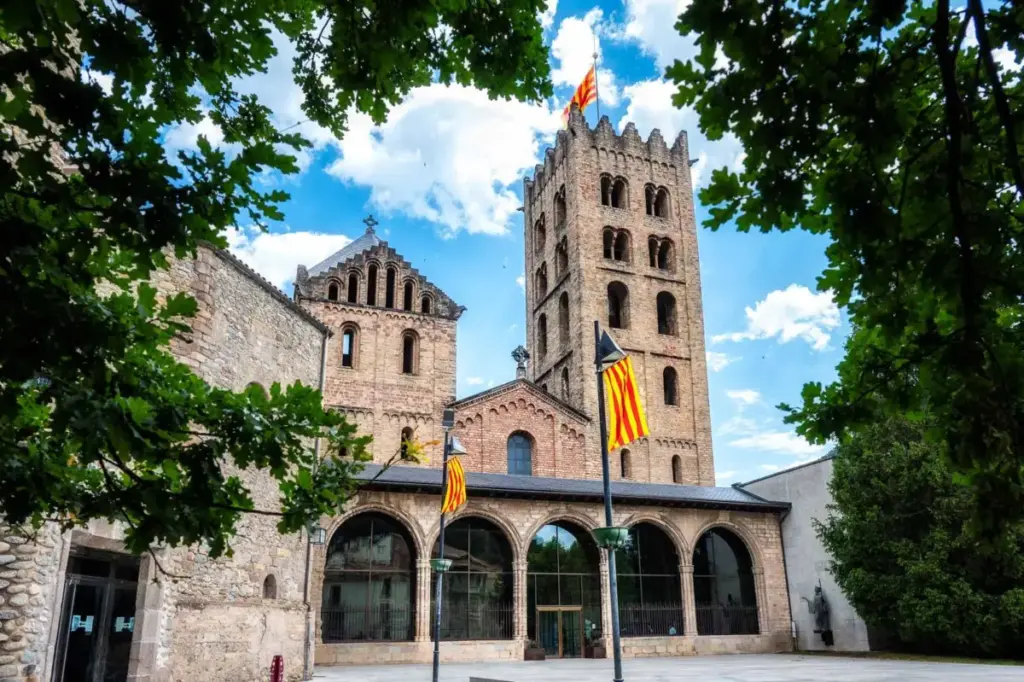
The journey begins in Ripoll, a town that immediately sets an authoritative tone for the expedition. Some locations serve merely as departure points; Ripoll belongs firmly to the rare category of places that encapsulate the emotional and historic blueprint of an entire territory. Often hailed as the "cradle of Catalonia," its monumental weight in the formation of the nation remains palpable.
At the epicenter of this magnetism stands the Monastery of Santa Maria de Ripoll. Founded by Wifredo the Hairy in 879 AD, it evolved into one of the paramount spiritual and intellectual beacons of medieval Catalonia. Standing before its Romanesque portal—added in the 12th century and celebrated as one of the crowning achievements of European stone sculpture—one quickly realizes this is not a passive sightseeing stop. It is a masterclass in reading history and identity directly through stone.
[Ripoll: Foundation (879 AD)]
       │
       ├──► Santa Maria de Ripoll (Spiritual & Political Power)
       ├──► The Romanesque Portal (12th-Century Sculptural Masterpiece)
       ├──► The Scriptorium (Medieval Knowledge & Codex Production)
       └──► Ethnographic Museum & Som Formatgers (Material Culture & Local Dairy)
Inside, the complex deepens through its cloister, archaeological remains, and the tombs of towering figures such as Ramón Berenguer III and Wifredo the Hairy himself. Wifredo’s legacy is inextricably linked both to the monastery’s origins and to the enduring romantic legend of the Catalan flag, the Senyera.
According to popular folklore, the four red stripes of the Senyera originated from the battle-wounded body of Wifredo. As the story goes, the Frankish king Charles the Bald dipped his fingers into the count’s bleeding wounds and traced four crimson lines across his golden shield. While modern historians confirm this is a romantic myth lacking documentary evidence—the heraldic bars did not appear until three centuries later—the tale has woven itself so deeply into the regional consciousness that it remains an inseparable companion to the monastery’s imposing presence.
The Scriptorium and Medieval Intelligence
Just steps away, the Ripoll Scriptorium dismantles the lazy, antiquated trope of the Middle Ages as a "dark and crude" epoch. While the monastery speaks to spiritual and political dominance, the Scriptorium illuminates the immense value placed on knowledge. Visitors are invited to understand how manuscripts were laboriously copied, how parchment was stretched from animal skins, and why a single book represented an object of extreme luxury and ostentation.
The process demanded grueling precision. Natural pigments—often bound with egg yolk to secure color fastness—and micro-lettering were utilized to conserve precious materials under the fading light of the cloister. Visitors can even test their dexterity with quill and ink, quickly discovering the immense physical toll exacted by medieval text production.
The day rounds out with a visit to the Ethnographic Museum of Ripoll, expanding the narrative from elite ecclesiastical history down to everyday material culture, trade, farming implements, and traditional textiles. Day one culminates in a pastoral cheese-tasting session with Som Formatgers, grounding the historical immersion back into the present moment through free-roaming, pasture-fed mountain dairy.
Night falls at the Hotel Abbatissa in Sant Joan de les Abadesses, a municipal hotel perched on a quiet hillside that doubles as a social inclusion project, employing a staff with diverse abilities while delivering refined local cuisine and restorative calm.
Day 2: Sant Joan de les Abadesses, Campdevànol, and Apicultural Heritage
The second day opens in Sant Joan de les Abadesses. If Ripoll commands respect through political and symbolic lineage, Sant Joan stuns through a history of female empowerment almost unprecedented for its era. Founded in the late 9th century as Catalonia’s first female monastery, it was governed by women for over a century—not as a token gesture, but as absolute administrators of spiritual, economic, and territorial sovereignty.
These pioneering abbesses commanded vast estates and wielded significant political leverage until political maneuvering and subsequent ecclesiastical fallout abruptly dismantled the female community in the late Middle Ages. The monastery, consecrated in 1150, stands as an architectural triumph of 12th-century Romanesque design, yet its historical narrative remains its most compelling asset.
Literary Resonance and Industrial Might
Stepping out into the Vila Vella, the urban fabric reveals how the town expanded directly in the shadow of the monastery. This locality holds a profound place in Catalan literature; poet Joan Maragall spent his summers here, penning iconic works such as El comte Arnau and La vaca cega.
Transitioning from medieval monasticism to industrial archaeology, the route leads to Campdevànol and the Centre PyFer del Ferro i de l’Aigua, housed within a restored 17th-century flour mill. Here, the narrative shifts to the elemental forces that drove the local economy: water power and iron metallurgy.
Industrial Evolution in the Ripollès:
┌─────────────────────────┐     ┌──────────────────────────┐     ┌────────────────────────┐
│ Water Power (Mill Race) │ ──► │ Catalan Forge (Metallurgy)│ ──► │ The Nail-Makers        │
└─────────────────────────┘     └──────────────────────────┘     └────────────────────────┘
                                                                        │
                                                                 (60,000 nails/month)
Campdevànol evolved from scattered parishes into a vital manufacturing hub thanks to its iron deposits and the ingenuity of its nail-makers (claveteros), who could produce up to 60,000 hand-forged nails a month for distribution across the country. Following a locally sourced, vanguard-infused lunch at the restaurant S’ha Acabat el Bròquil, the afternoon dives into apiculture at La Botiga de la Mel in Ribes de Freser.
This honey tasting transcends a standard gourmet retail stop. It offers a deep dive into hive dynamics—exploring the roles of drones and queens, extraction methods, and the expansive array of hive derivatives including propolis, royal jelly, beeswax candles, and medicinal balms.
The day concludes at the Hotel Resguard dels Vents in Ribes de Freser, featuring valley views, comprehensive thermal spa circuits, indoor and outdoor infinity pools, and a zero-kilometer dining philosophy designed to anchor the traveler deep into the physical sanctuary of the Pyrenees.
Day 3: Woolcraft, Bourgeois Summer Retreats, and High-Altitude Stone
OvellaLab and the Value of Slow Fibers
The final day opens in Campdevànol with an experiential workshop at OvellaLab, shifting the focus to traditional textiles, animal husbandry, and sustainable organic materials. In an age dominated by synthetic fast-fashion, this wool workshop operates entirely without electrical machinery, employing manual spinning wheels and slow, deliberate processes.
The statistics revealed during the workshop are startling:
Out of every one ton of raw fleece collected, only 500 to 600 kilograms remain clean and usable.
A single Ripollesa sheep yields approximately 700 grams of genuinely functional wool.
Transforming 120 kilograms of clean wool yields just 50 kilograms of finished yarn.
These numbers challenge modern consumption habits, highlighting why 100% natural wool reacts organically to use—pilling over time precisely because it is natural, breathable, and fully repairable rather than a disposable plastic blend.
Camprodon and the 19th-Century Bourgeoisie
The journey presses onward to Camprodon, a picturesque town whose current aesthetic was largely forged by the 19th-century bourgeois summer retreat phenomenon (veraneo). Wealthy families from Barcelona flooded the valley, constructing elegant villas, manicured tree-lined promenades, and establishing an infrastructure of leisure.
The Passeig de la Font Nova preserves this architectural memory, where physicians, lawyers, and architects established their summer estates. Camprodon is also the birthplace of the famous Birba biscuit factory, born from a local grocer who recognized a commercial opportunity in catering to affluent vacationers desiring a taste of the mountains to take back to Barcelona.
Further along, the Passeig Maristany—developed in the mid-1920s—displays even grander mountain architecture, including the Vora del Ter estate where Dr. Juan Negrín (prime minister of the Second Spanish Republic) resided toward the end of the Civil War. Most remarkably, one of the estates along this promenade integrates a genuine Romanesque church and cloister transported stone-by-stone from San Esteban de Gormaz in Soria, capturing the eccentric architectural ambition of the era’s elite.
Montgrony: Silence and Vertical Stone
The ultimate ascent of the journey leads to the Santuario de Montgrony. Perched dramatically in a high mountain amphitheater, the sanctuary sits below an upper church accessed via 144 steps hand-carved directly into the rock face—a design echoing the biblical symbolism of Jacob’s Ladder.
With simple, television-free hospideria rooms, lack of digital distractions, and a profound atmosphere of mountain quietude, Montgrony strips away the historical discourses of the previous days in favor of raw contemplation, panoramic hiking trails, and a definitive concluding stillness.
Supporting Context & Metrics
Region / Stop
Primary Historical Era
Core Economic Driver / Craft
Key Cultural Asset
Ripoll
9th–12th Century
Ecclesiastical & Scriptorial Power
Monastery of Santa Maria & Scriptorium
Sant Joan de les Abadesses
9th–12th Century
Female Monastic Governance
Abbey Complex & Vila Vella
Campdevànol
17th–19th Century
Iron Metallurgy & Wool Processing
Centre PyFer & OvellaLab
Ribes de Freser
Contemporary
Apiculture & Thermal Hospitality
La Botiga de la Mel & Resguard dels Vents
Camprodon
19th–20th Century
Bourgeois Tourism & Confectionery
Passeig Maristany & Birba Factory
Montgrony
Medieval / High Alpine
Spiritual Sanctuary & Pastoralism
Rock-Cut Staircase & Upper Church
Official Statements
Local cultural authorities and heritage stewards have increasingly emphasized the importance of value-added tourism over mass transit through the Pyrenean interior.
"Our objective across the Girona Pyrenees is not to turn our historic villages into open-air museums for brief afternoon strolls," notes regional heritage coordination representatives. "When a traveler engages with the Ripoll Scriptorium, handles raw wool at OvellaLab, or tastes pasture-fed cheeses from local shepherds, they are participating in a living continuity. The landscape is merely the canvas; the cultural memory, industrial heritage, and human scale are what make the journey truly enduring."
Furthermore, municipal tourism boards highlight the deliberate integration of social enterprise models, such as the inclusive staffing at municipal heritage hotels, proving that modern travel infrastructure can successfully merge high-end hospitality with community welfare and accessibility.
Future Outlook
As sustainable tourism trends shift away from overcrowded coastal resorts toward culturally immersive interior destinations, the Girona Pyrenees are exceptionally well-positioned to lead this transformation. The ongoing preservation of industrial architecture—such as the flour-mill-turned-museums in Campdevànol—coupled with the revival of traditional agrarian crafts like organic wool production and artisan apiculture, guarantees that the region’s heritage remains active rather than static.
Future infrastructural developments within the Girona Pyrenean corridor are projected to prioritize non-motorized greenways, expanded slow-travel itineraries, and digital archiving of medieval manuscripts to support educational tourism. By maintaining a delicate balance between historical preservation, local product integrity, and quiet contemplation, these valleys ensure that future visitors will continue to experience a journey whose emotional and cultural resonance far exceeds the distance measured on the odometer.