







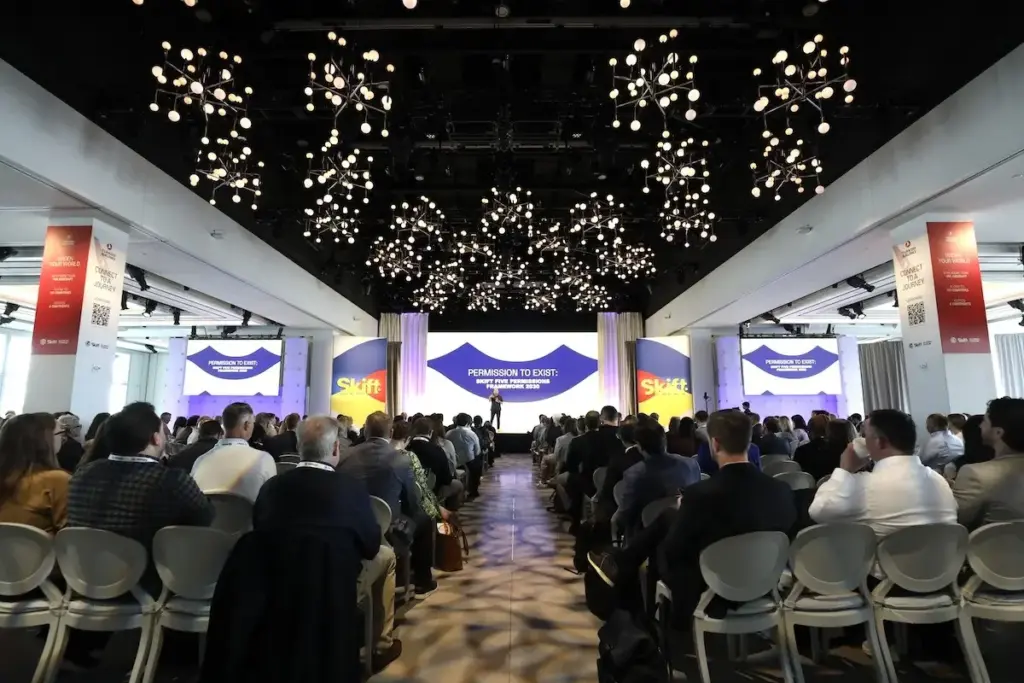
The global travel industry is currently experiencing a profound structural shift. While top-line demand remains robust, the underlying operational, economic, and technological foundations of the sector are being entirely redrawn. As executives prepare to gather for the Skift Global Forum 2026, scheduled for September 22–24, the central question hanging over the industry is no longer whether to adapt, but whether current strategic recalibrations are being designed for the correct decade.
According to research from the Skift Research State of Travel 2026 report, the modern travel ecosystem is built upon a four-layer stack: consumers, commerce, operations, and experiences. In the current market, every travel brand is being forced to defend its relevance across all four layers. Legacy assumptions that once reliably predicted traveler behavior, distribution costs, and booking channels have broken down. Today’s market is defined by two core tensions: a global travel market that continues to expand while rapidly shifting its geographic and demographic shape, and a technological landscape that is evolving far faster than consumer or corporate trust can keep pace.
The AI Fork in the Road: Legacy Retrofits vs. Startup Challengers
The intersection of travel and artificial intelligence has created a stark divide between industry incumbents and venture-backed challengers. For established travel brands, the primary return on investment (ROI) from AI has materialized as internal operational efficiency rather than consumer-facing transaction volume.
This operational focus is exemplified by platforms like Airbnb, which successfully leveraged AI to reduce its customer support cost per booking by approximately 16% in a single year. Similarly, Booking.com has utilized AI to streamline back-end operations, even as consumer booking behavior remains largely untouched by the technology. Currently, referral traffic driven by AI agents accounts for less than 1% of total room nights booked on Booking.com.
Travel Startup Funding Trends (AI-Enabled Startups Share)
=========================================================
2023:        ███ 10%
Mid-2025:    █████████████ 45%
In contrast, venture capital is betting heavily on a future where AI-native interfaces dominate the booking process. AI-enabled companies captured 45% of all travel startup funding by mid-2025, a dramatic increase from just 10% in 2023. This capital influx supports a wave of new entrants attempting to build entirely new distribution models from the ground up.
Caught in the middle of this divide are major players attempting to straddle both worlds. Airbnb’s CEO, Brian Chesky, has embarked on a comprehensive initiative to rebuild the platform as an AI-native company, even as the core, non-AI business continues to generate the revenue that funds this transition.

For distribution leaders who do not own their infrastructure, the strategic dilemma is acute. They must choose whether to align with legacy giants like Booking Holdings and Expedia, which possess the cash reserves and distribution scale to withstand prolonged transition periods, or to invest in retrofitting legacy systems that may ultimately prevent them from integrating with emerging AI-native booking ecosystems.
The New Search Paradigm: From ‘Search-and-Scroll’ to AI Curation
The mechanics of travel discovery are undergoing a fundamental transformation. The traditional consumer journey—characterized by search-and-scroll comparison shopping across multiple browser tabs—is being replaced by an "ask-shortlist-decide" paradigm.
According to Skift Research, consumer adoption of AI during the planning phase is rising rapidly. Nearly one-third (30%) of global travelers now report "extensive" use of AI for trip planning. This figure represents a 17-percentage-point increase in just twelve months, more than doubling the adoption rate of the previous year.
Consumer AI Adoption in Travel Planning
========================================
2024:    ████ 13%
2025:    █████████ 30% (+17pp increase)
However, while consumers are increasingly comfortable using AI to organize itineraries and generate ideas, they remain highly hesitant to use these platforms for transactions. Trust in direct brand channels and Online Travel Agencies (OTAs) remains high, whereas traveler sentiment regarding transactions completed entirely by AI agents is net negative. Currently, only 2% of leisure travelers are willing to delegate the actual booking and payment process to an AI assistant.
This disconnect presents a complex challenge for suppliers, particularly in the hospitality sector:
- The Visibility Crisis: Only 6% of hotels currently appear in AI-generated search results.
- The Data Trade-off: AI systems primarily recommend brands whose data is structured in a format the algorithm can easily read.
- The Control Dilemma: To gain visibility in AI search results, hotels must structure their data specifically for these models, which means ceding control over how their brand and pricing are represented.
- The Direct Funnel Risk: Conversely, prioritizing the protection of the direct booking funnel and proprietary customer data risks making a property entirely invisible to AI discovery engines.
The Premiumization Pivot: A High-Stakes Bet on Economic Inequality
As technological paradigms shift, the economic foundation of the travel industry is experiencing a profound socioeconomic bifurcation. Over the past two years, affluent travelers have disproportionately sustained the industry’s balance sheets, leading major brands to pivot their service offerings toward high-margin, premium products.

This trend is highly visible in the aviation sector. At Delta Air Lines, premium cabin revenue grew by 7% in 2025, while main cabin (economy) revenue fell by 5%. In the fourth quarter of 2025, premium revenue exceeded economy cabin revenue for the first time in Delta’s history—a trend that has continued into 2026, with nearly all of the carrier’s planned seat capacity growth dedicated to premium inventory.
Delta Air Lines Revenue Performance (2025)
==========================================
Premium Cabin Revenue:     ███████ +7%
Main Cabin Revenue:        █████ -5%
Competitors American Airlines and United Airlines are executing similar strategies, actively reconfiguring their fleets to ensure that premium seating comprises roughly half of all future cabin space.
| Airline | Premium Strategy (2025-2026) |
|---|---|
| Delta Air Lines | Premium revenue surpassed economy in Q4 2025; virtually all 2026 capacity growth targeted at premium seats. |
| American Airlines | Rebuilding aircraft configurations to target premium seats as ~50% of future cabins. |
| United Airlines | Matching fleet retrofits to expand premium cabin share to roughly half of available inventory. |
While premiumization offers higher margins and a temporary buffer against inflation, it also exposes travel brands to systemic risks. Skift Research indicates that 62% of global travelers plan to adjust or cancel their travel plans due to rising costs, highlighting a highly price-sensitive mass market that is actively trading down.
By restructuring their operations to cater primarily to high-net-worth consumers, airlines and hotel groups are placing a major bet on sustained income inequality. If the premium segment experiences a downturn, brands may find themselves with thinned customer bases and high-cost, low-density inventories that are difficult to fill with price-sensitive travelers.
The Hospitality Dilemma: Automating the Mid-Market without Losing Its Soul
In the hospitality sector, the tension between technology and human service has become a central strategic challenge. As labor shortages persist in critical customer-facing roles, hotel brands are increasingly deploying AI and automation to reduce frontline headcount and lower operational costs.
The Operational Mismatch
====================================================================
AI Investment Focus:  ██████████████████ (Reservations & Back-End Efficiency)
Labor Shortage Areas: ██████████████████ (Frontline & Human Touchpoints)
The prevailing industry strategy has been to treat human interaction as a premium service tier. Under this model, human-led service is priced as a luxury add-on, reserved for high-paying guests, while budget and mid-market brands transition to fully automated, self-service experiences.

While financially logical on paper, this approach carries significant long-term brand risk:
- Loss of Core Differentiation: Mid-market hotel brands risk losing the service-oriented touchpoints that historically differentiated them from short-term rentals and automated alternative accommodations.
- Irreversible Labor Reductions: Once frontline positions are eliminated and property operations are restructured around automated kiosks and digital concierges, rebuilding a service-oriented workforce during a market shift becomes extraordinarily difficult.
- The Capital Mismatch: Most current AI capital in hospitality is flowing toward booking and reservations efficiency, while the labor shortages most impacting guest satisfaction remain concentrated in physical, on-property service roles.
The Death of the Five-Year Plan: Speed Over Certainty in a Volatile World
The macroeconomic environment of 2026 has rendered long-term strategic planning obsolete. Geopolitical shifts, fluctuating currency values, and rapidly changing travel corridors are requiring brands to re-evaluate their strategic plans on a quarter-to-quarter basis.
This volatility is illustrated by the shifting patterns of inbound and outbound travel. In the United States, domestic travel volume has held steady at 2019 levels in real terms, while international inbound volume has fallen by 5.5%.
This shift caught many destination marketing organizations and international hotel operators off guard. The unpredictability of international recovery is further highlighted by the fact that industry forecasters recently pushed the timeline for a full recovery of U.S. inbound travel from 2025 to 2029 in a single downward revision.
U.S. Inbound Travel Recovery Timeline Revisions
===============================================
Previous Forecast:   2025
Revised Forecast:    2029 (Pushed back in a single revision)
Faced with such rapid changes, travel leaders are forced to choose between strategic speed and statistical certainty. Waiting for definitive market data before committing capital risks missing critical market windows entirely. Conversely, acting quickly on early indicators requires committing significant resources to trends that could reverse in the following quarter.
Strategic agility has evolved from a corporate buzzword into a vital operational necessity for surviving rapid shifts in global demand.

Navigating the Decades Ahead
As the travel industry convenes at the Skift Global Forum 2026, the overarching challenge for executives is to distinguish between short-term market corrections and permanent structural shifts. The global travel landscape has already begun a major reorganization:
- Geographic Corridors: Demand is shifting away from traditional North American and Middle Eastern routes toward emerging destinations in South America and Asia.
- Domestic vs. International: Shifting economic realities are altering the balance between domestic and international travel volumes.
- Product Tiering: Brands are navigating a stark divergence between premium high-margin services and cost-conscious mass market offerings.
- Search and Curation: The customer acquisition journey is transitioning from direct search queries to algorithmic AI curation.
The presentations and discussions at this year’s forum—featuring perspectives from legacy operators defending their scale, challengers seeking to disrupt distribution, and institutional investors allocating capital—aim to address these critical tensions.
Supported by knowledge partners and sponsors including McKinsey & Company, TBO, Brella, and Wordly, the event will provide the industry with the analytical frameworks needed to move beyond reactive forecasting and begin building business models designed for the next decade.