







In an era where premium hospitality is frequently defined by ostentatious displays of luxury and standardized global formulas, a quieter, more deliberate paradigm shift is taking root in the East. H World Group, one of the most prolific forces in the global hotel industry, is challenging the conventional luxury playbook with its new premium brand, Grand Ji Hotel.
By marrying a deeply rooted Chinese design philosophy with state-of-the-art technological and supply chain infrastructure, Grand Ji Hotel is attempting something rare in the hospitality sector: scaling an intimate, culturally nuanced guest experience across a rapidly growing brand portfolio.
As of June 30, H World Group’s massive global footprint comprised 13,539 hotels and more than 1.3 million operational rooms, with another 3,089 properties in its development pipeline. While the company has historically dominated the midscale and economy sectors with powerhouse brands like JI Hotel and Hanting—which ranked first and second globally by room count in a 2026 ranking of the world’s top 50 hotel brands—Grand Ji Hotel represents a highly strategic push into the premium market.
With two Grand Ji properties open as of late June, accounting for 441 rooms, and another 18 properties currently in the pipeline, H World is demonstrating how a hospitality giant can leverage its colossal operational scale to deliver a highly localized, sensory-driven guest experience.
Reimagining the Premium Experience: The Shift from "More" to "Better"
To understand the design ethos of Grand Ji Hotel, one must understand the changing expectations of the modern premium traveler. Kuang Ming (Ray) Chou, the founder and creative director of Vermilion Zhou Design Group and the chief designer at H World Group, observes that the traditional indicators of luxury—gilded lobbies, sprawling open spaces, and performative service—no longer resonate with today’s sophisticated guests.
"Premium guests today don’t necessarily want more," Chou explains. "They want better."
In the contemporary landscape, "better" is defined by intangibles: privacy, health, quietness, and effortless convenience. At Grand Ji Hotel, this perspective manifests in how space is conceptualized. Rather than creating massive, cavernous communal areas that can leave guests feeling exposed, the brand prioritizes a sense of protective distance and personal sanctuary.
This focus on spatial psychology is particularly relevant to modern Chinese travelers, who Chou notes have become highly sensitive to personal space and the proximity of strangers, especially when navigating unfamiliar environments. To address this, Grand Ji properties utilize light, elegant partitions in public areas such as the lobby, breakfast room, and fitness center. These architectural boundaries allow guests to feel connected to the hotel’s social energy while maintaining a comfortable sense of personal isolation and privacy.
The Five Anchors of Modern Chinese Hospitality
Rather than relying on superficial cultural motifs or literal historical replicas, the aesthetic and philosophical identity of Grand Ji Hotel is built around five fundamental natural anchors: water, clouds, tea, pine, and stone.
Each of these elements holds profound significance in traditional Chinese philosophy, representing ideals that transcend mere visual decoration:
- Water represents flexibility, softness, and quiet strength.
- Clouds evoke a sense of weightlessness and ethereal calm.
- Tea serves as the ultimate medium for human connection and daily hospitality.
- Pine symbolizes resilience, longevity, and a welcoming posture.
- Stone provides a grounding, permanent foundation.
Chou is quick to clarify that the integration of these elements is subtle and experiential rather than decorative. "We are not trying to put Chinese symbols everywhere and say, ‘Look, this is Chinese,’" Chou notes. "We are trying to go back to nature, and to the Chinese way of understanding nature."
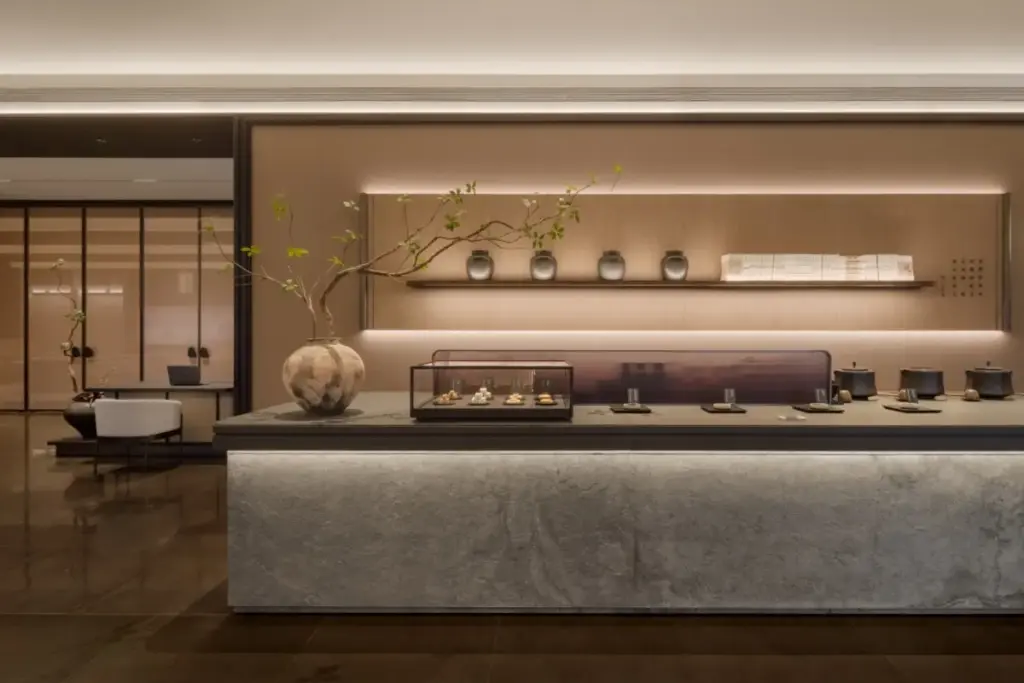
This philosophy is immediately apparent to guests upon arrival. Instead of confronting a traditional, imposing reception desk, travelers are guided to an understated check-in area centered around a long, communal tea table. Here, the check-in process is transformed into a welcoming tea ceremony. For domestic travelers, this ritual offers a comforting, deeply familiar transition from the road; for international visitors, it serves as an elegant, sensory introduction to the authentic customs of Chinese hospitality.
Designing for Silence and Restorative Sleep
In a hyper-connected, information-saturated world, true luxury is increasingly defined by the absence of noise. For Chou, creating a quiet environment is not just an aesthetic preference; it is a fundamental operational requirement linked directly to a hotel’s primary function: sleep.
"I think we are living in an age of too much information," Chou says. "When you are not quiet inside, when you are anxious or afraid, you cannot really rest."

To cultivate this mental and emotional quietude, Grand Ji Hotels are designed to slowly decompress the guest long before they reach their guestroom. The transition begins at the street level. A low exterior wall intentionally blocks direct views of the hotel lobby from the bustling street, requiring guests to walk alongside the barrier and slow their physical pace.
As they navigate this transition zone, guests encounter a welcoming pine tree and pass through an entryway lined with bricks made from compressed tea leaves. The subtle, earthy aroma of the tea leaves engages the guest’s sense of smell, acting as a sensory cue that they are entering a sanctuary of calm.
Inside, the hotel utilizes negative space, muted color palettes, and natural materials to reinforce this tranquil atmosphere. The design is deliberately restrained, encouraging a behavioral shift in guests. Chou notes that visitors naturally lower their speaking voices when entering Grand Ji public spaces, responding instinctively to the architectural cues of quietness without any explicit direction from staff.
Seamless Technology: Invisible Convenience in the Guestroom
While Grand Ji Hotel places a premium on natural materials and traditional philosophies, the entire experience is underpinned by H World Group’s advanced technology infrastructure. However, unlike many modern smart hotels that showcase technology for its own sake, Grand Ji adopts a philosophy where technology is meant to fade into the background.
Guests enjoy a frictionless stay through features like mobile-key room access, intuitive voice-controlled in-room amenities, and automated delivery systems. For example, rather than relying on a staff member to deliver extra towels or bottled water, the hotel utilizes autonomous service robots. This not only improves operational efficiency but also safeguards guest privacy by eliminating unnecessary face-to-face interactions.
Chou emphasizes that technology should serve to enhance, not distract from, the human experience. "I don’t want technology to become the main character," he says. Instead, technology should "disappear beside you," leaving the guest free to focus on the tangible, sensory aspects of their stay—the aroma of the tea, the texture of the materials, and the comforting stillness of the environment.
Scaling a Cultural Vision through Industrial Efficiency
One of the greatest challenges in the hospitality industry is maintaining the integrity of a highly detailed, artisanal brand concept during rapid market expansion. To solve this, H World Group is leveraging its immense industrial scale and supply chain capabilities to turn the Grand Ji design concept into a highly replicable business model.
In China’s competitive upper-midscale and premium segments, H World has established a dominant presence. In the second quarter of 2026, the company had 1,738 upper-midscale hotels open or in its development pipeline in China, representing a year-over-year increase of more than 13 percent.
H World Group - Upper-Midscale Footprint in China (Q2 2026)
┌─────────────────────────────────────────────────────────┐
│ Active & Pipeline Hotels: 1,738 Properties              │
├─────────────────────────────────────────────────────────┤
│ Year-over-Year Growth:   ▲ 13%+                         │
└─────────────────────────────────────────────────────────┘
To support the expansion of Grand Ji, H World utilizes a "one brand, one design" philosophy supported by advanced modular construction techniques. Key architectural and interior design elements are manufactured in controlled factory environments before being shipped directly to hotel sites for rapid assembly. This industrial approach guarantees an incredibly high level of craftsmanship and structural consistency, whether the hotel is located in the cold climate of Harbin or the tropical environment of Sanya.
"H World is not trying to make one beautiful hotel," Chou explains. "We are trying to create a new hotel model."
A Bold New Paradigm for Global Hospitality
As Grand Ji Hotel continues its expansion, it represents a broader cultural movement that Chou describes as a "Chinese Renaissance"—a thoughtful reexamination of historical traditions, cultural values, and hospitality practices, adapted for the realities of modern global life.
"A hotel is actually a very good place to do this, because a hotel is a small version of a culture," Chou notes. "It is how you live. How you eat. How you welcome people. How you sit together. How you keep distance. How you use color. How you understand space."
By relying on its sophisticated supply chain, proprietary technology, and unmatched market scale, H World Group is uniquely positioned to prove that a deeply localized, culturally rich hospitality concept can be scaled successfully without losing its soul. If Grand Ji Hotel succeeds in maintaining its meticulous attention to detail, quiet aesthetics, and sensory-driven hospitality across its expanding pipeline, it could very well redefine how the global hospitality industry conceptualizes premium travel.