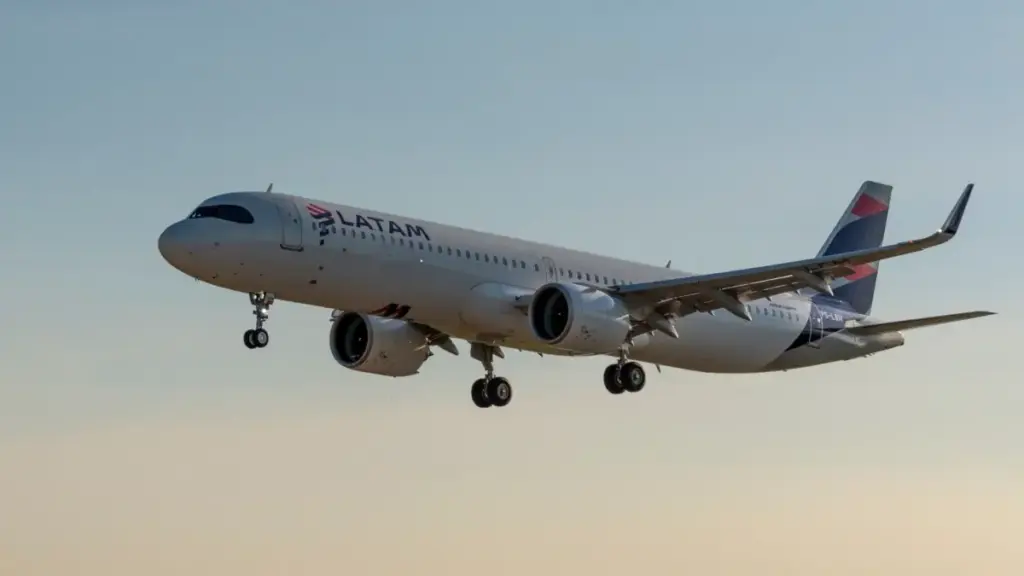
LATAM Airlines Group, Latin America’s preeminent multinational aviation titan, has announced a major financial milestone that underscores its aggressive growth strategy and deepening commitment to environmental responsibility. The carrier has successfully secured a robust $505 million financing package explicitly earmarked for the acquisition of 11 new-generation aircraft, scheduled for delivery throughout the second half of 2026.
This multi-faceted financial arrangement—spearheaded by banking giant BNP Paribas acting as the lead arranger—marks a strategic pivot in how major airlines fund fleet modernization. Notably, approximately $400 million of the total transaction is structured as sustainability-linked financing. Under this innovative framework, the economic terms of the loan are directly tied to LATAM’s performance metrics regarding emissions intensity, transforming corporate environmental benchmarks into tangible financial incentives.
The incoming aircraft order comprises a carefully balanced mix of manufacturers and airframes: one Airbus A320neo, four Airbus A321neo jets, and six Embraer E195-E2 regional airliners. This diverse procurement strategy provides LATAM with unprecedented operational flexibility. It enables the airline to precisely match capacity to passenger demand across its sprawling, complex network spanning South America and beyond, all while retiring older, less efficient airframes in pursuit of long-term net-zero carbon targets.
Detailed Chronology of the $505 Million Financing Deal
The path to securing a half-billion-dollar financing package in the current macroeconomic climate requires intricate planning, robust balance sheet management, and strong investor confidence. For LATAM Airlines Group, this transaction is the latest in a series of calculated financial maneuvers designed to solidify its post-restructuring market dominance.
The Spring and Summer Preparations (2026)
As LATAM navigated the first half of 2026, welcoming 13 next-generation aircraft into its operational fold between January and June, executive leadership was simultaneously finalizing capital structures to support the second wave of annual deliveries. The carrier recognized that relying solely on traditional, asset-backed debt would fail to capitalize on favorable capital market conditions for green initiatives.
By engaging BNP Paribas and a syndicate of international financial institutions, LATAM structured a package that balances traditional asset financing with sustainability-linked Key Performance Indicators (KPIs). The definitive agreements were struck in August 2026, officially announced to the public on August 25, 2026, setting the stage for the physical delivery of the 11 aircraft destined for the latter half of the year.
Strategic Integration into the Fleet
The inclusion of these 11 aircraft is not a random assortment; each model plays a specialized role in LATAM’s broader network architecture:
The Single Airbus A320neo: Serves as a reliable, high-frequency workhorse for dense domestic and regional trunk routes, offering standardized cockpit commonality and maximum cabin efficiency.
The Four Airbus A321neo Aircraft: Provides essential up-gauging capabilities. These stretched narrowbodies allow LATAM to add significant seat capacity on high-demand routes without having to commit widebody aircraft, maximizing revenue per slot at capacity-constrained airports.
The Six Embraer E195-E2 Regional Jets: Represents a cornerstone development, particularly for LATAM’s Brazilian domestic operations. These advanced regional jets bridge the gap between turboprops/small regional aircraft and mainline Airbus narrowbodies, allowing the airline to economically service thinner, secondary markets that would otherwise be unprofitable with larger equipment.
Supporting Context, Fleet Metrics, and Financial Engineering
To fully appreciate the significance of this $505 million capital injection, one must examine LATAM’s broader fleet dynamics, the mechanics of sustainability-linked debt, and the specific performance metrics of the chosen aircraft.
Fleet Expansion Trajectory
LATAM’s fleet strategy for 2026 is exceptionally aggressive. Having integrated 13 aircraft in the first half of the year, and with another 28 deliveries slated before December 31, the airline is on track to add over 40 aircraft to its registry within a single calendar year.
Metric / Milestone
Data Point
Total Fleet Size (Projected End of 2026)
Exceeds 410 aircraft
H1 2026 Deliveries
13 aircraft
H2 2026 Deliveries (Financed via $505M deal)
11 aircraft (1 A320neo, 4 A321neo, 6 E195-E2)
Total Planned Deliveries for Full Year 2026
41 aircraft
Medium-Term Growth Target (By 2030)
Up to 130 additional aircraft
By the close of 2026, LATAM will cement its status not only as the largest airline group in Latin America but also as one of the most formidable aviation networks in the Western Hemisphere. Furthermore, the carrier’s pipeline extends well into the decade, with plans to absorb up to 130 new aircraft by 2030, ensuring that over half of its total operating fleet will consist of next-generation, high-efficiency equipment. Notably, the introduction of the ultra-long-range Airbus A321XLR is penciled in for 2027, which will revolutionize point-to-point regional connectivity.
The Rise of Sustainability-Linked Aviation Finance
The inclusion of a $400 million sustainability-linked tranche highlights a growing paradigm shift in aviation banking. Traditional aviation loans focus strictly on the collateral value of the airframe and the creditworthiness of the lessee. Sustainability-linked loans (SLLs), however, introduce a dynamic feedback loop between corporate environmental governance and borrowing costs.
Under the terms agreed upon with BNP Paribas and participating lenders, LATAM’s financial margins are tied to its ability to meet rigorous emissions intensity reduction targets. This builds upon LATAM’s previous green financing ventures, including a $300 million engine-backed sustainability-linked revolving credit facility established in December 2024.
LATAM has committed to a binding corporate goal: achieving a 6% reduction in emissions intensity by 2030 compared to a 2019 baseline, keeping the airline on a steady trajectory toward its ultimate pledge of net-zero carbon emissions by 2050.
Technological Advantages of the New Airframes
The physical assets being financed are powerful drivers of both economic profitability and ecological compliance:
Airbus A320neo Family (A320neo & A321neo): Equipped with advanced Pratt & Whitney GTF or CFM LEAP-1A engines alongside aerodynamic Sharklets, these aircraft deliver at least a 20% reduction in fuel burn and CO2 emissions per seat compared to previous-generation CEO variants. Passengers also benefit from modern cabin interiors featuring upgraded ambient lighting, larger overhead bins, and improved acoustics.
Embraer E195-E2: Known in the industry as the "Profit Hunter," Embraer’s largest commercial jet features ultra-efficient Pratt & Whitney PW1900G geared turbofans and a redesigned wing. It achieves roughly 25% better fuel efficiency per seat than first-generation E-Jets, drastically lowering trip costs on regional routes while delivering a comfortable, single-aisle experience devoid of middle seats.
Official Statements and Industry Perspective
The strategic intent behind the $505 million transaction was clearly articulated by key executives within the airline. Andrés del Valle, LATAM’s Corporate Finance Director, emphasized the multidimensional value of the deal in an official corporate statement:
"This transaction combines three elements that are relevant to LATAM’s financial strategy: it diversifies our funding sources, supports the renewal and growth of our fleet, and reinforces our commitment to sustainability by integrating environmental performance indicators into our capital structure."
Industry analysts have echoed these sentiments, noting that LATAM’s ability to tap international financial markets on such favorable terms reflects the airline’s successful financial restructuring and robust operational recovery following past industry disruptions. By combining regional market dominance with a disciplined approach to balance sheet management, LATAM is effectively shielding itself against volatile jet fuel prices through modern fleet deployment while simultaneously satisfying institutional investors’ stringent Environmental, Social, and Governance (ESG) mandates.
Future Outlook: Navigating Tomorrow’s Skies
As LATAM Airlines Group looks toward the horizon, the convergence of fleet modernization, capital diversification, and sustainability sets a new benchmark for aviation in Latin America.
The successful closing of the $505 million financing package is far more than a routine commercial transaction; it is a strategic blueprint for how modern airlines must operate. By modernizing its mainline operations with Airbus narrowbodies while simultaneously opening up secondary and domestic markets with Embraer’s E-Jets, LATAM is engineering an adaptable, resilient network capable of withstanding macroeconomic headwinds.
With over 410 aircraft projected to be under its banner by the end of 2026, and a massive pipeline extending toward 2030—including the anticipated arrival of the game-changing Airbus A321XLR—LATAM is well-positioned to dominate the skies of the Americas. As the airline edges closer to its 2030 and 2050 environmental milestones, financial instruments like this $505 million sustainability-linked package prove that ecological responsibility and commercial profitability can fly hand in hand.