






For decades, the global tourism industry has relied on a lexicon of feel-good buzzwords to market its products. Terms like “green,” “eco-friendly,” “sustainable,” and “conscious travel” have been stamped onto tour itineraries, hotel brochures, and booking platform interfaces with little regulatory oversight. While many travel businesses operate with genuine intentions, the ubiquity of broad, unverified environmental claims has created a marketplace plagued by ambiguity. For travelers attempting to make conscious choices, distinguishing actual environmental stewardship from sophisticated greenwashing has become an exercise in guesswork.
That landscape is undergoing a permanent transformation. Set to take full effect on September 27, 2026, the European Union’s Empowering Consumers for the Green Transition (EmpCo) Directive introduces a rigorous regulatory framework for environmental marketing. Aimed squarely at misleading commercial practices, EmpCo establishes strict legal boundaries regarding how companies talk about their ecological impact.
For the tourism sector—spanning multinational tour operators, independent boutique hotels, travel advisors, and destination marketing organizations (DMOs)—this directive represents much more than a routine compliance hurdle. It signals a fundamental shift away from performative marketing toward verifiable, data-backed environmental accountability. Far from penalizing genuine operators, the directive offers a clear pathway for businesses already doing the hard work to stand out. Navigating this new era requires understanding the anatomy of the EmpCo Directive, identifying who falls within its scope, deconstructing its core mandates, and adopting proactive strategies well ahead of the 2026 enforcement deadline.
Detailed Chronology: The Road to Regulatory Oversight
The journey toward the EmpCo Directive did not happen in a vacuum. It is the culmination of years of growing consumer skepticism, empirical investigations by European authorities, and a legislative process designed to bridge the gap between corporate climate marketing and objective reality.
- The 2020 European Commission Sweeps: A pivotal milestone occurred when the European Commission, alongside national consumer protection authorities, published a sweeping study examining green claims across online marketplaces. The findings were stark: 53% of environmental claims were found to be vague, misleading, or entirely unfounded, while 40% lacked any supporting evidence whatsoever.
- The Rise of Consumer Skepticism (2021–2023): As sustainability became a primary driver for travelers—bolstered by post-pandemic shifts toward more mindful tourism—market saturation of eco-labels reached an all-time high. Public trust plummeted. Subsequent studies by consumer intelligence firms like YouGov revealed that over half of global consumers no longer trust sustainability claims made by commercial brands.
- March 2024: Formal Adoption of EmpCo: Recognizing the systemic failure of self-regulation, the European Union officially adopted the Empowering Consumers for the Green Transition (EmpCo) Directive (Directive EU 2024/825) as an amendment to existing consumer protection laws (specifically the Unfair Commercial Practices Directive and the Consumer Rights Directive).
- The Transitional Window (2024–2026): Member states were granted a multi-year window to transpose the directive into their national laws. During this grace period, businesses have been urged to audit their supply chains, marketing materials, and carbon accounting methodologies.
- September 27, 2026: Full Enforcement Date: From this date forward, enforcement authorities across EU member states will possess the legal mandate to penalize companies engaging in unsubstantiated green marketing, with enforcement actions carrying severe financial and reputational penalties.
Supporting Context & Metrics: The Scale of the Problem
To fully grasp why the EU has taken such a hard-line stance, one must examine the metrics defining modern consumer sentiment and industry practices. The travel sector, in particular, has leaned heavily on emotive imagery and vague promises to capture the growing demographic of eco-conscious tourists.

According to research highlighted by organizations like Booking.com and the European Commission, traveler awareness regarding tourism’s impact on local communities and ecosystems has never been higher. Yet, this awareness is matched by intense frustration.
[Consumer Trust vs. Reality in Sustainability Marketing]
┌────────────────────────────────────────────────────────┐
│ 53% of environmental claims are vague or unfounded     │  (EU Commission, 2020)
├────────────────────────────────────────────────────────┤
│ >50% of global consumers are skeptical of brand claims │  (YouGov)
├────────────────────────────────────────────────────────┤
│ 50% of green labels offer weak or zero verification    │  (EU Commission)
└────────────────────────────────────────────────────────┘
The proliferation of unverified badges and self-certified seals has compounded the issue. The European Commission has estimated that roughly half of all green labels operating across the European market offer weak, superficial, or entirely absent third-party verification.
EmpCo vs. The Green Claims Directive: Understanding the Distinction
Industry stakeholders frequently confuse the EmpCo Directive with the proposed Green Claims Directive (GCD). While both initiatives form pillars of the EU’s broader Circular Economy Action Plan, they serve different functions:
- The EmpCo Directive is already adopted law. It focuses on business-to-consumer (B2C) commercial practices, banning generic claims, unverified labels, and misleading offset-based neutrality statements at the point of sale.
- The Green Claims Directive, by contrast, is a separate legislative proposal that will introduce even more granular, pre-approval requirements for substantiating explicit green claims and environmental footprints through independent verification bodies before they are published.
Official Guidelines: Who Is Affected and What Is Demanded?
Geographic and Industry Reach: A Global Dragnet
A common misconception among non-European businesses is that EU directives apply exclusively to companies headquartered within the bloc. In reality, the EmpCo Directive operates on a market-impact principle.
The simple rule of thumb: If your travel business sells products, tours, or accommodations to consumers located within the European Union—or if you supply services to B2B partners who market to EU consumers—these standards apply to you.

Whether a safari operator is based in Kenya, an adventure tour provider is headquartered in Peru, or a luxury resort operates out of Southeast Asia, marketing directed at EU travelers must comply with EmpCo. Furthermore, B2B operators must clean up their messaging, as downstream partners will refuse to incorporate unverified claims into their consumer-facing materials.
The Anatomy of an "Environmental Claim"
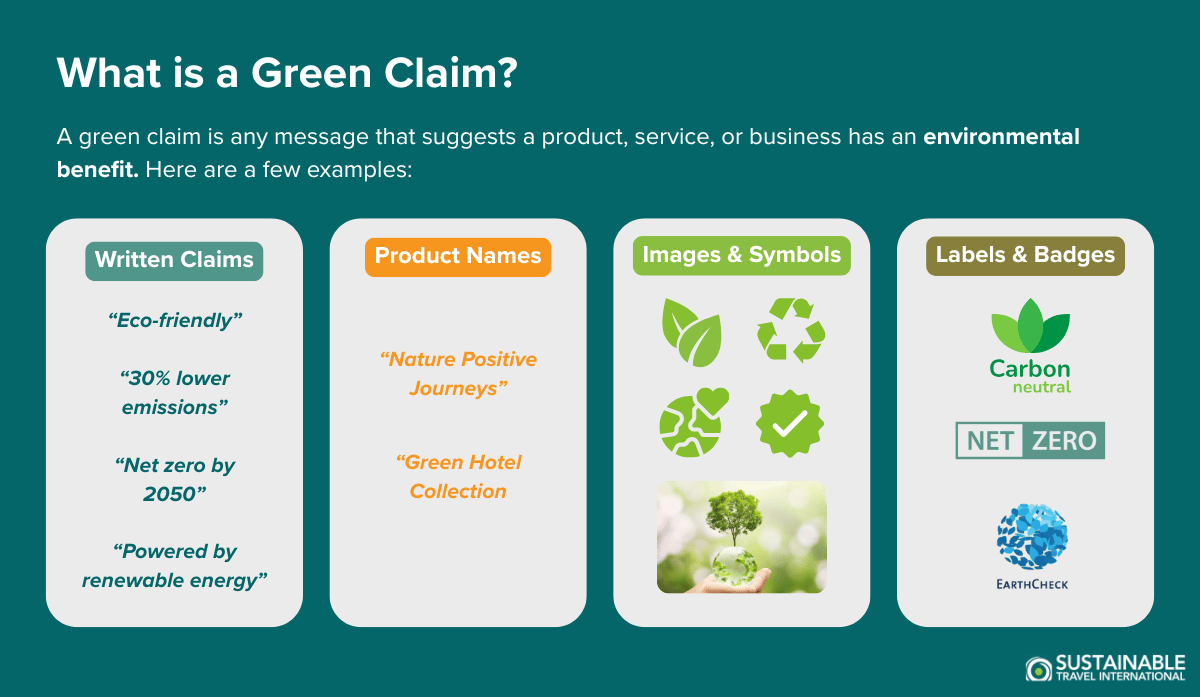
Under the directive, the definition of an environmental claim is intentionally broad. It extends far beyond written copy in brochures or website landing pages. Regulators will scrutinize:
- Company and Product Names: Collections titled "Nature Positive Journeys" or hotels branded with ecological buzzwords.
- Visual Assets and Imagery: Logos, badges, and graphic elements featuring leaf icons, pristine natural landscapes, or words like "conscious travel" and "earth-friendly."
- Implicit Messaging: Any design element that suggests a product or service has a positive or neutral impact on the environment without immediate, verifiable context.
Core Mandates for Tourism Operators
To achieve compliance ahead of the 2026 deadline, travel businesses must radically overhaul their communication strategies. The directive enforces five critical shifts:
1. Banishing Vague Claims in Favor of Specificity
Broad, generic descriptors such as "eco-friendly," "green," or "sustainable" are effectively prohibited unless backed by an elite, recognized certification.
- The Old Way: "Experience our sustainable jungle lodge and climate-friendly tours."
- The EmpCo Way: "We replaced 90% of domestic flights on our itineraries with electric rail transport, cutting transport emissions by 34%. Furthermore, 85% of our culinary ingredients are sourced from local farms within a 30-mile radius."
2. Eliminating Scope Overstatement
Companies must accurately represent the boundary of their environmental initiatives. If only the administrative head office runs on renewable energy, the entire hospitality group cannot be marketed as "powered by green energy." Similarly, if a tour operator has redesigned only two out of fifty itineraries to lower emissions, the entire catalog cannot be stamped as "low carbon." Mandatory regulatory compliances—such as local plastic bag bans—cannot be marketed as unique corporate achievements.
3. Decoupling Offsets from Operational Reductions
This is perhaps the most disruptive change for the travel industry. For years, airlines, hotels, and tour operators have marketed products as "carbon neutral" or "climate compensated" by purchasing carbon offsets.
The EmpCo Directive draws a definitive legal line: Purchasing external carbon offsets does not reduce or eliminate the physical footprint of a specific trip or hotel stay.
- Prohibited Language: Designations like "carbon-neutral holiday," "net-zero hotel stay," or "climate-compensated flight."
- Compliant Language: Framing offsets for what they truly are—an investment in external climate solutions (such as forest conservation or renewable energy infrastructure) that go beyond operational emission reductions. Operators must communicate these investments transparently without implying they neutralize the immediate product footprint.
4. Rigorous Evidence and Credible Future Targets
Making a claim requires proof. Businesses must baseline their current impact—utilizing trusted carbon accounting tools for tours and accommodations—to demonstrate actual reductions in waste, water, and emissions over time.
For forward-looking commitments (e.g., "net zero by 2050" or "zero single-use plastics by 2028"), the directive demands public, detailed implementation plans featuring measurable, time-bound milestones subject to independent expert review.
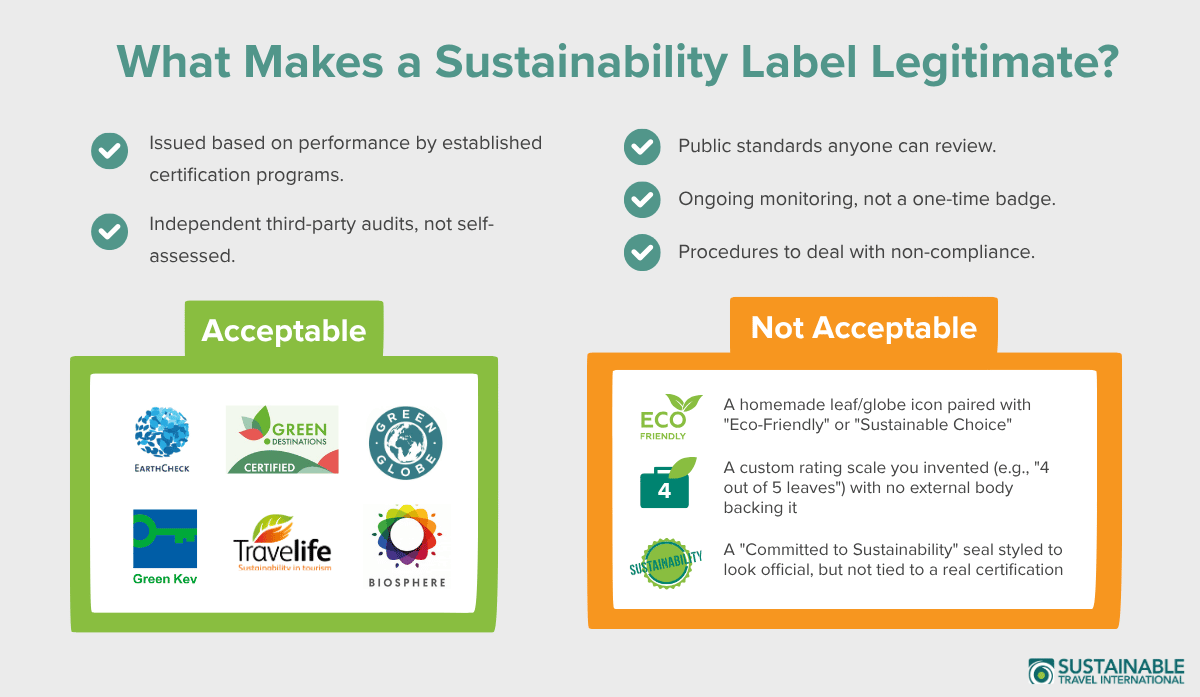
5. Sanitizing Sustainability Labels
Homemade badges, self-printed seals, and unverified trust marks are banned. Any label displayed on a booking platform must originate from public authorities or established, transparent certification programs featuring independent, ongoing monitoring. Industry standards such as Travelife, Green Key, Green Globe, EarthCheck, and Green Destinations remain benchmarks, provided the operator maintains active, audited certification.
Future Outlook: A Turning Point for Authentic Travel
As the September 27, 2026 enforcement date approaches, the tourism industry stands at a profound crossroads. For years, the lack of standardized terminology created a "race to the bottom," where the loudest marketing voices often drowned out the most dedicated environmental stewards.
The EmpCo Directive sweeps away this superficial noise. By penalizing greenwashing and demanding radical transparency, the EU is inadvertently leveling the playing field for genuinely sustainable operators.
For businesses willing to measure their footprints, invest in robust data collection, discard misleading carbon-neutral labels, and communicate their genuine progress with precision, the post-EmpCo era offers an unprecedented opportunity. In a market starved of authenticity, verifiable truth will no longer be just a legal necessity—it will be the ultimate competitive advantage.