






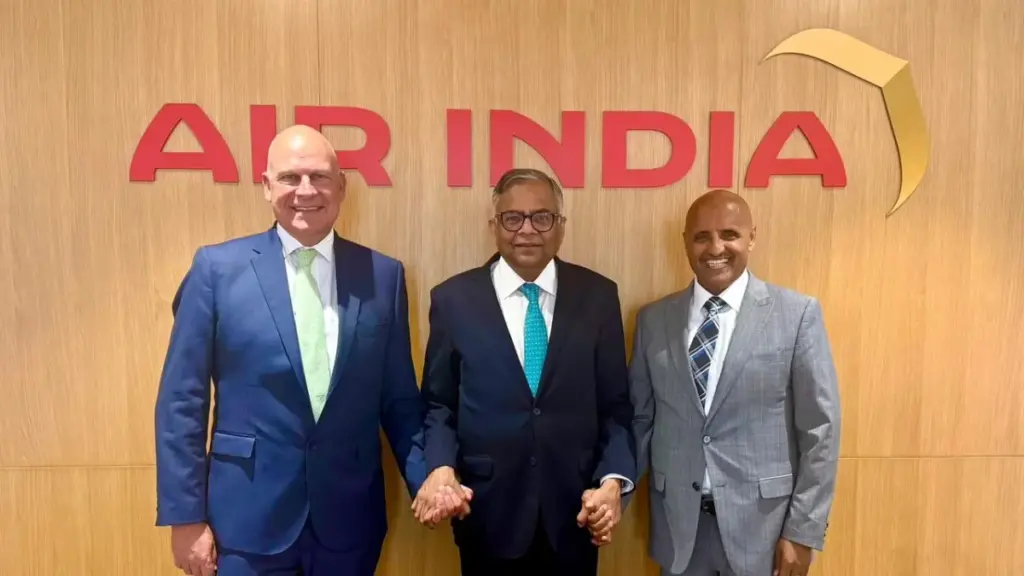
A formal changing of the guard has commenced at Air India, marking the end of an intensive stabilization period and the beginning of a high-stakes operational phase. In a joint employee town hall meeting on Monday, the airline’s parent company, Tata Group, initiated the transition of leadership from outgoing Chief Executive Officer Campbell Wilson to incoming chief Tewolde Gebremariam.
The transition represents more than a change in leadership; it signals a fundamental shift in the airline’s strategic priorities. Addressing employees alongside both the outgoing and incoming CEOs, Tata Sons and Air India Chairman N. Chandrasekaran delivered a direct mandate for the airline’s next chapter. Chandrasekaran told the assembled workforce that the next phase of Air India’s multi-year transformation will be judged on four non-negotiable pillars: safety, customer trust, reliable operations, and tighter control of costs.
This strategic pivot comes as the airline emerges from what Chandrasekaran described as one of the most difficult stretches in its history. Having spent more than four years rebuilding its foundational infrastructure, Air India is moving away from the capital-intensive phase of fleet procurement and corporate restructuring, turning its focus toward execution, financial discipline, and premium service delivery.
The Four Pillars: A Mandate for Executive Execution
As Tewolde Gebremariam prepares to take full operational control, the performance benchmarks laid out by Chairman Chandrasekaran serve as a clear roadmap for the incoming executive team. Each of the four pillars addresses a critical vulnerability in Air India’s ongoing effort to reclaim its status as a world-class global carrier.
                  ┌─────────────────────────────────────────┐
                  │       AIR INDIA'S NEXT PHASE            │
                  │         Strategic Pillars               │
                  └────────────────────┬────────────────────┘
                                       │
         ┌──────────────────┬──────────┴──────────┬──────────────────┐
         ▼                  ▼                     ▼                  ▼
   ┌───────────┐     ┌─────────────┐       ┌─────────────┐    ┌─────────────┐
   │  Safety   │     │  Customer   │       │  Reliable   │    │   Tighter   │
   │  Culture  │     │    Trust    │       │ Operations  │    │Cost Control │
   └───────────┘     └─────────────┘       └─────────────┘    └─────────────┘
1. Safety Culture
For any global airline, safety is the baseline of operations. However, for an airline undergoing rapid fleet expansion, integrating thousands of new crew members, and merging distinct operating certificates, maintaining an uncompromising safety culture requires constant vigilance. The mandate emphasizes standardized training, rigorous maintenance protocols, and the seamless integration of safety management systems across the newly consolidated airline group.
2. Restoring Customer Trust
Decades of underinvestment prior to the Tata Group’s 2022 acquisition left Air India with a tarnished reputation for cabin service, inflight entertainment, and overall passenger comfort. While hundreds of millions of dollars have been committed to retrofitting legacy aircraft and introducing state-of-the-art widebodies, the ultimate test lies in the day-to-day passenger experience. Restoring trust requires consistency in product delivery, cabin cleanliness, and customer service recovery when disruptions occur.
3. Reliable Operations
In the highly competitive Indian aviation landscape—dominated domestically by low-cost carriers with exceptional on-time performance (OTP)—operational reliability is a key differentiator. Air India has historically struggled with delays, schedule disruptions, and slow turnaround times. Improving OTP and minimizing flight cancellations are critical to attracting lucrative corporate travelers and premium international passengers.
4. Tighter Control of Costs
The first phase of Air India’s privatization was defined by massive capital expenditure, including historic aircraft orders and expensive corporate integrations. As the airline transitions into a mature operating model, the focus must shift to unit economics. Controlling operational costs, optimizing fuel efficiency, streamlining vendor contracts, and eliminating redundancies from the recent mergers will determine whether the airline can achieve long-term financial sustainability.
The Campbell Wilson Era: Laying the Foundations of a Giant
To understand the magnitude of the task inheriting by Tewolde Gebremariam, one must look at the state of the airline Campbell Wilson took over in 2022. When the Tata Group assumed control of the national carrier from the Indian government, they inherited an airline burdened by legacy bureaucracy, an aging and grounded fleet, outdated technology, and fragmented operations.
Under Wilson’s leadership, Air India embarked on a comprehensive five-year transformation plan known as Vihaan.AI. The strategy was structured to take the airline through three distinct phases: "Taxi" (fixing the basics and addressing immediate pain points), "Take Off" (building capacity and modernizing the fleet), and "Climb" (rapidly scaling to achieve global leadership).
The Scale of the Rebuild
Over the past four years, the scale of Air India’s restructuring has had few parallels in modern aviation history:
- The Historic Fleet Order: In 2023, Air India placed a landmark order for 470 aircraft from Airbus and Boeing, a mix of narrowbody and widebody jets designed to fuel international and domestic expansion for the next decade.
- Cabin Modernization: The airline initiated a $400 million cabin retrofit program aimed at completely stripping and rebuilding the interiors of its legacy legacy Boeing 777 and 787 dreamliner fleets, bringing them up to modern international standards.
- Technology Overhaul: Millions of dollars were funneled into upgrading the airline’s legacy IT systems, passenger service systems, website, mobile application, and digital customer service tools.
- The Vistara Merger: Perhaps the most complex operational hurdle was the merger of Vistara—a highly regarded joint venture between Tata Sons and Singapore Airlines—into Air India, consolidating India’s premium full-service airline market.
- Low-Cost Integration: Concurrently, the group worked to merge its budget subsidiaries, Air India Express and AIX Connect (formerly AirAsia India), to create a single, cohesive low-cost carrier to defend its domestic market share against dominant players like IndiGo.
Navigating the Challenges of Consolidation
While the achievements of the last four years have successfully modernized Air India’s infrastructure, the consolidation process has brought significant operational friction. The merger with Vistara, in particular, has been a delicate balancing act.
Vistara was widely recognized for its high standards of customer service, premium cabin crew training, and operational reliability. Merging its workforce, fleet, and loyal customer base into the much larger, legacy-laden Air India ecosystem has created natural integration challenges. Ensuring that Vistara’s premium service standards are not diluted, but rather absorbed to elevate the broader Air India brand, remains one of the most critical tasks of the transition.
   ┌─────────────────────────────────────────────────────────┐
   │               TATA GROUP AVIATION PORTFOLIO             │
   └────────────────────────────┬────────────────────────────┘
                                │
         ┌──────────────────────┴──────────────────────┐
         ▼                                             ▼
┌─────────────────────────────────┐           ┌─────────────────────────────────┐
│       FULL-SERVICE BRAND        │           │         LOW-COST BRAND          │
├─────────────────────────────────┤           ├─────────────────────────────────┤
│           AIR INDIA             │           │        AIR INDIA EXPRESS        │
│  (Merged with Vistara, Nov '24) │           │   (Merged with AIX Connect)     │
└─────────────────────────────────┘           └─────────────────────────────────┘
Furthermore, the integration of different labor groups, standardized operating procedures, and distinct corporate cultures has contributed to the "difficult stretch" referenced by Chairman Chandrasekaran. The incoming leadership will need to harmonize these internal dynamics to ensure that employees across all legacy brands feel aligned with the unified corporate vision.
Enter Tewolde Gebremariam: A Turnaround Specialist for a New Era
In selecting Tewolde Gebremariam as the new CEO, the Tata Group has chosen an internationally respected aviation executive with a proven track record of managing complex, state-backed carriers and transforming them into commercial powerhouses.
Gebremariam is best known for his highly successful tenure as the CEO of Ethiopian Airlines Group, a position he held from 2011 to 2022. Under his stewardship, Ethiopian Airlines grew from a regional carrier into Africa’s largest, most profitable, and most operationally efficient aviation group. He achieved this by establishing a highly disciplined multi-hub strategy, investing heavily in modern aircraft, developing robust cargo and maintenance divisions, and fostering a culture of strict cost control and operational self-reliance.
Why Gebremariam’s Skill Set Fits the Mandate
Gebremariam’s experience aligns closely with the four pillars outlined by Chandrasekaran:
- Operational Discipline in Developing Markets: Having run a major carrier out of a developing aviation market, Gebremariam understands the unique infrastructural, regulatory, and economic challenges that come with operating in regions like India.
- Proven Cost-Control Track Record: At Ethiopian Airlines, Gebremariam was celebrated for maintaining profitability even during global economic downturns and high fuel price environments, largely through aggressive cost management and revenue diversification.
- Hub-and-Spoke Expertise: Air India’s long-term success depends on transforming Delhi and Mumbai into major global transit hubs that can compete with Middle Eastern carriers. Gebremariam successfully turned Addis Ababa into a massive global gateway, a blueprint he can adapt for the Indian market.
From Expansion to Execution: The Road Ahead
The leadership transition marks the end of Air India’s initial defensive play. The airline is no longer simply fighting for survival or rushing to replace broken seats; it is now positioned as a well-capitalized challenger on the global stage.
However, with more aircraft, expanded resources, and grander ambitions comes a dramatic rise in expectations. The Indian government, the traveling public, global competitors, and the Tata Group’s board will be watching the transition closely. The heavy capital investments made during Campbell Wilson’s tenure must now begin to yield measurable returns.
The next phase of the journey will not be judged by the size of the aircraft orders placed, but by the precision of the airline’s daily operations. Under Tewolde Gebremariam, Air India must prove that it can not only build a massive aviation group but also run it with the efficiency, safety, and financial discipline of a world-class market leader.