









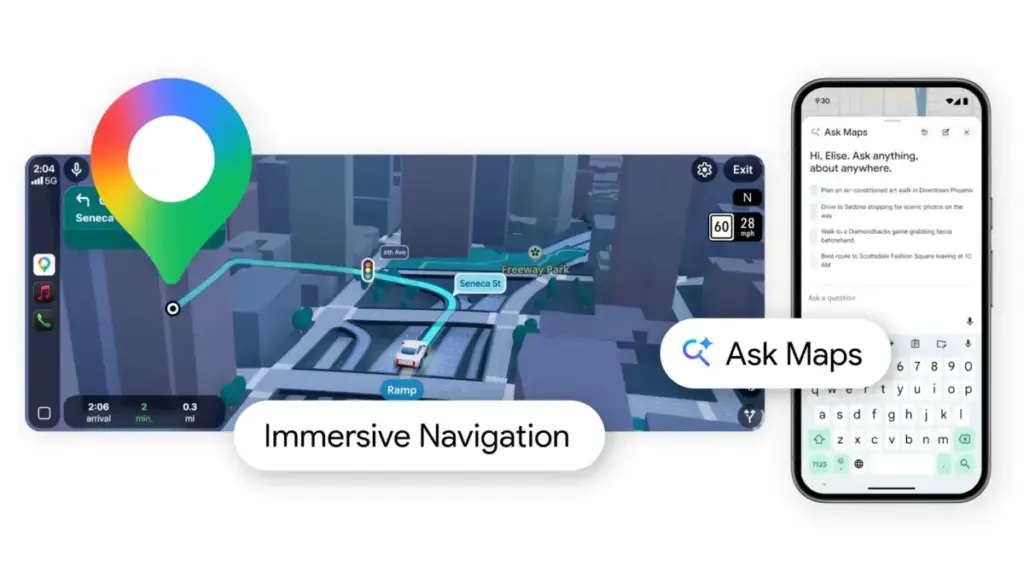
The global travel technology sector is undergoing a profound paradigm shift as artificial intelligence transitions from static, text-based query systems to dynamic, spatially aware conversational interfaces. At the vanguard of this evolution is Google, which has begun integrating advanced generative AI capabilities directly into Google Maps—a platform that already commands over one billion monthly active users. By marrying its Gemini-class large language models (LLMs) with its unrivaled database of global geospatial data, real-time transit routes, local business listings, and live inventory pricing, Google is positioning Google Maps not merely as a navigation tool, but as the ultimate end-to-end travel concierge.
Historically, hotel search has been a fragmented, high-friction endeavor. Travelers typically navigate a labyrinth of online travel agencies (OTAs), review platforms, and mapping applications to cross-reference prices, location convenience, neighborhood aesthetics, and personal itineraries. Google’s new AI-driven conversational search feature, internally and externally referred to under experimental frameworks like "Ask Maps," aims to collapse this multi-tab search funnel into a single, cohesive conversational stream.
[Traditional Search Funnel]             [Google Spatial AI Funnel]
  Review Sites (TripAdvisor)
  OTA Directories (Expedia)   ---> [Manual Cross-Referencing] ---> Booking
  Map Routing (Google Maps)  /
                                           vs.
  "Ask Maps" (Spatial AI) ---------------------------------------> Direct Booking
  (Combines vibe, routing, real-time rates, and personal calendar)
By allowing users to input complex, highly subjective queries—such as matching a specific "artsy vibe" with precise spatial constraints like "within walking distance of a local gym and top-rated restaurants"—and returning real-time, actionable pricing and availability rather than static estimates, Google is fundamentally altering the economics of travel discovery. Furthermore, by layering in the traveler’s own personal itinerary data harvested from Gmail, Google Calendar, and Google Flights, the tech giant is erecting a highly personalized, predictive ecosystem that traditional OTAs will find exceedingly difficult to replicate.
Detailed Chronology: The Evolution of Google’s Travel Ambitions
To understand the disruptive potential of Google’s latest spatial AI integration, it is essential to trace the decade-long trajectory of Google’s travel search and mapping products. This evolution reflects a deliberate transition from a utility-first directory to an immersive, transactional, and AI-first discovery engine.
+-------------------------------------------------------------------------+
|                          PRODUCT EVOLUTION PATH                         |
+-------------------------------------------------------------------------+
|  2010: ITA Software Acquisition (Foundation for Google Flights)        |
|    |                                                                    |
|  2016: Google Trips App Launch (Consolidating personal itineraries)      |
|    |                                                                    |
|  2019: Google Travel Hub (Merging Flights, Hotels, and Packages)        |
|    |                                                                    |
|  2023: Search Generative Experience (SGE) & Gemini Integrations         |
|    |                                                                    |
|  2024+: "Ask Maps" Spatial AI (Real-time inventory + Spatial Context)   |
+-------------------------------------------------------------------------+
Phase 1: The Infrastructure Layer (2010–2015)
The foundation of Google’s travel ecosystem was laid in 2010 with the controversial $700 million acquisition of ITA Software, the flight information software company that powered many of the airline industry’s search engines. Despite intense antitrust scrutiny and pushback from major travel players, the acquisition was cleared, leading to the birth of Google Flights in 2011. Over the next several years, Google systematically expanded its database of local business listings via Google My Business (now Google Business Profile) and enhanced Google Maps with detailed street-level data, public transit routing, and user-generated reviews.
Phase 2: Consolidation and the Travel Hub (2016–2020)
In 2016, Google launched the standalone "Google Trips" app, which automatically scanned users’ Gmail accounts to assemble comprehensive travel itineraries, including flights, hotel bookings, and rental car reservations. While the dedicated app was retired in 2019, its core functionality was absorbed into a unified desktop and mobile experience known as Google Travel. During this period, Google also aggressive expanded its "Google Hotel Ads" product, placing real-time bidding modules directly into standard search results and Google Maps, thereby capturing a massive share of high-intent travel traffic before it could reach OTAs.
Phase 3: The Generative AI and Spatial Synthesis Era (2023–Present)
The launch of Google’s Search Generative Experience (SGE) in 2023 marked the beginning of conversational search. However, SGE was largely web-centric. The latest breakthrough represents the migration of this generative capability directly into the spatial interface of Google Maps.
By embedding conversational AI ("Ask Maps") into a surface designed around location, transit, and proximity, Google has bypassed the limitations of traditional LLMs. Traditional LLMs often struggle with "hallucinations" regarding real-time details like room availability or current room rates. By grounding the AI in Google’s live inventory APIs and spatial databases, the system can synthesize subjective requests with objective, real-time transaction data.
Supporting Context & Metrics: The Battle for the Travel Funnel
The integration of spatial AI into Google Maps arrives at a critical juncture for the global travel and tourism industry, which is projected to reach a market volume of over $1 trillion by 2028. The competitive dynamics of this industry are defined by the struggle to control the "upper funnel"—the initial discovery phase where travelers are searching for inspiration and comparing options.
The Problem of the "Vibe Query"
Historically, search engines have been highly efficient at processing structured data queries, such as "Hotels in Miami under $250." However, they have struggled with unstructured, subjective, and highly contextual queries. According to consumer search behavior studies:
- Over 70% of travel planners express frustration with the need to use multiple tabs and apps to cross-reference hotel locations with planned activities, transit stops, and local dining.
- Traditional search engines force users to convert qualitative desires ("an artsy, boutique feel close to a fitness center") into quantitative filters (selecting star ratings or neighborhood checkboxes), often resulting in generic and unsatisfying recommendations.
Google’s spatial AI solves this by translating natural language queries into complex spatial and semantic database queries.
[User Natural Language Query]
"Find me a decently priced, top-rated hotel with an artsy vibe,
 within walking distance from a gym and restaurants."
                         |
                         v
[Google Spatial AI Processing Engine]
 +-----------------------------------------------------------------------+
 | 1. Semantic Analysis: Identifies "artsy vibe" (filters reviews/tags)  |
 | 2. Price/Rating Filter: Cross-references live GDS data for "decent"   |
 | 3. Spatial Proximity Engine: Measures walking radius from gym/dining  |
 | 4. Personalization Layer: Checks user's calendar for conference venue |
 +-----------------------------------------------------------------------+
                         |
                         v
[Curated, Real-Time Transactional Results on Map]
For instance, in the query showcased by Google:
"For next week’s conference in downtown Miami, find me a decently priced, top-rated hotel with an artsy vibe, within walking distance from a gym and restaurants."
The AI engine simultaneously executes several complex operations:
- Semantic Vibe Matching: Scans millions of user-generated reviews, photos, and merchant-provided descriptions to identify properties characterized as "artsy," "boutique," or "design-forward."
- Real-Time Inventory Verification: Queries live Global Distribution System (GDS) data and direct hotel feeds to verify actual pricing and occupancy for the specific dates of "next week."
- Spatial Proximity Analysis: Calculates walking routes and pedestrian accessibility from potential hotels to local gyms and highly-rated restaurants, ensuring the recommendations are geographically coherent.
- Itinerary Integration: Integrates the location of the "downtown Miami conference" (extracted from the user’s connected calendar or digital ticket) to ensure the suggested lodging is optimally positioned relative to the user’s primary daily destination.
The Economic Threat to OTAs
The financial implications for online travel agencies like Expedia Group and Booking Holdings are profound. These companies spend billions of dollars annually on performance marketing—predominantly on Google Search Ads—to acquire customers at the top of the funnel.
| Metric / Financial Indicator | Booking Holdings | Expedia Group | Google (Estimated Travel Ad Rev) |
|---|---|---|---|
| Annual Marketing Spend (approx.) | $6.8 Billion | $4.2 Billion | N/A |
| Dependence on Search Traffic | High | High | Dominant Channel |
| Platform Lock-In Risk | Elevated | Elevated | Low (Ecosystem Owner) |
If Google Maps can answer complex, multi-variable travel queries instantly and direct users to book directly with hotels or via Google’s own preferred booking pathways, the traditional OTA business model faces severe disintermediation. By providing actual, live pricing and availability rather than price ranges or estimates, Google eliminates the primary reason users leave map interfaces to visit OTA directory sites.
Official Statements and Industry Perspectives
The rollout of spatial AI within Google Maps has drawn sharp analysis from tech executives, hospitality leaders, and market analysts.
In public product demonstrations and developer keynotes, Google executives have emphasized the user-centric design of the new feature. Philipp Schindler, Senior Vice President and Chief Business Officer at Google, has repeatedly highlighted the transformative power of conversational search across Google’s core properties:
"With generative AI, we are reimagining what a search engine can do. By bringing these capabilities to Google Maps, we are giving users a highly personalized, contextually aware assistant that understands not just where you want to go, but the exact experience you want to have when you get there."
Industry analysts, however, view the development through a more competitive and regulatory lens. A senior travel research analyst at Skift remarked:
"Google Maps is the ultimate Trojan horse in travel. It is already deeply embedded in the daily utility of travelers for navigation and local discovery. By adding sophisticated, conversational AI that pulls in personal itinerary data, Google is creating an ecosystem where the traveler never has to leave the map to plan, validate, and ultimately book their stay. This is more than an incremental update; it is a structural threat to traditional search-and-compare directories."
Hoteliers, meanwhile, view the update with a mixture of cautious optimism and apprehension. On one hand, Google’s push toward direct-booking links could help hotels bypass the hefty 15% to 25% commissions charged by major OTAs. On the other hand, it further solidifies Google’s role as the gatekeeper of the hospitality industry, leaving hotels vulnerable to future monetization changes within Google’s ad auction model.
Future Outlook: The Autonomous Travel Concierge and Regulatory Hurdles
As Google continues to refine its spatial AI capabilities, the future of travel planning points toward a highly automated, agentic paradigm.
The Rise of Autonomous Travel Agents
In the coming years, we can expect "Ask Maps" to transition from a conversational advisory tool to an autonomous execution agent. Armed with secure digital wallets (via Google Pay) and explicit user preferences, future iterations of this technology will not only identify the ideal "artsy hotel near the conference," but will also be authorized to complete the booking, reserve a table at the nearby restaurant, and pre-book transit—all within a single, voice-activated prompt.
Furthermore, the integration of real-time environmental data—such as weather forecasts, local traffic disruptions, and real-time crowd density data—will allow the AI to dynamically adjust itineraries on the fly. If a flight is delayed, the system could automatically notify the hotel of a late check-in, reschedule the dinner reservation, and update the ground transit route.
[Flight Delay Detected]
          |
          v
[Google Spatial AI Agent]
 +-------------------------------------------------------------------------+
 | - Automatically updates hotel on late check-in                          |
 | - Reschedules dinner reservation at nearby restaurant                   |
 | - Re-routes transit options based on real-time evening schedules        |
 +-------------------------------------------------------------------------+
          |
          v
[Seamless, Updated Itinerary Delivered to User]
Regulatory and Antitrust Headwinds
Despite the technological promise of spatial AI, Google’s path to total travel dominance is fraught with regulatory challenges. The company is currently embroiled in multiple landmark antitrust lawsuits in both the United States and Europe.
In the European Union, the Digital Markets Act (DMA) strictly prohibits "gatekeeper" platforms from self-preferencing their own services over those of third-party competitors. Google’s tendency to display its own hotel search modules and direct-booking links prominently above organic search results has already drawn significant regulatory pushback.
As Google Maps integrates more deeply with personal itineraries and real-time transaction engines, regulators will closely scrutinize whether Google is unfairly leveraging its dominance in mapping and operating systems (Android) to crush competition in the travel booking and local search markets.
Conclusion
Google’s decision to bring spatial context to AI hotel search represents a watershed moment in travel technology. By synthesizing the subjective nuance of conversational AI with the objective reality of real-time pricing, spatial proximity, and personal itineraries, Google is building an incredibly sticky, high-utility travel planning ecosystem. For travelers, the feature promises an unprecedented level of convenience and personalization. For the travel industry writ large, it signals a new era of competition where the battleground is no longer just about who has the cheapest inventory, but who possesses the smartest, most contextually aware map.