







The modern landscape of international air travel is defined by a delicate balance between ultra-low-cost unbundling and the persistent consumer demand for baseline comforts. In a recent development capturing the attention of value-conscious travelers and industry analysts alike, Copa Airlines has introduced a competitive fare structure connecting North American gateways—most notably highlighted by routes originating from San Francisco (SFO)—to the vibrant cultural heartbeat of Rio de Janeiro, Brazil (GIG).
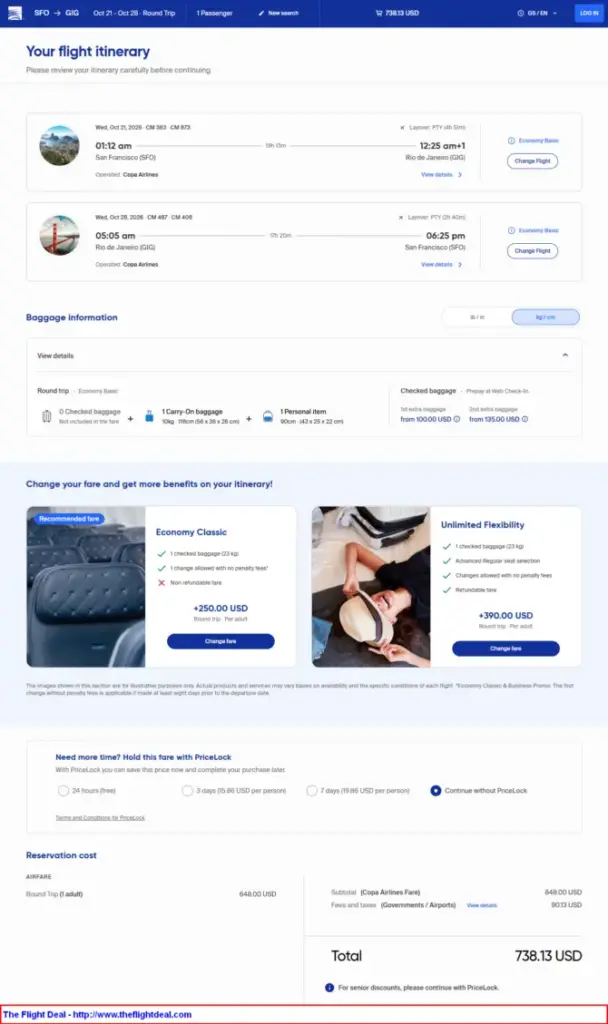
For travelers tracking transcontinental pricing models via advanced flight search engines such as Matrix Airfare Search by ITA Software, this route presents a fascinating study in fare architecture. The baseline pricing strategy begins at an enticing $788 for Basic Economy when queried through neutral search aggregators. However, a strategic redirection directly to Copa Airlines’ proprietary booking portal reveals a more dynamic pricing matrix: a stripped-down Basic Economy tier priced at $738, contrasted with a traditional Regular Economy tier priced at $988.
This $250 delta between Copa’s Basic and Regular economy offerings underscores a broader aviation trend: the hyper-segmentation of the cabin experience. While ultra-low fares capture headlines and draw price-sensitive consumers into the booking funnel, they simultaneously shift the true cost of travel onto ancillary services. For a destination as alluring as Rio de Janeiro—famed for its iconic stretches of sand like Ipanema, the dramatic backdrop of Sugarloaf Mountain, and a rich tapestry of history and architecture—understanding the nuances of these fare classes is no longer merely a matter of budget optimization; it is an essential component of modern journey planning.
Detailed Chronology: Unpacking the Copa Airlines Rio de Janeiro Fare Structure
To fully grasp how these fares manifest in the contemporary booking ecosystem, one must examine the step-by-step mechanics of discovering, verifying, and purchasing these tickets. The lifecycle of this specific fare deal follows a precise technological and administrative trajectory.

Phase One: Discovery via Matrix Airfare Search
The journey of securing an optimal airfare frequently begins away from airline homepages and within professional-grade routing engines. Utilizing Matrix Airfare Search by ITA Software allows savvy travelers to scan complex global distribution systems (GDS) for raw inventory. In the case of the San Francisco-to-Rio de Janeiro route, initial algorithmic pricing evaluates to approximately $788 for a restrictive Basic Economy product. This phase serves as the foundational discovery step, validating that inventory exists on specific calendar dates and mapping out the underlying routing mechanics, which typically involve a seamless connection through Copa’s primary hub at Tocumen International Airport (PTY) in Panama City.
Phase Two: Direct Channel Repricing
A common quirk in modern revenue management is the disparity between third-party aggregators and direct carrier channels. Upon transferring the dates identified in ITA Software directly to Copa Air, the pricing algorithms adjust. The fare drops by $50 to $738 for the foundational Basic Economy tier, while the comprehensive Regular Economy tier establishes itself at $988. This recalibration highlights the economic incentive airlines maintain to drive traffic directly to their proprietary platforms, thereby bypassing intermediate distribution costs while simultaneously upselling customers on higher-tier amenities.
Phase Three: The Unbundling Dilemma—Basic vs. Regular Economy
At the heart of this pricing structure lies the divergence in what the passenger actually receives for their capital investment:
- The $738 Basic Economy Fare: Designed strictly for the hyper-minimalist traveler, this entry-level ticket provides the seat and transcontinental transportation, but strips away foundational flexibilities. Passengers must navigate stringent restrictions regarding seat selection, ticket modifications, and baggage allowances.
- The $988 Regular Economy Fare: Commanding a $250 premium, this traditional tier restores passenger dignity and predictability. Crucially, it includes one checked bag and a normal-sized carry-on allowance, mitigating the risk of punitive airport gate fees that frequently neutralize the initial savings of a "cheap" ticket.
Supporting Context & Metrics: Decoding Mileage Accruals, Routing, and Ancillary Costs
When evaluating an international journey spanning thousands of miles, the sticker price tells only part of the story. Intelligent travel planning requires a deep dive into frequent flyer economics, alliance partnerships, and auxiliary expenses such as accommodations, ground transportation, and credit card rewards optimization.

Mileage Earning and Alliance Dynamics
Copa Airlines is a proud member of the Star Alliance and maintains a robust commercial partnership with United Airlines. For frequent flyers enrolled in United’s MileagePlus program (or other Star Alliance loyalty schemes), flying on Copa-operated metal opens pathways to accumulating valuable redeemable miles and Premier Qualifying Credits (PQC).
However, the proliferation of Basic Economy fare classes has fundamentally altered mileage accrual rules across major global carriers. While a Regular Economy ticket purchased at the $988 price point typically earns full mileage and elite status qualification credits based on the fare class and distance flown, Basic Economy tickets often face severe earnings penalties. Passengers must carefully cross-reference their ticket’s fare class code against United’s partner earning charts to ensure that choosing a $738 ticket does not inadvertently sacrifice hundreds or thousands of elite-qualifying miles that could contribute to status renewal.
The Financial Impact of Ancillary Fees
The decision to save $250 by opting for Basic Economy requires a cold, hard calculation of personal travel habits. Consider the typical baggage profile of a vacationer heading to Brazil for a week or more:
- Checked Luggage: International carriers typically charge substantial fees for second checked bags, and under strict Basic Economy rules, even the first checked bag may incur a steep surcharge if not bundled into the fare.
- Seat Selection: Basic Economy passengers are routinely assigned seats at check-in, running a high risk of being relegated to middle seats on long-haul segments—such as the multi-hour leg from Panama City down to Galeão International Airport (GIG) in Rio de Janeiro.
- Change and Cancellation Policies: The rigidity of basic fares means that any unexpected disruption to personal or professional schedules can result in the total forfeiture of the ticket value, whereas higher fare classes often permit changes for a fee or offer travel credits.
Maximizing International Credit Card Strategies
When executing transactions across international borders or booking travel via aggregator platforms like Priceline, the choice of payment instrument can yield significant financial returns or expose the consumer to hidden costs.

- Foreign Transaction Fees: Savvy travelers ensure they utilize credit cards boasting zero foreign transaction fees, avoiding the standard 3% surcharge levied by traditional banking institutions.
- Travel Rewards Optimization: Utilizing premium travel credit cards that offer elevated multipliers on airline purchases (such as 3x to 5x points per dollar) transforms a $988 airfare purchase into a substantial haul of transferable bank points, which can subsequently be redeemed for luxury hotel stays or future flight upgrades.
- Travel Protections: Premium cards often bundle complimentary trip interruption, baggage delay, and emergency medical insurance, providing a vital safety net when journeying to South America.
Official Statements & Industry Perspectives: The Strategic Vision of Regional Hubs
While individual airlines rarely issue press releases for routine fare adjustments, aviation analysts and industry economists closely monitor the broader operational philosophies driving these pricing strategies. The model deployed by Copa Airlines—leveraging a centralized hub in Panama City (the "Hub of the Americas") to connect North American metropolises like San Francisco with South American destinations like Rio de Janeiro—represents a masterclass in network efficiency.
According to commercial aviation strategists, the implementation of tiered economy pricing is an inevitable response to the heterogeneous nature of modern travel demand. Airlines are no longer selling a monolithic product called "a seat to Brazil." Instead, they are tailoring discrete product tiers to distinct consumer personas:
- The Price-Sensitive Leisure Traveler: Willing to sacrifice comfort, baggage allowances, and flexibility for the absolute lowest entry cost, thereby filling aircraft seats that might otherwise fly empty.
- The Value-Conscious Professional or Extended Vacationer: Seeking a balanced compromise where essential amenities (like checked baggage) are bundled into a predictable, transparent price point.
- The Premium Segment: Catering to those who bypass economy entirely in favor of business class cabins for enhanced flat-bed comfort on overnight routes.
Industry insiders note that while basic economy fares can occasionally draw consumer ire due to their restrictive nature, they ultimately democratize air travel, enabling a broader demographic of travelers to explore culturally rich destinations like Rio de Janeiro without being priced out by rigid, all-inclusive fare floors.
Future Outlook: Navigating the Trajectory of South American Air Travel
As the global aviation market continues its post-pandemic evolution, several macro-trends will dictate the future of pricing and availability for routes connecting North America to South America.

1. Dynamic Pricing and Algorithmic Volatility
Gone are the days of static seasonal fare charts. Modern revenue management systems utilize artificial intelligence and real-time demand forecasting to adjust ticket prices dynamically. Fares identified at $738 or $788 are inherently ephemeral; they respond instantly to shifting fuel prices, currency fluctuations (such as the strength of the Brazilian Real against the US Dollar), and localized booking velocities. Travelers looking to capitalize on these deals must remain agile, utilizing real-time alert services to secure inventory the moment it dips into promotional thresholds.
2. The Evolution of Ancillary Bundles
As consumer pushback against hyper-unbundled travel grows, airlines are experimenting with intermediate "Economy Plus" or semi-flexible bundles that bridge the chasm between austere basic fares and traditional regular economy. In the coming years, we may see carriers refine these tiers to include specific perks—such as priority boarding or choice seat selection—without forcing passengers to pay for a fully flexible regular economy ticket.
3. Sustainability and Environmental Costs
Looking further ahead, the long-term cost of transcontinental air travel will increasingly incorporate environmental compliance mechanisms, such as carbon offset mandates and sustainable aviation fuel (SAF) blending requirements. While these regulatory shifts are vital for the ecological sustainability of routes over the Amazon basin and beyond, they will inevitably exert upward pressure on baseline ticket prices. Consequently, capitalizing on current promotional windows remains one of the few ways travelers can experience global destinations at historical price points.
Conclusion
The availability of competitive economy fares to Rio de Janeiro via carriers like Copa Airlines offers a compelling invitation for exploration. Whether one chooses the minimalist gamble of the $738 Basic Economy tier or opts for the peace of mind offered by the $988 Regular Economy product, informed decision-making remains the ultimate travel companion. By leveraging sophisticated search tools, understanding the hidden costs of unbundled travel, and optimizing payment strategies, modern explorers can successfully navigate the skies—touching down ready to experience the timeless allure of Ipanema, Corcovado, and the vibrant spirit of Brazil.