




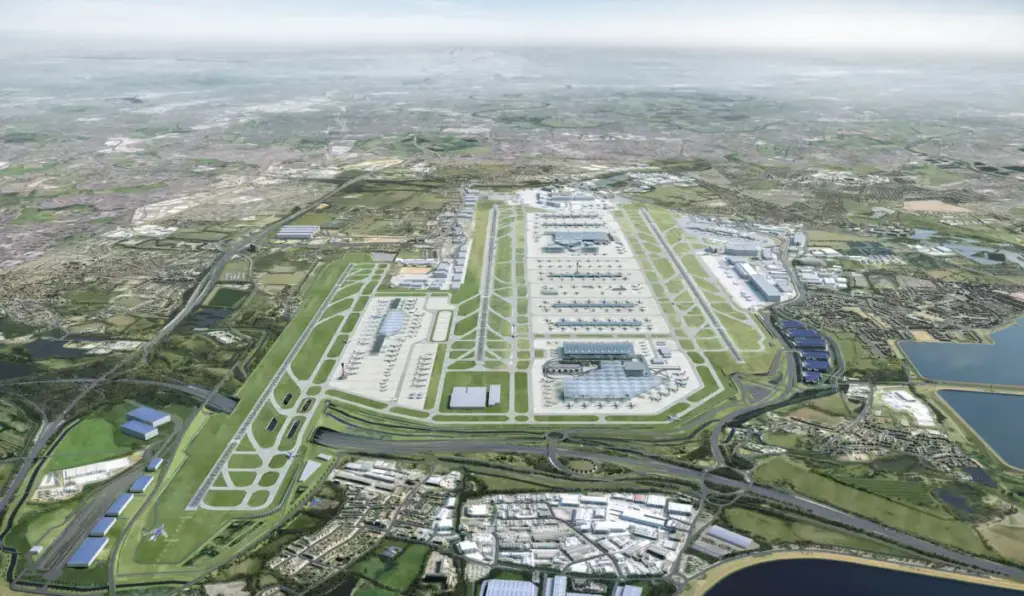
For decades, the debate over expanding London Heathrow Airport has been one of the most contentious battlegrounds in British politics. Proponents argue that a third runway is vital for securing the United Kingdom’s position as a global trading hub, boosting connectivity, and driving economic growth. Opponents point to the immediate local impacts of noise, air pollution, and the destruction of nearby communities.
However, a far more formidable obstacle now stands in the way of the airport’s sprawling ambitions: the mathematical and physical reality of climate change.
As the UK grapples with its legally binding commitment to reach net-zero greenhouse gas emissions by 2050, climate scientists, policy advisors, and environmental economists are pointing to a stark paradox. To align Heathrow’s physical expansion with national climate goals, policymakers may have to resort to an ironic intervention: deliberately throttling the very passenger demand that the new infrastructure is designed to accommodate.
This counterintuitive approach has gained significant traction among UK climate experts, culminating in a series of stark warnings delivered to government ministers. The consensus is clear: without intervention to manage demand, any physical growth at Heathrow risks derailing the country’s broader environmental commitments.
The Compatibility Gap: Net Zero vs. Runway Three
The tension between aviation growth and environmental stewardship was thrust back into the spotlight by the UK’s official independent advisory body, the Climate Change Committee (CCC). In a series of highly critical assessments, the committee questioned how any major airport expansion can be justified under the current regulatory framework.
“Emissions from flying are projected to rise, even without Heathrow expansion, and the UK does not currently have a credible plan to bring them down,” said Nigel Topping CMG, chair of the Climate Change Committee. “That poses a serious challenge to our climate commitments.”
Topping’s intervention cuts to the heart of a policy vacuum that has persisted across multiple government administrations. While the UK has established ambitious statutory carbon budgets, the strategy for addressing international aviation emissions remains heavily reliant on future technological breakthroughs that may not arrive in time.
Under the current trajectory, the physical expansion of Heathrow is simply "not currently compatible with the UK’s Net Zero target," Topping warned.
The core of the issue lies in the sheer volume of greenhouse gases associated with aviation. Because aircraft burn fossil fuels at high altitudes, their environmental impact is uniquely challenging to mitigate. If Heathrow adds a third runway, the resulting increase in flight capacity would inevitably lead to a surge in emissions, unless offset by unprecedented—and currently unavailable—technological innovations.
The Policy of Demand Management: Throttling the Desire to Fly
Historically, transport planning in the UK has operated on a "predict and provide" model. Economists forecast a rise in passenger numbers, and engineers build the runways, terminals, and road networks required to meet that demand.
However, to keep global warming within the limits established by the Paris Agreement, policy experts suggest this model must be inverted. If the technology to fly cleanly does not exist at scale, the only reliable way to reduce emissions is to limit the number of flights. This concept, known as "demand management," is rapidly moving from the fringes of environmental activism into mainstream policy discussions.
To limit passenger demand while simultaneously expanding physical infrastructure like Heathrow seems contradictory. Yet, some economists suggest that if a third runway is built to alleviate current congestion and improve operational resilience, it must be accompanied by strict fiscal measures to prevent an overall increase in passenger volume.
Pricing Passengers Out of the Air
How do you throttle demand in a free-market economy? The most direct mechanism is taxation. Climate advisors have floated several policy levers designed to make flying more expensive, thereby curbing discretionary travel:
- A Frequent Flyer Levy: This policy would tax passengers progressively based on how often they fly each year. Under this system, a family taking a single annual holiday would pay little to no tax, while business travelers and wealthy individuals taking multiple flights a month would face escalating financial penalties.
- Kerosene Taxation: Currently, commercial aviation fuel (kerosene) is exempt from fuel duty in many parts of the world, including on international flights leaving the UK. Introducing a fuel tax would force airlines to internalize the environmental cost of their operations, naturally driving up ticket prices.
- Reforming Air Passenger Duty (APD): Increasing the existing departure tax, particularly for long-haul and premium-class flights, would act as an immediate deterrent to non-essential travel.
While these measures are economically logical, they are politically explosive. Critics argue that raising the cost of flying disproportionately harms lower-income families, turning air travel back into an exclusive luxury for the wealthy. Navigating this equity challenge remains one of the most difficult tasks for policymakers advocating for demand management.
The Industry’s Responsibility: Who Pays for Decarbonization?
For years, the aviation sector has defended its growth plans by pointing to future green technologies, such as Sustainable Aviation Fuels (SAF), hydrogen-powered aircraft, and electric short-haul flight. However, the timeline for these technologies to reach commercial maturity and global scale is measured in decades, not years.
Furthermore, the transition to green aviation will require trillions of dollars in capital investment. Currently, much of this financial burden remains unallocated, with the industry hoping for government subsidies and the public sector demanding that airlines foot the bill.
“Government needs to ensure that the aviation industry takes responsibility for the emissions it creates and bears the costs of decarbonisation,” Nigel Topping emphasized. “Those conditions do not exist today.”
The Reality of Sustainable Aviation Fuels (SAF)
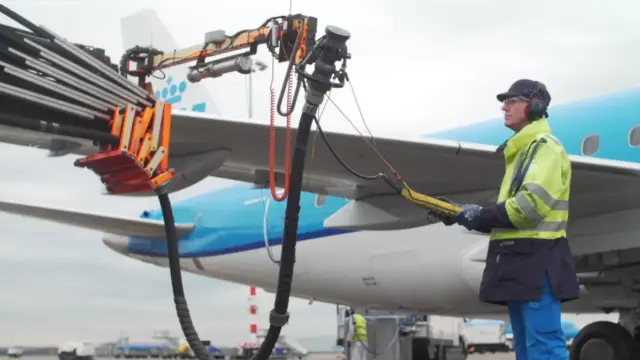
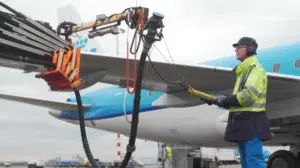
Currently, SAF is touted as the primary short-to-medium-term savior for the aviation industry. Derived from waste oils, agricultural residues, or synthetic carbon capture, SAF can be blended with conventional jet fuel and used in existing aircraft engines.
However, the barriers to scaling SAF are immense:
- High Costs: SAF is currently three to five times more expensive to produce than fossil-derived kerosene.
- Resource Constraints: Producing enough SAF to power the global aviation industry would require vast amounts of land, water, and renewable energy, potentially competing with food production and other decarbonization needs.
- Incomplete Decarbonization: While SAF can significantly reduce life-cycle carbon emissions, burning it still releases carbon dioxide and non-CO2 pollutants into the upper atmosphere.
Without a regulatory framework that forces airlines to purchase SAF despite its high cost—and pass those costs onto consumers—market forces alone will not drive adoption. Until the industry bears these costs, the expansion of airports like Heathrow effectively subsidizes carbon-intensive travel at the expense of the taxpayer and the planet.
The Global Scale of the Aviation Challenge
The debate over Heathrow is not occurring in a vacuum. Globally, aviation accounts for approximately 2.5% of total carbon dioxide emissions. While this percentage may seem modest compared to power generation or road transport, it does not tell the whole story.
The Warming Multiplier: Non-CO2 Impacts
When aircraft burn fuel at high altitudes, they emit more than just carbon dioxide. They also release nitrogen oxides ($NO_x$), water vapor, soot, and sulfate aerosols. These emissions interact with the atmosphere to produce contrails and cirrus clouds, which trap heat escaping from the Earth.
Atmospheric scientists estimate that the net warming effect of aviation is up to three times greater than the impact of its $CO_2$ emissions alone. This makes the sector’s true contribution to global warming significantly higher than the standard 2.5% figure suggests, intensifying the urgency of halting airport expansions.
| Emission Type | Primary Impact on Climate | Mitigation Status |
|---|---|---|
| Carbon Dioxide ($CO_2$) | Long-term atmospheric warming | Requires transition to SAF, hydrogen, or electric power |
| Nitrogen Oxides ($NO_x$) | Alters ozone and methane concentrations | High-altitude impact remains difficult to mitigate |
| Contrails & Cirrus Clouds | Traps outgoing thermal radiation | Dependent on flight path adjustments and fuel composition |
Furthermore, while other sectors of the global economy—such as electricity generation and surface transport—are rapidly decarbonizing through wind, solar, and electric vehicles, aviation emissions are projected to rise. As other industries clean up their acts, aviation’s share of global emissions will inevitably balloon, turning it into one of the largest remaining obstacles to a net-zero world.
A Nation Without a Plan
The central criticism leveled by the Climate Change Committee is not just directed at Heathrow Airport, but at the UK government itself. The committee argues that Westminster has adopted a policy of wishful thinking, relying on the "Jet Zero" strategy—a policy document that envisions a world where aviation can continue to grow indefinitely while somehow achieving net-zero emissions through technological miracles.
The CCC’s assessment is clear: the Jet Zero strategy lacks credibility. It does not contain the policy triggers or backstops needed if technological developments stall. If SAF production fails to meet targets, or if zero-emission aircraft prove non-viable for long-haul routes, the UK has no backup plan to curb emissions.
By allowing airport expansion proposals to proceed in the absence of a robust, enforceable decarbonization framework, the government is effectively putting the cart before the horse.
Until a mechanism is in place to ensure that the aviation industry pays for its environmental damage, and until there is a proven pathway to reducing absolute emissions, expanding Heathrow remains a high-risk gamble with the Earth’s climate. The message from the UK’s top climate advisors is unambiguous: the runway to unlimited growth has officially run out.