





For more than three decades, the narrative of modern adventure travel has been closely intertwined with the personal brand of Bruce Poon Tip. Since founding G Adventures in Toronto in 1990, Poon Tip has served not only as the operational engine of the company but also as one of the global travel industry’s most outspoken advocates for sustainable, community-centric tourism. Under his leadership, G Adventures grew from a gritty, one-man startup financed by personal credit cards into a global powerhouse that helped redefine what it means to travel responsibly.
Yet, behind the charismatic founder and the colorful brochures of small-group expeditions lies a complex global business that has recently undergone its most significant structural evolution to date. As the travel industry emerges from the unprecedented disruption of the COVID-19 pandemic, G Adventures is transitioning from a founder-led enterprise into a sophisticated, multi-tiered corporate group.
With a new holding company structure, a redistributed executive leadership team, and a rare window into its financial health provided by international regulatory filings, G Adventures is positioning itself for a new era of growth.
From a Toronto Basement to a Global Paradigm: The Poon Tip Legacy
To understand the current transformation of G Adventures, one must first understand the philosophy upon which it was built. In 1990, Bruce Poon Tip recognized a massive void in the tourism market. On one end of the spectrum were budget backpackers traveling independently; on the other were mass-market, all-inclusive resort packages and cruise ships that often isolated travelers from local cultures and funneled profits away from host communities.
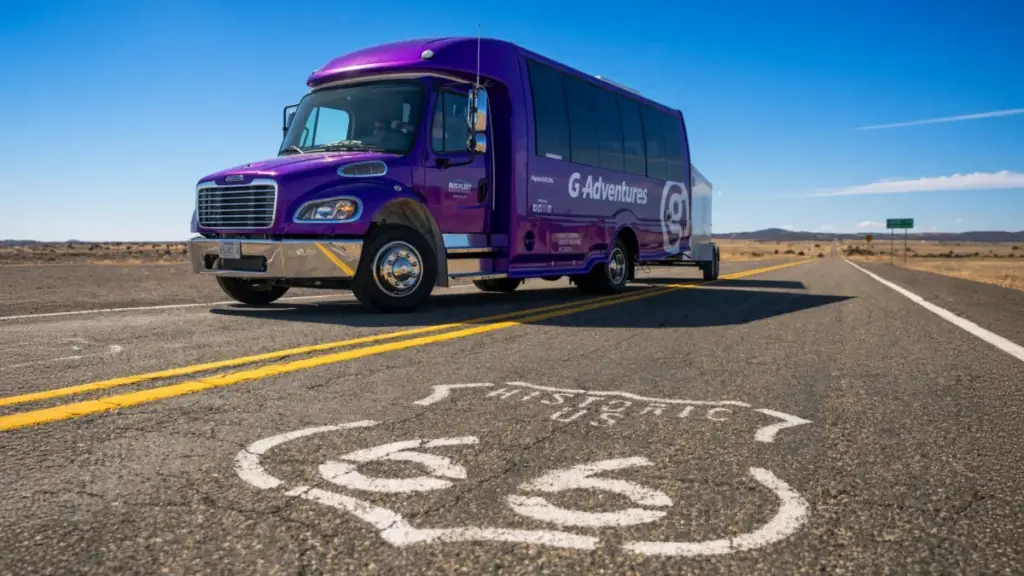
Poon Tip’s solution was small-group, grassroots travel. By keeping group sizes small, utilizing local transportation, staying in family-owned accommodations, and dining at local eateries, G Adventures sought to ensure that the economic benefits of tourism remained within the destination. This approach, which came to be known as community-based tourism, challenged the traditional extraction-based model of global travel.
To institutionalize this mission, Poon Tip established Planeterra in 2003. This non-profit organization was designed to work alongside G Adventures, channeling resources, training, and funding into local community enterprises—such as women’s cooperatives, indigenous youth training cafes, and local conservation programs—which were then integrated directly into G Adventures’ tour itineraries.
Over thirty years, this dual commercial-nonprofit model transformed G Adventures from a niche operator into a defining force in adventure travel. Poon Tip became a prominent public figure, authoring bestselling books on entrepreneurial purpose and lecturing globally on the power of business to drive social change. However, as the company grew in scale and complexity, the demands of day-to-day operations began to conflict with the strategic, big-picture advocacy required of its founder.
The 2023 Restructuring: Stepping Back to Scale Up
The year 2023 marked a watershed moment in the corporate governance of G Adventures. Recognizing the need to separate long-term vision from daily operational management, the company underwent a major structural reorganization, culminating in the creation of a new parent holding company: G Travel Community (GTC).
Under this new corporate architecture, Bruce Poon Tip stepped away from the day-to-day management of the tour operating business. Instead, he assumed the role of Chairman of G Travel Community. This transition allowed Poon Tip to focus on global brand advocacy, strategic partnerships, and the high-level vision of the collective brands, while handing over the operational reins to a seasoned executive team.
The leadership of the group is now divided between two key executives:
- Ben Perlo serves as the Chief Executive Officer of G Adventures. Perlo, who previously ran the company’s high-performing US operations, is responsible for the core adventure travel brand, overseeing its global sales, marketing, and tour operations.
- Jeff Russill serves as the Chief Executive Officer of G Travel Community. Russill’s mandate involves overseeing the broader holding company structure, managing shared services, and identifying opportunities for growth, acquisition, and synergy across the wider GTC portfolio.
This restructuring represents a classic maturity phase for a founder-led business. By institutionalizing leadership, G Travel Community aims to ensure operational continuity, improve efficiency, and create a scalable framework that can support future acquisitions or brand expansions in the experiential travel space.
Piercing the Private Veil: What Corporate Filings Reveal About G Adventures
Because G Adventures is a privately held corporation, it is under no obligation to publish the consolidated annual reports or quarterly financial statements typical of publicly traded travel giants like TUI Group or Booking Holdings. This lack of public reporting has historically made the true scale and financial performance of the company difficult for industry analysts to measure.
However, a detailed picture of the company’s financial health has emerged through regulatory filings. Because G Adventures operates extensively in international markets, it must comply with local corporate reporting laws. Filings submitted to corporate registries in the United Kingdom, combined with Canadian public records, have provided an unusually transparent look at the company’s financial journey through the pandemic and its subsequent recovery.
The most telling data comes from the group’s UK filings. The documentation details a robust financial rebound, highlighting $447 million in revenue for the reporting period.
This multi-hundred-million-dollar figure underscores the massive scale at which G Adventures operates. It also confirms that the company has successfully reclaimed its position as one of the largest independent adventure travel operators in the world, capable of generating substantial top-line revenue even as global tourism markets continue to stabilize.
Navigating the Pandemic Crucible and the Long Road to Recovery
The $447 million revenue milestone is particularly significant when viewed through the prism of the COVID-19 pandemic. Few sectors of the global economy were as devastated by the pandemic as international adventure travel.
For a business like G Adventures, which relies on the seamless movement of small groups across international borders—often in remote, developing regions—the pandemic was an existential threat. In March 2020, global travel ground to a near-total halt. Borders closed, flights were grounded, and tour operators were forced to suspend thousands of departures, trigger massive refund cycles, and hibernate their global operations.
During this crisis, G Adventures had to navigate the dual challenge of preserving cash flow while supporting its extensive network of local community partners, many of whom had no other safety net. The company’s ability to survive this prolonged shutdown, avoid bankruptcy, and maintain its core community relationships is a testament to its operational resilience and brand loyalty.
The financial data from UK and Canadian records reveals a clear trajectory of this recovery:
- The Collapse: Post-2020 filings show the expected dramatic drop in revenue, reflecting the period when global operations were largely frozen and cash was heavily utilized to manage refunds, overhead, and safety protocols.
- The Pivot: Throughout 2021 and 2022, G Adventures adapted by introducing domestic travel options, enhancing health and safety protocols (such as their "Travel with Confidence" policy), and restructuring internal operations to reduce fixed costs.
- The Resurgence: The $447 million revenue figure in the UK filing reflects the explosive return of consumer demand for experiential travel. Post-pandemic travelers have shown a heightened preference for authentic, small-group, and nature-based experiences over crowded, mass-tourism destinations—a shift that plays directly into G Adventures’ historical strengths.
The New Horizon: Scaling Sustainable Travel in a Competitive Landscape
As G Travel Community navigates the post-pandemic landscape under the leadership of Ben Perlo and Jeff Russill, the company faces a rapidly changing competitive environment. The adventure travel market is no longer the niche sector it was in 1990. Today, major travel conglomerates and private equity-backed operators are aggressively expanding their footprint in experiential and sustainable travel.
Furthermore, the rise of conscious consumerism means that "sustainability" has transitioned from a unique selling proposition to a baseline consumer expectation. G Adventures must continually innovate to maintain its leadership position.
With Bruce Poon Tip operating at the strategic helm of G Travel Community, the company is well-positioned to leverage its pioneering reputation. The holding company structure of GTC provides a platform to potentially acquire smaller, specialized tour operators, expand into new geographic source markets, or develop new travel verticals that align with the core mission of community-based tourism.
The transition from a business defined solely by its founder to an institutionalized corporate group with $447 million in UK-reported revenue demonstrates that G Adventures has successfully crossed the chasm from a passionate entrepreneurial venture to a resilient, multi-national corporate entity. As the G Travel Community looks to the future, its challenge will be to maintain the authentic, grassroots spirit of 1990 while managing the complex financial and operational demands of a global tourism powerhouse.